
Related videos:
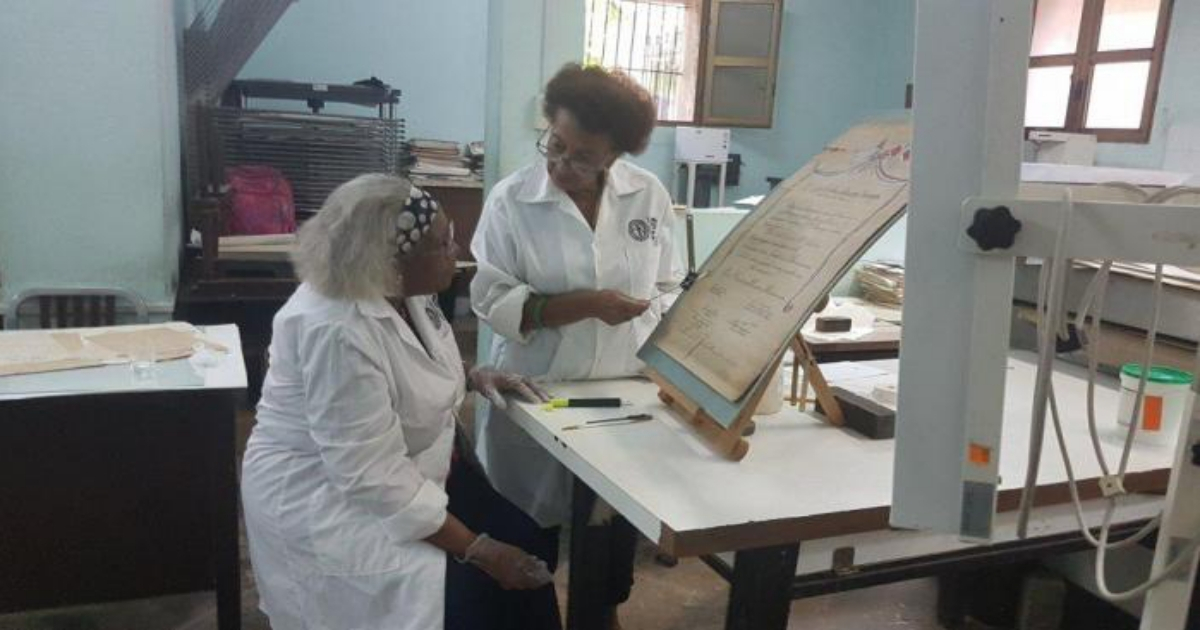
The members of the National Assembly expressed on Wednesday the urgency for provincial and local commissions to operate in order to recover Cuba's deteriorated documentary sources in their multiple formats.
"We still have many gaps and some losses at the local level," said the Havana deputy Liset Martínez during the national commission on Historical Memory. For her part, Inés Betancourt stated that "the situation of the local historical archives is very complex" in Granma, without providing further details in the segment aired on state television.
During the session, information was provided about the digital project being developed by the University of Computer Sciences (UCI) and the state communications monopoly ETECSA, aimed at protecting original documents through preservation, restoration, and digital capture for consultation purposes.
The leader Miguel Díaz-Canel remarked about that program, which involves other institutions, that "in some cases, the focus has shifted to digitization, as restoration is more complicated."
Although the official note from the newspaper Juventud Rebelde does not specify the amount of money invested or the material recovered so far, it reports that funds were allocated to "the Cuban institutes of Radio and Television (ICRT) and of Art and Cinematographic Industry (ICAIC), the National Library, national archives and music archives, as well as the Office of Historical Affairs of the Council of State" and other entities.
For now, it has been noted that the newspapers have already digitized some of their material in recent years, especially the photographs, but in the case of the universities, only the University of Havana has a systematic approach to digitization.
One of the representatives present in this National Assembly committee, which will soon appoint the Prime Minister of Cuba, stated that the departure of valuable personal documents for history from the country should be avoided, adds the cited source.
The lack of preservation in Cuba not only affects documentary archives but also impacts the architectural heritage of the island.
Few resources at a time when Cubans fear a return to the Special Period are compounded by neglect regarding well-known works such as the iconic sidewalk of La Rampa in the capital, where some workers broke the mosaics of prominent painters in June of this year.
Filed under: