
Related videos:
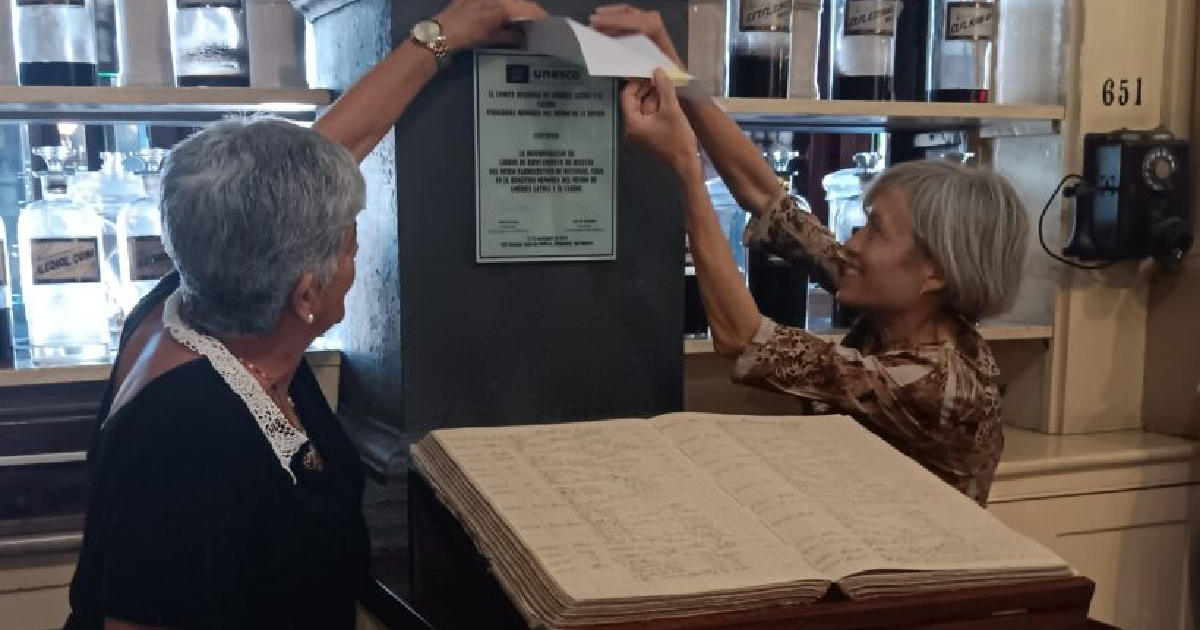
The recipe settlement books of the Pharmaceutical Museum of Matanzas, formerly known as the French Pharmacy, have been added to the prestigious Memory of the World Register for the Latin America and Caribbean region of the United Nations Educational, Scientific and Cultural Organization (Unesco).
“The recognized documentary collection includes handwritten books of medical prescriptions, dating back to the 19th century and early 20th century, and serves as an exceptional testament to the development of pharmaceutical science in Latin America,” highlighted Unesco when reviewing the event on its official site.
The 55 volumes of documents contain over one million medical prescriptions, including their composition and details such as the name of the physician who prescribed each one, the consecutive number, the price, and the date of receipt, specified the newspaper Girón from the province of Matanzas.
It is a complete collection that reflects the uninterrupted operation of the French Pharmacy of Dr. Ernesto Triolet, from January 1, 1882, to January 16, 1964, highlighted Marcia Brito Hernández, the director of the institution.
Only one other Cuban file, that of the Antonio Núñez Jiménez Foundation, shares this recognition.
A window to medical and social history
Books not only document recipes but also everyday events, epidemics, and even curiosities such as the “mysterious” passage of sunlight through the patio to the dispensing table, between March 8 and 13, noted Girón.
Additionally, they reveal information about personalities such as the musician Miguel Faílde (1852-1921), the creator of the danzón, the national dance of Cuba, and who was the first black person in the city to have an open account at the pharmacy.
“They are an inexhaustible source of research,” emphasized Brito. The documents record the epidemics that plagued the city, the most common diseases, the ages of those who suffered from them, the personalities associated with this place, even, “the times when a poor person could not afford to pay for a doctor's services and turned to Dr. Triolet to get a prescription; many times, these preparations ended up in the hands of the patient at no cost.”
The collection features prescriptions from numerous esteemed figures in medicine, such as the eminent Cuban scientist Carlos J. Finlay, the doctor and general from the War of Independence Pedro Betancourt Dávalos, the doctors Alfredo Carnot D’ Lisle and Armando Carnot Veunles, father and son, as well as all the physicians from the renowned Font family, Brito noted.
From the World to Cuba: The Evolution of National Pharmacy
The collection shows how the pharmacy gradually incorporated local plants and remedies, merging European and traditional knowledge. “At first, the raw materials were imported, but then Cuban herbs and contributions from enslaved people were integrated,” explained the institution's director.
Even today, more than 90% of the substances described in the first volume are preserved in the museum, which would allow for the preparation of formulas from 1882.
“The emergence of what I consider the Cuban pharmacy is also appreciated. Dr. Triolet came from the Paris school, his partner, Dr. Juan Fermín Figueroa, from the Madrid school, and his wife, Dr. Dolores Figueroa, the first Cuban woman to earn a doctorate in Pharmacy, had studied in New York,” he recalled.
In the beginning, all the raw materials, especially the plants, are imported, because they come from a completely different environment. Then, little by little, they start incorporating the herbs from the island and the native substances. It is also evident how enslaved people contribute to this, as they were part of the community they served and brought their own remedies to be prepared here. The blend that is our identity is also present in the sciences,” Brito shared.
The archival collections of the Pharmaceutical Museum also include over 800,000 original medication labels and a library with essential titles from the French, Spanish, and American pharmacopoeias, published from the late 19th century to the early 20th century.
The institution also archives the complete economic record of the pharmacy and the private paperwork of the Triolet family.
Curious stories: the cold remedy for Máximo Gómez
Among the highlighted anecdotes is the prescription given to Generalísimo Máximo Gómez (1836-1905), who was traveling from Oriente to Havana and became ill with a cold in the city of Cienfuegos.
According to the record book, Dr. Curbelo, his personal physician, prescribed a syrup that was prepared at the pharmacy, which helped the leader recover and continue his journey. "The price is not listed, so they didn't charge the general," Brito remarked.
International recognition
The official announcement by UNESCO took place on March 27, accompanied by a tribute featuring music, poetry, and the presence of heirs from the Triolet family.
Anne Lemaistre, the regional director of UNESCO, described the museum as “a gem within Latin America, exceptional in its authenticity and extremely well-preserved.”
With this recognition, recipe books are established as an invaluable heritage, not only for Cuba but for the scientific and cultural memory of the world.
The Botica Francesa was founded on January 1, 1882 by Ernesto Triolet Lelievre, a native of Lissy, France. Located in a prime spot in what is known as the Athens of Cuba, across from the Plaza de Armas, it stands as a three-story building, showcasing neoclassicism in the domestic architecture of Matanzas at the end of the 19th century.
After undergoing renovations and adjustments, it became the Pharmaceutical Museum on April 30, 1964. It was declared a National Monument in 2007.
According to researchers, the quality of products prepared at the French pharmacy was recognized by the public. A testament to this was the invitation to Triolet, along with other significant Cuban merchants, to participate in the 1900 World's Fair in Paris.
Dr. Triolet lived in Cuba for over 30 years and died in the French capital on December 19, 1900, a victim of pneumonia. His remains were temporarily taken to the Montparnasse Cemetery and later transferred to Matanzas, where he was buried in the family pantheon at San Carlos Cemetery.
Filed under: