
Related videos:
The United States government released the first images of immigrants transferred to the Guantanamo naval base in Cuba on Tuesday, as part of the deportation policy of President Donald Trump.
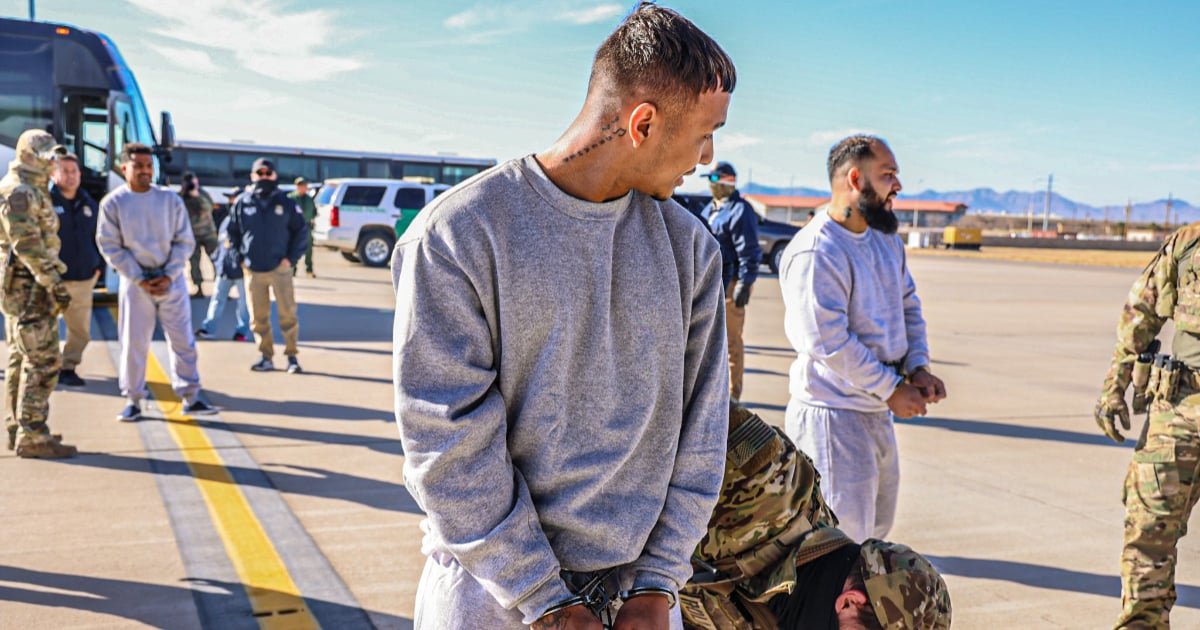
The photographs, released by the Secretary of Homeland Security Kristi Noem, show a group of people dressed in gray uniforms and handcuffed, being escorted by security agents.
In one of the images, a man with tattoos on his neck looks to the side while a military officer holds him by the handcuffs.
In another, you can see a migrant with a serious expression walking alongside a hooded agent in camouflage uniform.
The scene unfolds on what appears to be a runway, with buses and official vehicles in the background.
According to Noem, “President Trump has been very clear: Guantanamo Bay will house the worst of the worst. That starts today”, she wrote on her X account.
Less than a week ago, Trump announced the construction of a detention center at the Guantánamo Naval Base, with the capacity to hold up to 30,000 migrants.
This measure is part of its strategy to strengthen control over illegal immigration and to detain those migrants accused of serious crimes who cannot be deported to their countries of origin.
The plan has generated international criticism and concerns. The Cuban government strongly rejected the decision, calling it "brutality" and warning about potential "serious consequences" for regional stability.
Furthermore, human rights organizations have expressed concerns about the use of Guantánamo, known for its history of human rights violations, as a detention center for migrants.
Despite the criticism, the Trump administration has defended the measure as a solution to relieve pressure on detention centers in U.S. territory and to manage the immigration crisis more effectively.
The Secretary of Defense, Pete Hegseth, stated that the Department of Defense is coordinating efforts to enable areas within the base for this purpose.
This development is part of a series of actions by the Trump administration aimed at intensifying deportations and supporting immigration policies, including the expansion of expedited deportations and the suspension of visas to countries that do not cooperate in accepting their deported citizens.
Frequently Asked Questions about the Deportation of Immigrants to Guantánamo
Why is the United States deporting immigrants to Guantanamo Naval Base?
The United States has decided to use the Guantanamo Naval Base as a detention center for immigrants as part of President Donald Trump's deportation policy. This measure aims to strengthen control over illegal immigration and manage the migration crisis more effectively, especially for those migrants accused of serious crimes who cannot be deported to their home countries.
How many migrants will be detained in Guantánamo?
The U.S. government's plan is to establish a detention center in Guantánamo with the capacity to accommodate up to 30,000 migrants. However, it is expected to start with a smaller number of deportees before reaching full capacity.
What criticisms has the use of Guantánamo as a detention center for migrants received?
The decision to use Guantánamo to house migrants has been criticized by the Cuban government, which considers it an act of "brutality," and by human rights organizations due to the history of human rights violations at the base. Furthermore, it is noted that this could have "serious consequences" for regional stability and is seen as a demonstration of hostility toward the migrants' countries of origin.
What role do the marines play at Guantánamo Naval Base in relation to the detention of migrants?
A contingent of American marines has been deployed in Guantánamo to assist in the expansion of the Migration Operations Center. Their role is to collaborate with the Department of Defense and Homeland Security to ensure the implementation of President Trump's immigration policy.
Filed under: