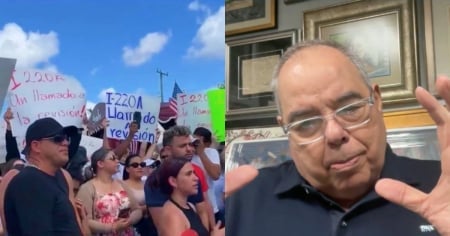
The Florida immigration attorney, Willy Allen, has stated in comments to CiberCuba that "the likelihood of Cubans who entered through parole and family reunification being detained and deported is zero."
Allen was quite emphatic in an interview with this platform where he discussed the consequences of the suspension of administrative procedures for Cubans who entered the United States through these two migration pathways (parole and reunification).
In his opinion, it is "hard" that "those who waited in line in Cuba" are now left in a kind of legal limbo, which he prefers to call a "black hole."
"Now they have been dealt another blow. Those who have followed the rules of waiting are the most affected. There is a solution: it is to wait. The possibility that they will be frustrated and waiting exists, and it will be a much more difficult process," he said.
Willy Allen, with a long career in law in Miami, reassures the more than 110,000 Cubans who entered the United States during the Biden Administration under humanitarian parole, a permit for legal travel to the U.S., always with the endorsement of a financial sponsor, which allows for the possibility of obtaining a two-year work permit. This is a migratory status that does not exist and has never existed, for example, in countries like Spain.
The Biden Administration suspended the parole in July 2024 upon detecting irregularities. Although it was resumed in September 2024, very few Cubans were able to enter the United States through that route starting from that date.
On January 22, 2025, President Donald Trump included the elimination of humanitarian parole among the 41 executive orders he signed right after taking office at the White House.
This week it was revealed that on February 14, 2025, Andrew Davidson, an official from USCIS (United States Citizenship and Immigration Services), ordered the suspension of ongoing administrative processes for individuals who had entered the U.S. with parole (from Latin America and Ukraine) and through family reunification.
Regarding this last avenue, the lawyer recalled that it was paused since 2020 due to the sonic attacks on the U.S. Embassy in Havana, and Biden reactivated it in 2022.
Since taking office, President Donald Trump has eliminated parole, made the CBP One application, which allowed for scheduling appointments at the border to apply for entry measures into the United States, disappear; he has canceled TPS (Temporary Protected Status), which benefitted 300,000 Venezuelans; initiated deportations to Guantánamo; and has begun executing deportations to Venezuela and Colombia.
The latest decision was made public this week and involves the suspension of the proceedings initiated in USCIS by beneficiaries of parole and family reunification. Both can qualify for asylum cases, family-based protections, and the Cuban Adjustment Act, which allows them to apply for a green card (residency) one year and one day after being in the United States.
Filed under: