
Related videos:
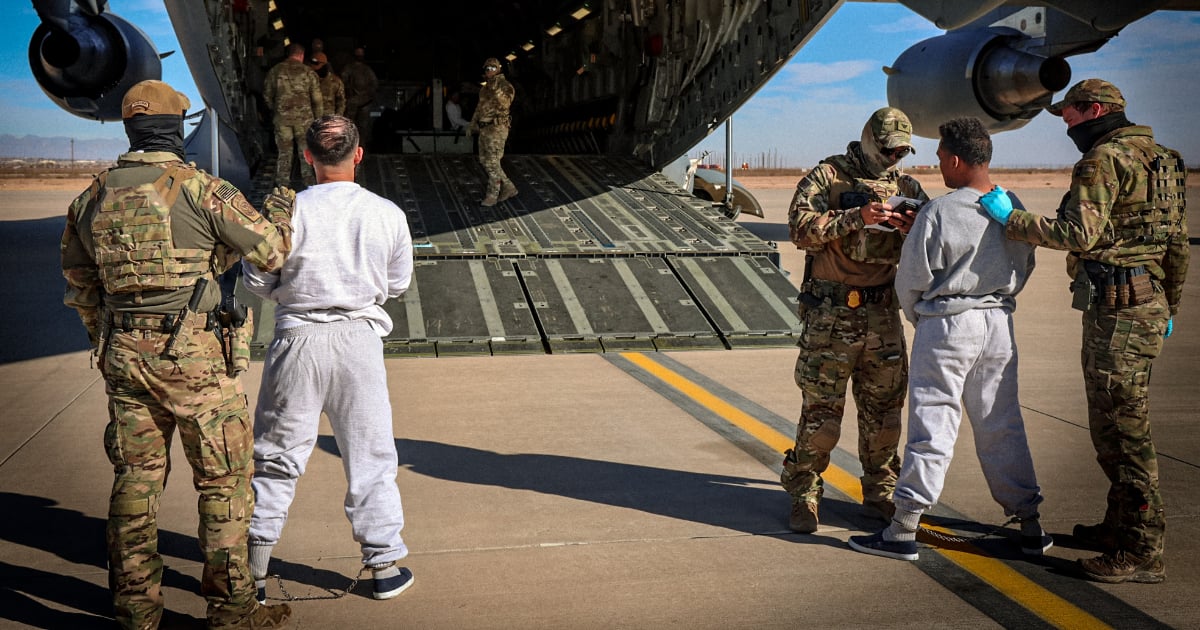
In at least a dozen U.S. military bases, the administration of President Donald Trump plans to build detention centers for undocumented immigrants, according to an internal memo from the Department of Homeland Security (DHS) accessed by National Public Radio (NPR).
The objective is for these places to function as initial reception points to "prepare detainees for their deportation", states the document sent by Juliana Blackwell, acting executive secretary of DHS.
Among the bases mentioned for inclusion in the plan is, first and foremost, the Fort Bliss, near El Paso (Texas), on the border with Mexico, from where the project would commence.
Then, the Joint Base McGuire-Dix-Lakehurst (New Jersey), the Niagara Falls Air Reserve Station (New York), Hill Air Force Base (Utah), and Homestead Reserve Base (Florida) would be added.
In this role, the Department of Defense would play an important part, which is why they were asked to significantly expand the role of the Army in the enforcement of immigration laws.
According to details from NPR, the plan would have a two-month evaluation period during which the center in El Paso would host up to 1,000 immigrants, with the potential to expand up to 10,000, becoming a key center for deportation operations.
This information comes to light just a few days after it was revealed that the Trump administration suspended the plan to house migrants in tents in Guantánamo because these facilities did not meet the detention standards established by the Immigration and Customs Enforcement (ICE), such as air conditioning and electricity. This decision was made a few weeks after additional accommodations were opened for deported migrants at the base.
The transfer of migrants to the Guantanamo naval base has faced legal obstacles in the United States.
A federal judge in New Mexico temporarily prohibited the transfer of three Venezuelans detained by ICE to that base, highlighting the legal challenges facing President Trump's plan to build a large center in Guantánamo for migrants who cannot be deported.
The Cuban government has also criticized and rejected the decision to expand the capacity of the Guantanamo naval base to accommodate up to 30,000 migrants, warning of possible "serious consequences" and describing the measure as a "brutality".
Cuban authorities consider the base to be "a territory of Cuba illegally occupied beyond the jurisdiction of U.S. courts."
Frequently Asked Questions about the Construction of Immigrant Detention Centers on U.S. Military Bases
What does the Trump administration plan to do with undocumented immigrants?
The administration of President Donald Trump plans to build detention centers for undocumented immigrants at military bases in the United States. These centers will serve as reception points to prepare detainees for deportation. At least a dozen military bases have been identified where these projects will take place.
Why was the plan to use tents in Guantánamo suspended?
The plan to use tents at the Guantanamo Naval Base was suspended because the facilities did not meet the detention standards set by the Immigration and Customs Enforcement (ICE), such as air conditioning and electricity. This decision was made after additional accommodations for deported migrants were established at the base.
What military bases are included in the immigrant detention plan?
The Trump administration's plan includes the construction of detention centers at several military bases in the United States. The mentioned bases are Fort Bliss in Texas, Joint Base McGuire-Dix-Lakehurst in New Jersey, Niagara Falls Air Reserve Station in New York, Hill Air Force Base in Utah, and Homestead Reserve in Florida. These bases will play a crucial role in the implementation of the immigrant detention and deportation project.
What is the Cuban government's stance on the use of Guantánamo for the detention of migrants?
The Cuban government has strongly criticized and rejected the decision to expand the capacity of the Guantanamo Naval Base to accommodate up to 30,000 migrants. They consider the base to be "territory of Cuba illegally occupied" and warn of possible "serious consequences" resulting from this measure, labeling it as "brutality."
What challenges does the immigrant detention plan in Guantánamo face?
The plan faces significant legal and logistical challenges. A federal judge in New Mexico temporarily prohibited the transfer of detainees to the base, highlighting the legal hurdles in constructing a detention center in Guantánamo. Furthermore, the plan has been criticized by the Cuban government and human rights organizations, which have expressed concerns about detention conditions and the rights of those held.
Filed under: