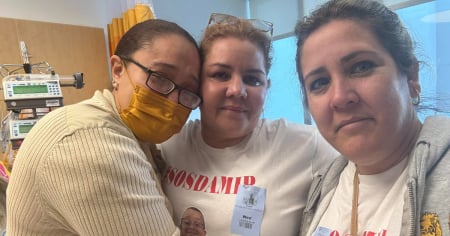
In less than 24 hours, Cubans in Cuba, the United States, and other parts of the world managed to raise nearly all the funds needed to pay for the air ambulance service that will transport the child Damir Ortiz Ramírez to the United States, where he needs to receive treatment for his serious illnesses.
The activist Idelisa Diasniurka Salcedo Verdecia revealed in a live stream on her Facebook profile that in just 16 hours, $36,804.20 was raised. The required amount is $38,000.
"Thank you, gentlemen," she said, emotionally.
A source revealed to CiberCuba that if the funds are completed by the end of this Saturday, the child and their mother could travel to Miami on Sunday.
"We're almost there," added Diasniurka, who expressed her gratitude to everyone who contributed to the campaign, including several musicians.
"In Cuba, people have donated more than a million pesos," he added with admiration.
Damir Ortiz, diagnosed with type 1 neurofibromatosis, a plexiform neurofibroma in his right eye, as well as acute leukemia, secured a humanitarian visa on Friday to receive treatment in a hospital in the United States.
This Saturday, the mother of the minor, Eliannis Ramírez, went to the U.S. embassy, where she was given the two visaed passports, as confirmed in another broadcast by Diasniurka Salcedo.
Although the diplomatic office does not open on weekends, they made an exception for her due to the seriousness and urgency of the situation. Now the child can travel and must be transferred immediately.
Although a fundraising campaign was organized on the GoFundMe platform to support Damir and his mother, that money will not be usable until the child arrives in the United States and proof of his location is provided. For this reason, Salcedo urged Cubans to contribute financially.
"Because the fundraising is still on hold, because the policy does not allow us to use that money, because the child is not here," Salcedo argued on Friday.
In recent months, Damir's health situation worsened with a diagnosis of acute leukemia, further complicating his delicate health.
A hospital in Miami agreed to treat him, and the aforementioned GoFundMe campaign was launched to raise $40,000 to cover medical and travel expenses.
The family had already requested a humanitarian visa for the child, but the embassy had denied it due to the lack of documentation issued by the Ministry of Public Health of Cuba (MINSAP).
Frequently Asked Questions about the case of Damir Ortiz and his transfer to the United States
Why is it necessary to transfer Damir Ortiz to the United States?
Damir Ortiz needs to be transferred to the United States to receive specialized medical treatment that is not available in Cuba. The child has been diagnosed with type 1 neurofibromatosis, a plexiform neurofibroma in his right eye, and acute leukemia—conditions that require medical attention beyond the capabilities of the Cuban healthcare system. A hospital in Miami has agreed to treat him, but he is facing multiple bureaucratic hurdles in obtaining the necessary visa.
How has Damir's relocation to the United States been funded?
The Cuban community has successfully raised the necessary funds for the transfer of Damir Ortiz through a solidarity campaign. In less than 24 hours, over $36,804 was collected to pay for the air ambulance service that will take the boy to the United States. Additionally, a GoFundMe campaign was launched to cover medical and travel expenses, although the use of those funds is restricted until Damir arrives in the United States.
What obstacles did Damir face in obtaining the humanitarian visa?
The main obstacle to obtaining the humanitarian visa was the refusal of the Ministry of Public Health of Cuba (MINSAP) to provide the necessary documentation. Despite a hospital in Miami agreeing to treat Damir, MINSAP argued that Cuba has the necessary resources for his treatment and refused to issue the required authorization letter for the United States Embassy.
What role have activists played in the case of Damir Ortiz?
The activists have been crucial in raising awareness and managing the case of Damir Ortiz. They have organized fundraising campaigns, pressed authorities for a humanitarian visa, and highlighted the deficiencies of the Cuban healthcare system. Their efforts have been vital in bringing international attention to Damir's case and in mobilizing resources and support within the Cuban community.
Filed under: