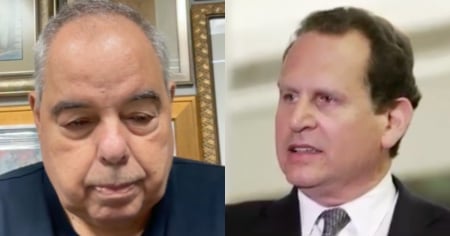
The Florida attorney Willy Allen, an expert in immigration, believes that the three Cuban-American congressmen from Florida (María Elvira Salazar, Carlos Giménez, and Mario Díaz-Balart) can take immediate action to address the issue faced by Cubans with I-220A who, since last week, have begun to be detained when attending their ICE appointments at the immigration center in Miramar (Broward).
In Allen's opinion, "it's in their hands" to do something, he said in reference to the Florida congress members, because he believes that the solution for the I-220A is "administrative" and, in his view, depends on the "political will" of the Secretary of the Department of Homeland Security (DHS), the also Republican Kristi Noem.
"The Secretary of Homeland Security has the authority to determine that the I-220A is a legal entry for the Cuban Adjustment and is based on laws and memoranda that previously existed regarding the entry of Cubans, which require inspections and admission. They can determine this without any difficulty, but it must be an administrative decision, and Cuban-American representatives can exert some pressure to make it happen," he insisted, alluding to the tightness of the voting link in the House, which would make Florida's three votes decisive.
However, the lawyer fears that the Secretary of Homeland Security may wait for the ruling from the judge who is reviewing a lawsuit regarding the I-220A, expected in October, before making a decision on the matter. And this, Allen emphasizes, is where Cuban-American congress members might have an influence, although he suspects that right now, none of them will take action because those who align with Trump are not in the picture.
Despite previously criticizing María Elvira Salazar in an interview with CiberCuba for announcing a bill that would grant legal status to I-220A holders, the attorney acknowledged on Monday that she is the only one of the three Cuban-American congress members who continues to focus on the I-220A, announcing that she will present this bill in Congress to grant them parole so they can benefit from the Cuban Adjustment Act.
In the lawyer's opinion, that law is unnecessary because, in theory, all Cubans who are inspected, interviewed, and admitted to the United States can benefit from the Cuban Adjustment Act, and this is something that applies in the case of the I-220A. Therefore, he insists that the problem could be solved "with a single stroke," referring to the phrase used by María Elvira Salazar to criticize that Alejandro Mayorkas, the Secretary of Homeland Security under the Biden Administration, has not resolved this issue "with a single stroke."
Salazar has requested time to address the issue of the I-220A because President Trump has just arrived at the White House, and she believes this will be resolved over a legislative term that hasn't even reached the threshold of the courtesy 100 days given to all leaders. However, those affected do not see it this way due to the arrests (at least 18 in the last week) in Miramar of Cubans with I-220A who have not committed any crimes and who have their asylum appointments scheduled.
Willy Allen clarifies that the migratory status of the I-220A was instituted during Trump's first term, so it would not be a problem to find a legal framework for it in this second term. He also warns that, similar to the Venezuelans deported this weekend to El Salvador, the 60,000 Cubans who have committed crimes in the United States and are not accepted back to the Island by the Díaz-Canel regime could also be sent to a third country.
Regarding the most frequently asked question about whether it is a good time to travel to Cuba to see family, Allen advises being cautious and waiting for conditions to stabilize, as the Trump administration has not achieved the level of deportations it had intended and is likely to try to fulfill that electoral promise.
To those with I-220A, the attorney advises attending the Immigration appointment, if possible, accompanied by a lawyer, because while those who attend risk being detained, not showing up makes the situation worse. In other words, while going is risky, not going is worse. However, in the case of a detention, it is always possible to secure release on bail, which typically ranges between $3,000 and $12,000, with the assistance of a lawyer.
Filed under: