
Related videos:
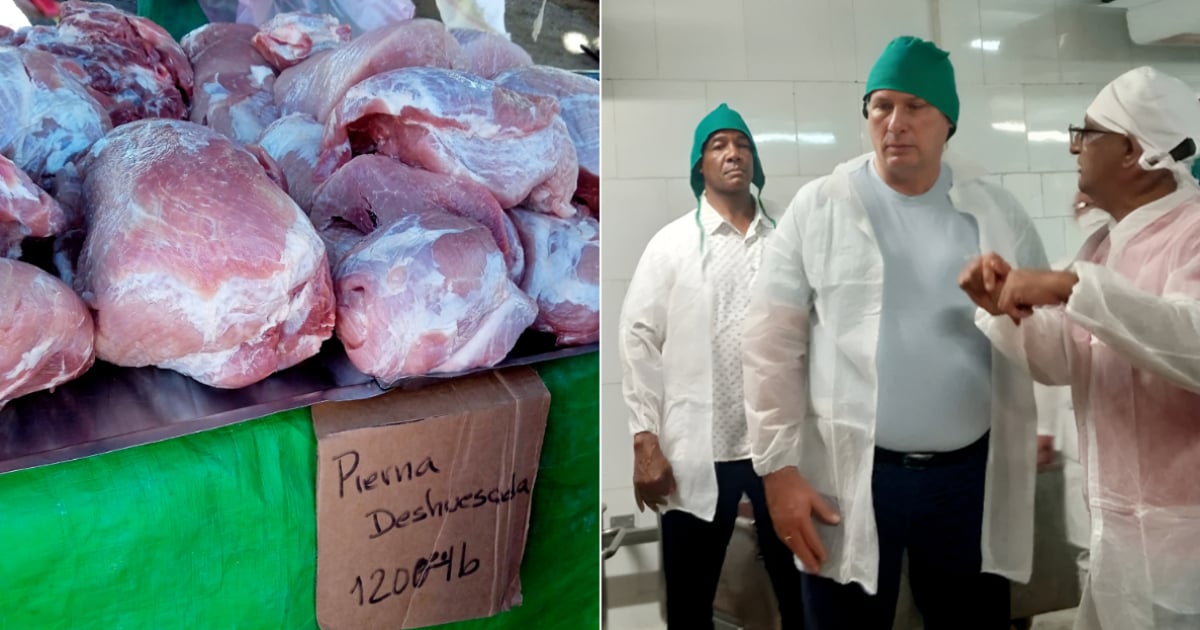
The increase in the price of pork in Cuba has acted as a striking "slap" to the regime, highlighting the failure of government measures intended to "correct distortions" and "revitalize the economy."
According to data from the official National Office of Statistics and Information (ONEI), the maximum price of pork shoulder in Havana rose from 580 Cuban pesos (CUP) in December 2023 to 980 CUP in February 2025, reflecting an increase of 68.9%.
This increase is not an isolated phenomenon, but rather a reflection of a deeper crisis in the Cuban agricultural sector. Cuban economist Pedro Monreal referred to it on X (formerly Twitter), expressing his frustration with a cutting remark to the executive of Miguel Díaz-Canel: "And now tell me whatever you want about the government's 'projections' to correct distortions and all that nonsense."
In 2023, pork production experienced a 93.2% decrease compared to the previous year, dropping from 200,000 tons to just 13,300 tons. This drastic reduction has turned pork, traditionally a primary source of protein in the Cuban diet, into an unaffordable luxury for most of the population.
The government's response to this crisis has been the implementation of multiple economic measure packages, whose results are evident, but which have led to numerous speeches and propaganda proclamations that do not provide sustenance.
In July 2024, the Council of Ministers presented a set of actions aimed at "correcting distortions and revitalizing the economy during 2024". These measures included adjusting the 2024 Plan and Budget to "war economy" conditions, reducing budget allocations to decrease the fiscal deficit, and centralizing budget approval.
Furthermore, it was proposed to calculate the fiscal impact of imports made by non-state management forms and to establish a uniform pricing policy for all economic sectors. However, these measures did not succeed in reversing the negative trend.
In February 2025, the government elevated the "Government Projections" to a "Government Program to Correct Distortions and Revitalize the Economy," although it lacked concrete measures and repeated previous promises without real changes.
Later, in the same month, new measures were announced that included the updating of electricity rates, the establishment of maximum retail prices for basic products such as rice and beans, and the implementation of prepaid cards for fuel purchases. There was also an effort to attract foreign investors to the Mariel Special Development Zone, along with a proposal for a new mechanism for the management and allocation of foreign currency.
Despite these efforts, inflation has continued its upward trend. Essential products and services have seen significant price increases, severely impacting the purchasing power of Cubans and forcing them to face difficulties in acquiring basic food items.
The lack of tangible results has generated criticism and skepticism among the population, who see these measures as insufficient and disconnected from everyday reality. The phrase "Revitalize the economy... which economy?" has become a common expression of discontent and frustration.
In January 2025, a Cuban shared a video on her Facebook profile showing that in Miami, a pork leg cost $24.90, which is $0.99 per pound. In contrast, in Cuba, one pound of pork reached over 1,500 Cuban pesos during the New Year, which is equivalent to $4.44 according to the exchange rate at that time.
Pork, traditionally a staple in the Cuban diet, has become an unattainable luxury for most of the population due to its high price.
In December 2024, the price of a pound of pork steak surpassed 1,400 pesos in the informal market, a prohibitive figure for many Cubans, especially for retirees.
This situation has led to the disappearance of pork-based products, such as chicharrones, from the Cuban table. At the end of 2024, a retiree from Santiago de Cuba expressed her frustration by stating that "chicharrones are part of the past". Like many in her community, she longs for the days when she could "at least taste a little piece of macho," referring to the pig, which is what they call it in Eastern Cuba.
Authorities insist that prices remain at "more than 600 pesos per pound of pork," but reality tells a different story. This disconnect between official data and the harsh reality faced by the people reflects the government's ineffectiveness and the lack of transparency in the state's statistical data.
The government has pledged to increase meat production with innovative initiatives, such as the establishment of multipliers, the use of liquid feeds, and the integration of producers.
However, these measures have not translated into tangible results. Current monthly production remains well below the 17,000 tons needed to meet demand.
The government attributes this situation to the shortage of supplies such as corn and soy, and to the lack of medications, although there are other obstacles affecting farmers, such as bureaucratic hurdles.
Meanwhile, Cubans are facing exorbitant prices and witnessing the disappearance of an essential culinary tradition. Almost no one can afford roasted pork at the end of the year, which reflects a food crisis affecting the population and limiting their access to essential sources of protein.
The current situation demands comprehensive and sustainable solutions that address the root causes of the economic crisis in Cuba. Meanwhile, the population continues to face daily challenges in accessing basic food, with the hope that effective policies will be implemented to guarantee their right to adequate nutrition and a dignified life.
Filed under: