Tensions between Venezuela and the U.S. reached a new high this week after Nicolás Maduro referred to U.S. Secretary of State Marco Rubio as an "idiot" three times in less than a minute during a televised address.
"Democracy is what we want. Democracy is what we are building. The world says no, that it is a regime. There goes the fool Marco Rubio threatening Venezuela from Guyana. Fool. No one threatens Venezuela, because this is the homeland of the Liberators. This is the homeland of Bolívar, fool." said the South American leader.
The reaction was in response to the warnings from Rubio about potential military consequences if Caracas acts against Guyana within the context of the territorial dispute over Esequibo.
"And that this is a regime, that this is a dictatorship... In his life, Marco Rubio has seen a popular assembly, he has gone to a neighborhood, because they are part of the corrupt elite of Miami. Very corrupt, who hate Venezuela," Maduro added.
He also noted that Marco Rubio is the "godfather" of "La Sayona," a nickname the president uses to refer to the opposition leader María Corina Machado.
The reaction of the Chavista leader was prompted by the statements made by Marco Rubio from Georgetown, the capital of Guyana, where the Secretary of State firmly expressed that any potential Venezuelan aggression would be met with a strong response.
“If they attacked Guyana or ExxonMobil [...] it would be a very bad day, a very bad week, for them. It wouldn’t end well,” warned the American diplomat.
Marco Rubio: Military Support for Guyana and a Warning to Caracas
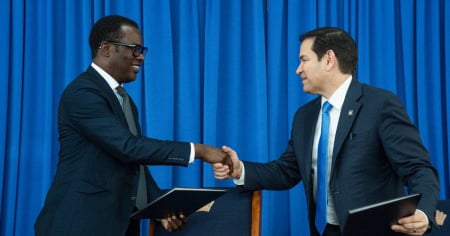
Rubio's visit to Guyana - accompanied by Guyanese President Irfaan Ali - carried significant symbolic and military content.
The official from the Trump Administration reaffirmed Washington's political and strategic support for Georgetown amid joint military maneuvers between the U.S. Navy and the Guyana Defense Forces.
"We have a large Navy and it can reach almost anywhere, to any part of the world. And we have ongoing commitments with Guyana," said Rubio.
He also added that "there will be consequences for 'adventurism', there will be consequences for aggressive actions," without specifying the nature of any potential military response.
These statements were accompanied by new cooperation agreements in defense and security, particularly concerning the offshore oil facilities in Guyana's Exclusive Economic Zone.
Rubio described the Venezuelan threats as part of "illegitimate territorial claims by a drug-trafficking regime."
Esequibo, the centerpiece of a century-old dispute
The dispute over Esequibo, a region of 160,000 km² rich in oil and natural resources, dates back to colonial times.
In 1899, an arbitration ruling awarded the territory to the then British colony. Venezuela never recognized that decision and, following Guyana's independence in 1966, both countries signed the Geneva Agreement, which established a negotiated path to resolve the controversy.
During the governments of Hugo Chávez and the early years of Maduro, Caracas moderated its territorial stance in search of political support in the Caribbean.
But everything changed following the discovery of large oil reserves by ExxonMobil in disputed waters in 2015. Since then, Chavista rhetoric has become more radical.
In recent months, tensions escalated with the Venezuelan regime's decision to hold elections for governors and deputies in Esequibo on May 25th.
The National Electoral Council included the region in the regional elections, although it is unclear how this measure will be implemented in a territory it does not control.
Guyana's response has been stern. The Minister of National Security, Robenson Benn, warned that if a Guyanese citizen accepts the governor's position for the Esequibo proposed by Caracas, “we will charge them with treason and arrest them.”
Furthermore, anyone who supports that choice will also be considered a traitor.
Maduro challenges and plays the victim
The Venezuelan leader used his speech to rally against external threats: “This people, if it has anything, is that when they are threatened, when they are attacked, they become more rebellious.”
Defense Minister Vladimir Padrino López assured that the Venezuelan Armed Forces will act "with firmness and determination" in the face of any attempt at foreign intervention: "We will not tolerate threats from any foreign official," he said.
The very Godfather defended the legitimacy of Venezuela's claim: “It is outrageous that our claim over the Esequibo territory is deemed illegitimate, considering that the Geneva Agreement is the valid instrument signed by the parties involved in the territorial dispute.”
Vice President Delcy Rodríguez also raised her voice: she referred to Irfaan Ali as “the Zelensky of the Caribbean,” and accused Marco Rubio of being “the little man holding the position of Secretary of State in the United States” who “claims to threaten Venezuela.”
Regional escalation
The recent diplomatic crossing occurs against a backdrop of increasing militarization in the area. In early March, a Venezuelan corvette dangerously approached an ExxonMobil oil platform, in a move that analysts describe as the most serious in years.
Meanwhile, the United States and Guyana continue to strengthen their military cooperation. Recent naval exercises aim to enhance coordination in response to crisis scenarios.
The judicial front: The International Court of Justice
The territorial dispute is currently before the International Court of Justice (ICJ), following Guyana's appeal to this body in 2018 after the failure of United Nations mediation. Venezuela has challenged the tribunal's jurisdiction but has participated in the proceedings. Caracas is expected to submit its final written reply regarding the validity of the 1899 arbitral award in August.
Meanwhile, the Maduro government insists on keeping the tension alive with actions such as including Esequibo in the official map and in the electoral processes. From Miraflores, the narrative remains confrontational: "No one threatens Venezuela because this is the homeland of the liberators," Maduro reiterated
Frequently Asked Questions about the Tensions between Venezuela and the U.S. over the Esequibo
Why did Nicolás Maduro insult Marco Rubio?
Nicolás Maduro insulted Marco Rubio due to the warnings from the U.S. Secretary of State regarding possible military actions if Venezuela acts against Guyana in the territorial dispute over Esequibo. Maduro responded by calling Rubio an "idiot" in a television appearance, also questioning his understanding of democracy and labeling Rubio as part of a corrupt elite.
What is the position of the United States regarding the Esequibo dispute?
United States, represented by Marco Rubio, strongly supports Guyana in the territorial dispute over Esequibo. Rubio has made it clear that any aggression from Venezuela against Guyana or against ExxonMobil facilities would have serious consequences, reaffirming Washington's political and strategic backing of Georgetown.
What is Esequibo and why is it important?
Esequibo is a region of 160,000 km² rich in oil and natural resources, whose sovereignty is disputed between Guyana and Venezuela. The importance of Esequibo lies in its natural resources, especially following the discovery of large oil fields by ExxonMobil in 2015, which has intensified Chavista rhetoric and tension in the region.
How has Guyana responded to Venezuela's actions in Essequibo?
Guyana has responded firmly to Venezuela's actions in the Esequibo. The Minister of National Security of Guyana warned of treason charges for any citizen who accepts the position of governor of the Esequibo proposed by Caracas. Furthermore, Guyana has strengthened its military cooperation with the United States to counter potential aggression.
Filed under: