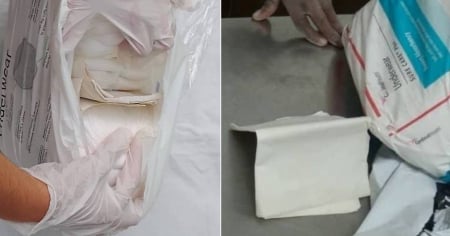
A Cuban citizen appeared this Friday before the Provincial People's Court of Santiago de Cuba on charges of trafficking, from Jamaica, one kilogram of cocaine hidden inside the soles of eight pairs of rubber flip-flops.
In a report from the local telecenter Tv Turquino, it was revealed that in a landmark trial, the accused, whose identity has not been disclosed, was charged with smuggling drug packages hidden within the soles of footwear.
The information indicates that, after the detection of narcotics by customs authorities at the Antonio Maceo International Airport, the woman "cooperated" for the monitored delivery of the package to two individuals who were processed by the police.
The three defendants were sentenced to prison terms of 19, 17, and 13 years, respectively, with accessory penalties that include the deprivation of rights provided in the Penal Code, the confiscation of the drugs, the sandals that contained them, the rest of the miscellaneous items in the luggage, cash, a Samsung mobile phone, and the prohibition of leaving the national territory.
The citizens were judged in an oral and public trial corresponding to Case 15 of 2025 and sanctioned according to what is stipulated in article 235.1 subsection A, and subsections C and G of the Criminal Code.
According to the official media, one of the defendants was a repeat offender and was on probation, while another was a "multiple repeat offender" in the commission of criminal acts.
The penalties for drug trafficking in Cuba can be extremely severe, reaching up to 30 years in prison, life imprisonment, or even the death penalty, depending on the circumstances of the crime, such as the involvement of minors under 18, significant amounts of drugs, or connections to international trafficking. The Cuban government has adopted a zero-tolerance approach to drug trafficking, conducting exemplary trials to deter such activities.
Last week, Cuban customs authorities reported an increase in the entry of drugs into the country by air. The most common method is the use of "blind mules", individuals who sell space in their suitcase to carry packages to Cuba, but unknowingly end up transporting narcotics.
The head of Customs at "José Martí" International Airport in Havana warned that travelers are solely responsible for the items they carry and encouraged them to think twice about whether it's worth the decision to carry packages in exchange for money.
In recent months, numerous cases have been reported of people under the influence of drugs on the streets of Cuba. The use of "El Químico" has raised alarm due to its devastating effects on the physical and mental health of young people.
Frequently Asked Questions about Drug Trafficking and Trials in Cuba
Why was the Cuban citizen convicted of drug trafficking?
The Cuban citizen was sentenced for trafficking one kilogram of cocaine hidden in the soles of eight pairs of flip-flops, transported from Jamaica. She was arrested after the narcotics were detected at the Antonio Maceo International Airport in Santiago de Cuba and received a sentence of 19 years in prison, along with two others involved in the case.
What measures is Cuba taking against drug trafficking?
The Cuban government has intensified its zero-tolerance policy towards drug trafficking, conducting exemplary trials and increasing anti-drug operations in the country. Penalties for drug trafficking can reach up to 30 years in prison, life imprisonment, or the death penalty, depending on the circumstances of the crime.
What is the situation of drug trafficking in Cuba?
The drug trafficking in Cuba has increased, with a rise in the entry of narcotics by air and sea. The authorities have reported a significant increase in drug consumption, especially among the youth, which reflects a growing problem that the regime is attempting to control with repressive measures rather than preventive ones.
What is "the chemical," and why is it dangerous?
"The chemical" is an extremely potent synthetic cannabinoid that mimics the effects of marijuana. It is up to one hundred times more potent than marijuana and is produced illegally using toxic ingredients, which increases the risk of poisoning and overdose deaths, especially among young Cubans.
Filed under: