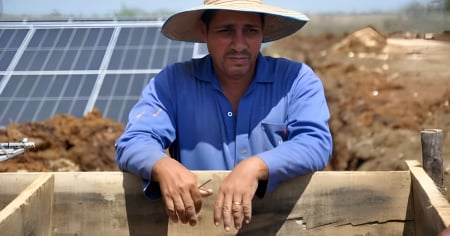
Amid the worst energy crisis in recent Cuban history, the regime once again dressed itself as a savior by announcing the installation of solar panels in mountainous communities of Guantánamo, such as Los Naranjos, located nearly 800 meters above sea level.
What Granma, the official organ of the Communist Party of Cuba (PCC), presented as a technical and social achievement, was actually a portrait of the accumulated failures of the "revolutionary project."
In an article titled "Where the Sun Shines at Night," the official journalist José Llamos Camejo reveled in the testimonies of farmers who expressed their gratitude to the sun for now being able to power lamps and televisions, as if electricity were a luxury granted by the state’s grace, rather than a citizen's right that should have been ensured decades ago.
The question is unavoidable: Was there no electricity in those communities before the recent installation? According to the testimonies gathered by Llamos Camejo, no. Some broken solar appliances without batteries were all that existed until recently. Today, following the arrival of "solar modules," life is changing. But why has it taken so long?
It is impossible not to notice the historical paradox: in previous articles from Granma, the inhabitants of Los Naranjos have been portrayed as devotees of Fidel Castro and recipients of promises fulfilled by the so-called "revolution" since 1959.
However, the PCC body confessed this Sunday, without shame, that they never had stable access to electricity. What kind of “transformation” lasts more than six decades without guaranteeing the most basic needs?
The current action is part of a government campaign to emphasize the change in the energy matrix as a revolutionary virtue, without mentioning the context that necessitates it: the inability of the National Electric System to supply the population, characterized by constant blackouts and a collapsed thermal power plant.
Talking about solar panels in 2025 sounds more like survival propaganda than coherent energy policy. According to figures from Granma itself, 625 modules will be installed this year in Guantánamo, a number that barely scratches the surface of the country's actual needs.
The renewable energy label in state-run media has become a narrative balm, a way to disguise governmental ineptitude and incompetence, as well as the structural deterioration of the national electrical system with sustainability rhetoric.
The installation of solar panels in communities like Los Naranjos is not a sign of progress, but rather the most evident symptom of a historical debt that the regime is trying to settle with belated gestures and recycled speeches. What should be a starting point towards a dignified life, turns into a propaganda banner.
And the question continues to resonate: how did these communities live for six decades without electricity? And even worse: how could what reveals a failure be presented as a victory?
Filed under: