
Related videos:
In a maneuver that has puzzled experts and governments alike, the president of the U.S., Donald Trump, has included uninhabited territories, lacking economic activity and inhabited solely by wildlife, in his new global tariff list.
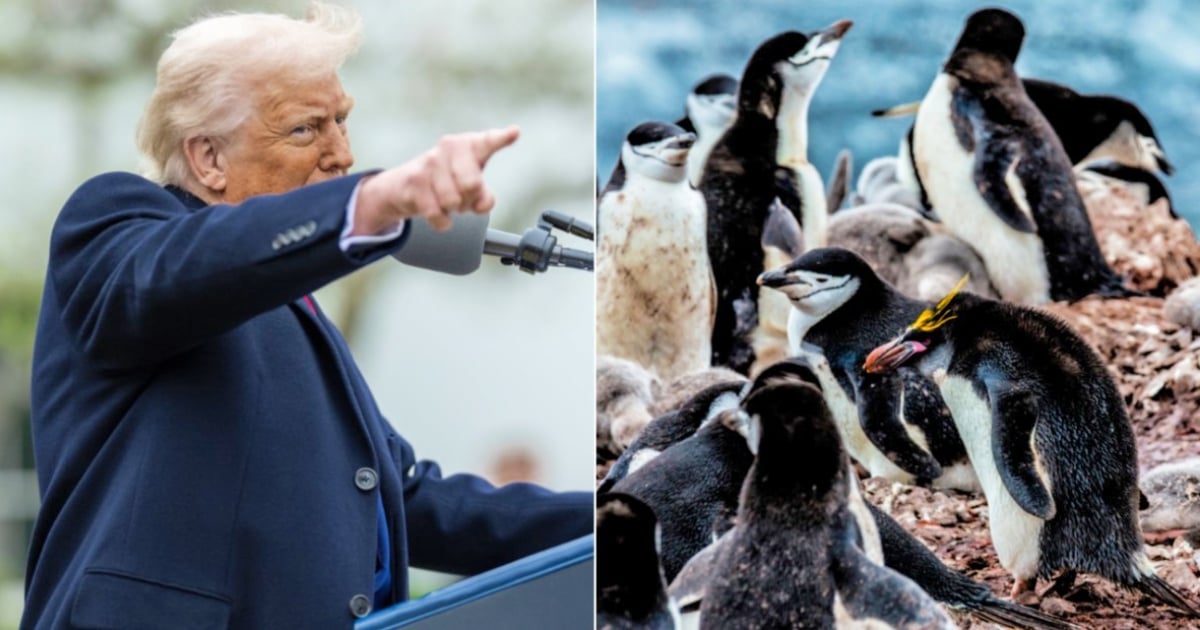
Among those affected are the remote Heard Island and McDonald Island, under Australian sovereignty, known for their ecological value and for being inhabited solely by penguins, seals, and seabirds.
Trump's measure, announced this Wednesday, is part of a renewed protectionist discourse aimed at repositioning the United States in international trade.
Penguins on the blacklist: Heard and McDonald Islands targeted for tariffs
One of the most striking decisions is the inclusion of Heard and McDonald Islands, a remote subantarctic archipelago under Australian sovereignty, with no human population or recognized economic activity.
These islands, declared a Natural World Heritage Site, are home to thousands of penguins, seals, and seabirds.
They lack infrastructure, do not engage in exports, and their visits are strictly regulated for ecological reasons.
Despite this, the Trump Administration decided to impose a 10% tariff on its supposed exports.
"Due to the extreme isolation of the Heard and McDonald Islands, along with the persistent severe weather and maritime conditions, human activities in the region have been, and continue to be, limited," states the official portal of the Australian Government regarding these territories.
The measure also affects other external territories of Australia, such as the Cocos (Keeling) Islands, Christmas Island, and Norfolk Island.
The latter, with just over 2,000 inhabitants, received a tariff of 29%, a figure higher than that applied to mainland Australia itself.
Business owners from affected areas like Norfolk Island described the decision as "inexplicable." Richard Cottle, the owner of a concrete company, stated that "it was a simple mistake." Another entrepreneur, who specializes in pest control, claimed that the only known import from the U.S. is "rodent bait."
According to the Norfolk Chamber of Commerce, in 2019 the island was the 223rd largest exporter in the world, with sales of soybean meal and seeds worth 1.7 million US dollars. However, in recent years, no significant trade activity towards the U.S. has been identified.
"I'm not entirely sure that Norfolk Island is a commercial competitor."
The Australian Prime Minister, Anthony Albanese, reacted with bewilderment.
"I'm not entirely sure that Norfolk Island, in this regard, is a commercial competitor to the gigantic economy of the United States," he said to the Australian press.
He added that the measure "exemplifies that no place in the world is exempt from this."
According to official data, in 2023 Norfolk Island exported products worth $655,000 to the United States, including $413,000 in leather footwear.
However, a spokesperson for the local administrator stated to SBS News that they have no "known exports" to the U.S. market.
“Tourism is the main industry of Norfolk Island and the primary driver of economic activity. We are baffled,” he stated.
Norway, also affected: Tariffs on a military territory and Svalbard
Norway was not immune to the impact of tariff policy.
The arctic territory of Jan Mayen, a volcanic island uninhabited except for temporary military and scientific personnel, was subject to a 10% tariff, just like the archipelago of Svalbard.
In this last one, whose current economy is centered around tourism, about 3,000 people live there.
Continental Norway, for its part, faces a 15% tariff. Prime Minister Jonas Gahr Støre described the measure as "bad news."
According to official data, about 8% of Norwegian exports are destined for the United States.
A British military territory is also on the list
The British Indian Ocean Territory, where the Diego Garcia military base is located, was also targeted with a 10% tariff.
This territory is exclusively inhabited by about 3,000 British and American military personnel and contractors. There are also no known exports from this enclave.
Geopolitical contrast: No tariffs on Russia, Cuba, or North Korea
One of the strongest criticisms of the measure has been the absence of countries that have tense or sanctioned relations with Washington. Russia, Belarus, North Korea, and Cuba were not included in the list.
"The White House justified that they are already facing sanctions that prevent any significant trade. However, in 2024, the United States imported more goods from Russia ($3 billion) than from Ukraine ($1.2 billion), the latter of which was indeed subject to punitive tariffs of 10%, according to U.S. Census data."
This decision has raised suspicions of a more selective and political rather than technical approach in trade policy.
"Trump does not impose tariffs on Russia, but he does on penguin islands," summarized a European media outlet.
Other impacted territories: Tokelau, Gibraltar, and Réunion
The list also includes small and non-independent territories such as Tokelau (1,600 inhabitants), which is dependent on New Zealand; Gibraltar, a British territory claimed by Spain; and Réunion, a French overseas department with nearly 900,000 inhabitants, which received a tariff of 37%.
The case of Reunión has been one of the most controversial due to the disproportionate tariff impact. Without a clear explanation, the decision affects a region that is fully integrated into European territory and has formal trade ties with France and the European Union.
Conclusion: Rhetoric or real impact?
Although many of the decisions lack practical effect, the gesture has been interpreted as a symbolic maneuver.
Analysts agree that this is a way to strengthen Trump's nationalist and protectionist rhetoric without directly confronting economic powers with which the U.S. has strategic relations.
From Australia and Norway to France, reactions have ranged from diplomatic surprise to logistical bewilderment.
Meanwhile, penguins, seals, and seabirds from Heard and McDonald Islands remain unaware of their new role as symbolic actors in the most unusual trade war of the century.
Filed under: