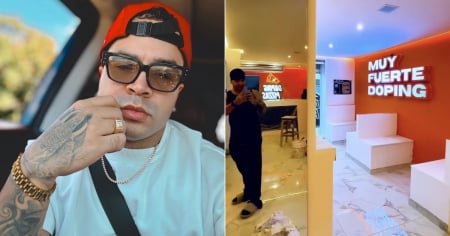
Reggaeton artists Yomil and Yulién Oviedo recently participated in an event organized by the Cuban regime, in another attempt by the dictatorship to address the phenomenon of urban music in Cuba.
The workshop, organized by the Cuban Institute of Music, was attended by artists, musicologists, and cultural leaders, as well as key political figures such as Vice Prime Minister Inés María Chapman and Minister of Culture Alpidio Alonso Grau.
The government is now interested in discussing the impact of urban music on society, as the genre has gained ground especially among young people. Amid the exchanges, Yomil and Yulién were seen as two of the major "names" of the event, although their participation raised doubts and criticisms.
Despite being known for their denunciations of censorship and the regime's limitations, especially Yomil, who has openly stated that he lives under a dictatorship, both artists agreed to participate in a talk promoted by the very system they criticize so much.
The silence on their social media following the event and the lack of details about what was said during the workshop fuel speculation about their genuine commitment to the causes they once championed.
The meeting, which was presented as a space for dialogue, appears more as an attempt by the government to subordinate urban culture to its interests, incorporating it into its official narrative.
As has been seen with other cultural phenomena, the regime seeks to channel the popularity of reggaeton without addressing the structural problems that have led to its rise: an economic, educational, and social crisis that drives many young people to turn to this form of expression in response to the lack of alternatives.
The fact that a figure like Yomil participates in these kinds of events calls into question the authenticity of his stance against the dictatorship.
Meanwhile, Cuban state television did not clarify the actual content of the artists' interventions, leaving it uncertain whether substantive issues were truly discussed or if it was merely a show to distract public opinion from the country's more serious problems.
In March, the government program Mesa Redonda dedicated an episode to the impact of the distribution on Cuban society, its cultural, social, and political implications, and its growing influence on popular taste.
Luis Emilio Aybar, director of the Cuban Institute of Cultural Research "Juan Marinello," stated that the distribution has significant social strength, and emphasized that the position of the Ministry of Culture is "neither to demonize it nor to exalt it uncritically."
The government's official stance of trying to balance the phenomenon of "reparto" (the rise of reggaeton and other urban genres) without completely condemning it reflects the inherent contradiction of the regime.
While they attempt to control everything, from music to cultural expressions, the values promoted by these genres, such as vulgarity and machismo, directly conflict with the principles that the State claims to uphold.
"The reggaeton and the distribution are the result of revolutionary education: Coarseness, vulgarity, machismo and many more things. They are the men of the future who were once called 'the new man'," commented an internet user.
The manipulation of popular culture in Cuba by the government seems to have no limits.
His approach to urban music and its forced integration into the official spaces of the country is yet another example of how the dictatorship tries to control even the last corners of the cultural and social life of the Cuban people.
Frequently asked questions about Yomil and Yulién Oviedo's participation in the urban gender debate in Cuba
Why did Yomil and Yulién Oviedo participate in the debate on urban gender in Cuba?
Yomil and Yulién Oviedo participated in an event organized by the Cuban regime to discuss the impact of urban music on society. Despite their previous criticisms of the government, they chose to be part of the workshop convened by the Cuban Institute of Music, which sparked speculation about their true commitment to the causes they once defended. Their participation in the event was seen as an attempt by the government to incorporate the urban genre into its official narrative.
What is the Cuban government seeking by discussing urban genre?
The Cuban government seeks to address the impact and growing popularity of the urban genre, especially among young people. It appears to be an attempt to control and subordinate the genre to its interests, integrating it into its official narrative without addressing the structural issues that have fueled its rise. This reflects a contradiction, as the regime tries to capitalize on the popularity of reggaeton while conflicting with the values it promotes.
What has been the reaction of the population to the government's stance on urban music?
The reaction from the population has been mixed, with skepticism and criticism toward the regime's attempt to control urban music. Many view this approach as a distraction from the country's more serious issues, such as the economic and social crisis. Furthermore, officials' statements regarding the "Reparto" as a political act have sparked debates on social media, where it is seen more as an attempt at symbolic appropriation rather than a genuine acknowledgment.
Filed under: