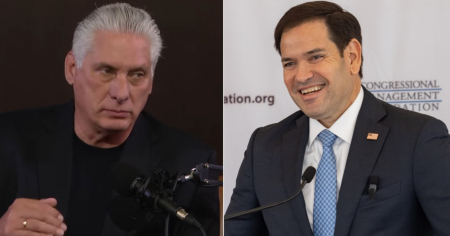
Cuban Foreign Minister Bruno Rodríguez faced strong criticism after celebrating the massive protests that took place on Saturday, April 5, in the United States against the authoritarian profile of the new Donald Trump Administration.
The diplomat used his account on the social network X (formerly Twitter) to praise the demonstrations of the #HandsOff movement, organized across the 50 states of the North American country and supported by more than 150 civil organizations.
"Millions of people in all 50 states of the U.S. and in a dozen locations around the world joined the #HandsOff protests to say enough to authoritarianism, fascism, and the violation of #HumanRights that the plutocracy ruling that country promotes by any means available," wrote Rodríguez.
However, the citizen response was swift, especially from Cubans inside and outside the island, who reminded him of the systematic repression that his own government exerts against any expression of public dissent.
"It's called democracy... you choose who to vote for and you can go out and protest if you disagree. Something that you all can't do... you always vote for the same failed model and it's very difficult for you to protest without ending up worse off than you already are," commented a user.
Another one pointed out: "Bruno, you must be in shock seeing millions of people freely protesting in the streets against the president of their country. You’re not used to scenes like that."
"Let’s hope that when the people of Cuba take to the streets again, you say the same things against your corrupt government and the most bloodthirsty dictatorship in America," commented another internet user.
From official spokespersons and media controlled by the Communist Party, the Cuban government amplified images of the marches as if it were a foreign crisis.
However, Cuban activists like Magdiel Jorge Castro responded emphatically: "How fortunate that in the U.S. liberal democracy allows for protest. In the regime you represent, it is prohibited."
The #HandsOff movement emerges as a reaction to policies implemented during the second term of former President Donald Trump, many of which are now being pushed more forcefully by the influence of billionaire Elon Musk and his leadership of the controversial Department of Government Efficiency (DOGE).
The protesters opposed the closure of social programs such as Medicare and Medicaid, the mass dismissal of federal employees, and the elimination of protections for vulnerable communities such as immigrants, transgender individuals, and racial minorities.
The central demands include: an end to the control of billionaires over public institutions, protection of essential social programs, and expansion of rights and guarantees for marginalized communities.
In contrast, in Cuba, any attempt at protest is criminalized, faced with arbitrary detentions, digital blackouts, excessive police presence, and discrediting campaigns.
Although Article 56 of the Constitution recognizes the right to peaceful assembly, there is no complementary legislation on the island that ensures its actual exercise, rendering it a dead letter.
Frequently asked questions about protests and human rights in Cuba and the U.S.
Why did Bruno Rodríguez celebrate the protests in the U.S.?
Bruno Rodríguez celebrated the protests in the U.S. as a democratic expression against the perceived authoritarianism of Donald Trump's administration. However, this stance was criticized for the double standard it represents, given that in Cuba, protests are suppressed and free expression of dissent is not allowed.
What is the #HandsOff movement and what are its demands?
The #HandsOff movement is a massive protest that emerged in the U.S. in response to the policies of Donald Trump's second term, particularly those affecting social programs and the rights of vulnerable communities. Its demands include ending the control of billionaires over public institutions, protecting essential social programs, and expanding rights for marginalized communities.
How do the protests in the U.S. compare to those in Cuba?
In the U.S., protests are a manifestation of democracy, where citizens can express their disagreement without fear of reprisals. In contrast, in Cuba, any attempt to protest is criminalized and met with repressive measures such as arbitrary detentions, digital blackouts, and excessive police presence.
What is the situation of human rights in Cuba according to the government and the observed reality?
The Cuban government, through figures like Bruno Rodríguez, claims that it respects and promotes human rights in accordance with its Constitution. However, the reality reveals systematic violations of these rights, with restrictions on freedom of expression, association, and peaceful assembly, along with a constant repression of dissent.
Filed under: