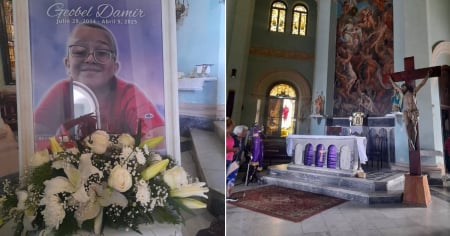
In another demonstration of the Cuban regime's iron grip on social life and even on others' pain, State Security surrounded the Colon Cemetery on Wednesday, preventing people from attending the funeral mass for little Damir Ortiz, who passed away in Miami after years of medical negligence on the Island.
The ceremony, scheduled for 4:00 PM at the cemetery chapel, was organized by family members, activists, and citizens who wished to bid a final farewell to Damir.
However, the act of love and farewell was overshadowed by a police operation that included patrols stationed at multiple points outside the cemetery and the detention of citizens attempting to reach the site.
This is what happened to the activist Alberto Turís Betancourt Pérez, who was intercepted by a police officer just before entering the cemetery.
The incident was recorded on video and shared by activist Idelisa Diasniurka Salcedo Verdecia, who reported: "Many people were not allowed to enter! Why? Here you go. They just detained Turís."
The young man recounted the incident and recorded the exact moment he was arrested
"I'm here at the cemetery, the repression is strong. They won't let you in; there are patrol cars on every corner, everywhere. You can't get in," he detailed in a live broadcast from the location.
Impeded from crying
The activist Lara Crofs was also one of the victims of the repressive siege.
According to reports on social media, she was detained in her own block by State Security agents who monitored her to ensure she did not attend the mass.
"They shut me in on the block so I can't attend. According to this new SE officer, it's regional," he wrote, accompanying his post with images of the patrol cars stationed in front of his house.
"This is not about me personally. It's about a community that just wants to show respect and empathy," Lara added in a message filled with helplessness and frustration.
Despite the harassment, the mass took place.
Damir's grandmother, Mercedes Báez, arrived accompanied by a caregiver and received the affection of those who managed to get past the police cordon.
Father Jorge Luis presided over the ceremony, marked by prayers, tears, and solidarity. “Lord, have mercy,” was heard among the attendees, in a plea that also encompassed all the sick children on the Island.
A tragedy that could have been avoided
Damir Ortiz passed away in the United States, at Nicklaus Children’s Hospital in Miami, where he was transferred after a long struggle by his mother, who for years denounced the lack of medications, misdiagnoses, and inadequate medical care in Cuba.
The social media campaigns, led by her mother and supported by activists both in the country and in exile, ultimately succeeded in obtaining authorization for her trip to the United States.
But it was too late. Damir arrived in septic shock, due to a resistant bacteria he contracted on the Island, which ultimately took his life.
In Miami, her mother has received support from numerous compatriots who see in her case not only a personal tragedy but also an open wound in the Cuban healthcare system, which is deteriorated and lacking essential resources.
Politicization of pain
The regime's attempt to limit the scope of the mass and criminalize civic solidarity with Damir's family has generated a wave of indignation. "It wasn't a political act. It was a farewell, a prayer for a child who suffered the unimaginable. Why prevent it?" questioned a Cuban on social media.
For years, the repressive organs of State Security have targeted any citizen who expresses a critical voice, even when it involves honoring the life of a child.
The mass for Damir Ortiz was no exception. What should have been a respectful and peaceful event turned into a symbol of how far a government can go to control any act, even mourning the loss of a loved one.
Frequently Asked Questions About the Police Cordón in Cuba During the Mass for Damir Ortiz
Why did the Cuban police cordon off the Colón Cemetery during the mass for Damir Ortiz?
The Cuban police cordoned off the Colón Cemetery to prevent people from attending the mass for Damir Ortiz, a child who passed away in Miami. This action is part of the regime's control over events that could be perceived as protests or criticism. The mass had been organized by family members and activists, raising concerns among the authorities about possible expressions of social discontent.
What obstacles did the attendees of the mass for Damir Ortiz face?
The attendees faced a heavy police operation that included patrols at multiple points in the cemetery and the detention of citizens attempting to reach the site. Activists like Alberto Turís Betancourt Pérez were intercepted and detained, while others like Lara Crofs were held back in their own blocks by State Security.
How did the repression impact the ceremony for Damir Ortiz?
Despite the repression, the mass for Damir Ortiz took place, led by Father Jorge Luis and marked by prayers, solidarity, and tears. However, the police presence and the detention of citizens overshadowed what should have been an act of love and farewell, turning it into a symbol of governmental repression against any form of criticism or peaceful resistance.
What was the response of the Cuban community regarding the case of Damir Ortiz?
The Cuban community responded with outrage and solidarity to the case of Damir Ortiz. The story of the boy mobilized thousands both on and off the island, who participated in campaigns to bring him to the United States and to provide support for his family. The case highlighted the shortcomings of the Cuban healthcare system and the bureaucratic obstacles to accessing proper medical care.
Filed under: