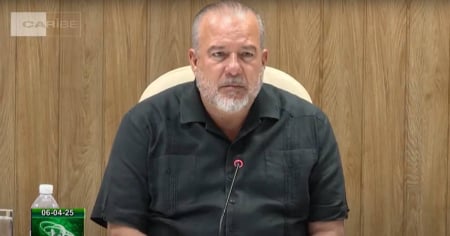
The Prime Minister of Cuba, Manuel Marrero Cruz, praised the doctors and health sector workers, assuring that "our health system will continue to grow", in a speech full of political symbolism, which comes at a time when the country is shaken by the death of the child Damir Ortiz in Miami.
During his speech at a meeting analyzing the results of the year 2024 for the Ministry of Public Health (MINSAP), and in words conveyed by the Cuban Television News, Marrero expressed his "recognition."
Additionally, the Cuban leader pointed out that “despite what our adversaries say, our healthcare system, the work of the Commander in Chief, will continue to grow and face these adversities because we have the most important assets: the professionalism and human quality of all the professionals and workers in this sector. Therefore, we express our recognition in light of the campaigns of hatred against those in white coats."
Marrero also stated that "the highest leadership of the country" congratulated the profession for its defense of medical ethics and the values of the socialist system, emphasizing their "humanistic and social" commitment.
The prime minister's statements come just days after the passing of little Damir Ortiz, a Cuban child who was transported to Miami for urgent medical care, following public complaints about the lack of adequate diagnosis and negligence in the island's hospitals.
Damir passed away on April 5 at Nicklaus Children's Hospital. His case moved thousands of Cubans who shared his story on social media and called for a more effective, transparent, and humane healthcare system.
Internationally, Marrero's words can also be seen as an indirect response to U.S. Secretary of State Marco Rubio, who has renewed his efforts to pressure Latin American governments not to hire Cuban medical brigades, described as “modern forms of medical slavery” and “atrocious practices.”
Even the department he leads has urged governments that have agreements with the Cuban regime for the hiring of medical personnel to explore fair alternatives that do not violate the rights of professionals.
In fact, through the Office of Western Hemisphere Affairs at the Department of State, Washington denounced that the Cuban regime earns over 4.9 billion dollars a year from medical missions.
The current support for Marrero contrasts with his statements from August 2021, when he blamed healthcare staff for mistreatment of patients amid the hospital collapse due to COVID-19.
In a meeting in Cienfuegos, the Prime Minister pointed out that "the main grievances of the population are related to mistreatment" and criticized the lack of doctors to provide adequate care.
These words sparked a wave of outrage on social media. Several doctors publicly responded, accusing the government of blaming them for a failing system.
It was reported that they were working in extreme conditions, without basic materials, and facing emotional and physical overload. Those claims still resonate today, especially after the Damir Ortiz case.
Frequently Asked Questions about the Health System Crisis in Cuba
How has the Cuban government responded to criticism regarding medical negligence in the case of Damir Ortiz?
The Cuban government, through MINSAP, has defended the medical care provided to the child Damir Ortiz, stating that all decisions were made by consensus and that the child's well-being has always been the priority. However, this stance has been criticized by both the child's mother and activists, who are denouncing medical negligence and a lack of adequate resources to treat his condition in Cuba.
What has Manuel Marrero said about the Cuban health system in the midst of this crisis?
Manuel Marrero praised Cuban doctors and stated that "our healthcare system will continue to grow", highlighting the human and professional quality of the medical staff. However, his statements contrast with the criticisms and reports of negligence and lack of essential resources in the Cuban healthcare system.
What impact does the crisis of the Cuban healthcare system have on the population?
The Cuban population suffers the consequences of a collapsed healthcare system, with limited access to medications and adequate medical services. The lack of resources and medical personnel exacerbates healthcare, leaving citizens in a vulnerable situation, especially in severe cases like that of the child Damir Ortiz.
What are the main criticisms of Manuel Marrero's speech on health in Cuba?
The main criticisms of Manuel Marrero's speech focus on the contradiction between his praises of the Cuban healthcare system and the reports of negligence and lack of resources that emerge in cases like that of Damir Ortiz. The perception is that the Cuban government maintains a triumphalist discourse disconnected from the reality faced by the population and healthcare professionals on the island.
Filed under: