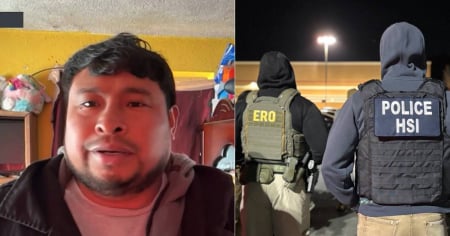
The Trump administration revoked the F-1 visas of 18 students from Florida International University (FIU) as part of an agreement with the Immigration and Customs Enforcement (ICE).
The measure, which has raised significant concern among the university community, comes after the implementation of a joint program between FIU and immigration authorities.
The visa revocation occurred between March 25 and April 10, 2025. Of the 18, 11 are current students and the other seven are recent graduates.
The news has generated tensions within the educational community, as everyone now faces uncertainty about their legal future in the United States.
This action is part of an agreement signed between FIU and ICE, which allows campus police to receive training to enforce immigration laws.
The new agreement is part of the 287(g) program, which grants officials the authority to detain, interrogate, and in some cases, arrest individuals suspected of being undocumented immigrants.
Although specific details about the reasons behind the visa revocation have not been disclosed, the Trump administration has intensified immigration enforcement actions on university campuses as part of an effort to strengthen national immigration policies.
According to data provided by the institution, more than 700 students and recent graduates from various educational institutions across the country have experienced changes in their legal status since the State Department began implementing those measures.
The president of FIU, Jeanette Nunez, former lieutenant governor of Florida, spoke about the political context that has led to this change in university policies.
In a recent interview with Local 10, Nunez stated that while the university has a duty to provide education to students, it is also their responsibility to prioritize resources for the legal residents of the state.
"We need to ensure that we have enough capacity and enough seats for our legal residents of the state of Florida," Nunez commented, referring to the increasing pressure on state universities to manage access to higher education in light of the presence of international students.
The change has sparked a strong debate about immigration and its impact on educational institutions in the United States.
Advocates for immigrant rights express concern over the use of campuses as immigration checkpoints, which could create a climate of fear and distrust among international students, who make up a significant portion of the university community.
This week, the deportation of a student from the University of Florida after being arrested in a traffic stop made headlines.
Felipe Zapata Velázquez, 27 years old, was deported to his home country, Colombia, after being detained by the U.S. Immigration and Customs Enforcement (ICE) following a traffic violation in Gainesville.
Zapata, a third-year student in the Food and Resource Economics program at the College of Agricultural and Life Sciences at FIU, was arrested on March 28. The young man held a valid F-1 student visa.
The mother, Claudia Velázquez, explained that her son was processing the I-20 form to renew his license and that he had already paid the corresponding fines.
However, after resolving the matter at the police station, ICE agents intercepted him and informed him that, due to having that infraction on his record, they had to take him into custody.
Subsequently, he was transferred to Jacksonville and then to the Krome Detention Center in Miami-Dade, where, according to his mother, he was pressured to sign a self-deportation agreement without the presence of a lawyer.
Florida Democratic Congressman Maxwell Frost labeled the incident as "government kidnapping."
"Felipe Zapata Velásquez is just the latest victim of Trump's despicable campaign against immigrants. What should have been a routine traffic stop turned into a nightmare," he noted.
Earlier, state legislator Yvonne Hinson, a Democrat from Florida, questioned Zapata's detainment, stating that a mere traffic violation does not warrant such a severe measure. "Immigrants are under attack now more than ever."
Frequently Asked Questions about Visa Revocation and Immigration Policies in the U.S.
Why did the Trump administration revoke the visas of students from Florida International University?
The revocation of the F-1 visas for 18 students from Florida International University is part of an agreement between the university and the Immigration and Customs Enforcement (ICE). This agreement allows campus police to receive training to enforce immigration laws and is part of the 287(g) program, which grants authorities to such officers to detain, question, and, in some cases, arrest individuals suspected of being undocumented immigrants. The Trump administration has intensified immigration control actions on college campuses as part of an effort to strengthen national immigration policies.
What is the 287(g) program and how does it affect international students in the U.S.?
The 287(g) program allows local law enforcement to collaborate with ICE in the identification and detention of undocumented immigrants. In the university context, this means that campus authorities can receive training to enforce immigration laws, which has raised concerns within the international student community by creating an atmosphere of fear and distrust.
What are the implications of the collaboration between universities and ICE on migration issues?
The collaboration between universities and ICE, as seen at Florida International University, allows university authorities to actively participate in the enforcement of immigration laws. This has led to the revocation of visas for students and graduates, creating uncertainty about their legal status. This measure has been criticized by immigrant rights advocates, who fear that campuses will become immigration checkpoints, impacting the international student community.
What measures is the Trump administration taking regarding international student visas?
The Trump administration is intensifying controls over international student visas as part of its stringent immigration policy. This includes the revocation of visas in cases of violations of immigration laws and collaborations between universities and ICE for the enforcement of these laws. The government's stance is that visas are a privilege, not a right, and can be revoked if deemed a threat to national security or in violation of the law.
Filed under: