
Related videos:
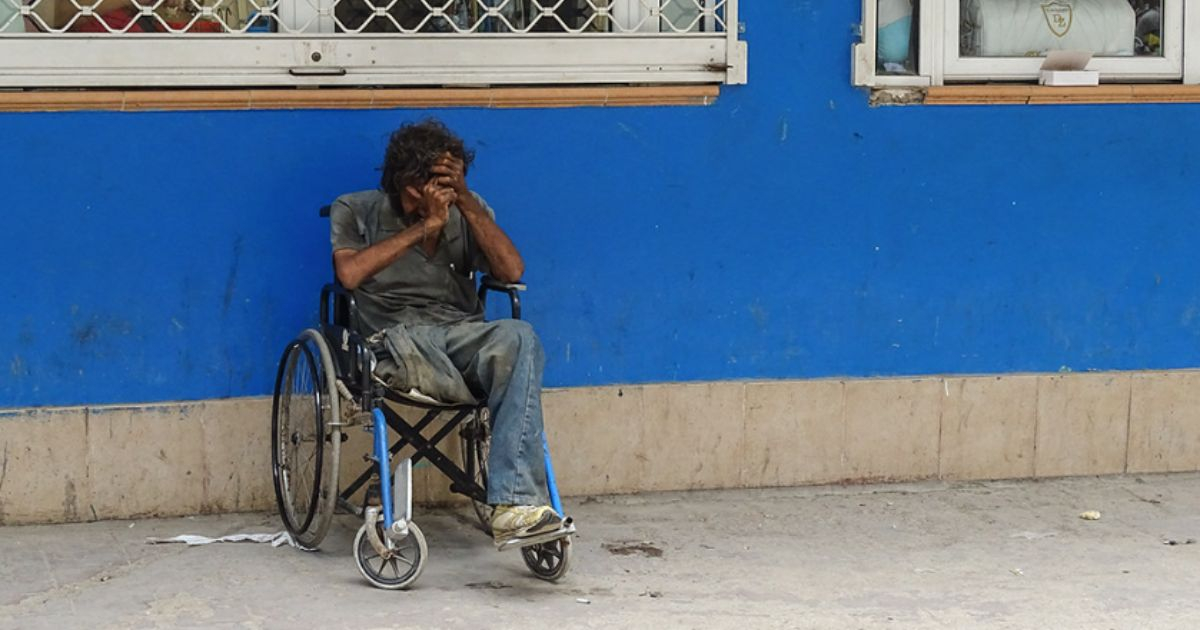
In Cuba, where the regime claims that "no one is left behind," ironically, the authorities themselves celebrate as an achievement the rescue of people who have survived for years on the streets, abandoned, homeless, without resources, and without family.
What should be a cause for reflection on a system that failed to prevent this reality has now become a propaganda banner of institutional success, as stated in a journalistic piece published by the official newspaper Granma.
Under the title "A Work of Love, for the Dignity of Those Most in Need," the official propaganda reports on the assistance provided at the Community Center in Santiago de Cuba to individuals facing vulnerability, homelessness, or wandering.
In a triumphant tone, they describe how now they "sing and smile" in collective celebrations for their birthdays, having spent decades living in neglect and social ridicule.
“Wandering aimlessly, sleeping wherever night would catch me, facing mockery and rejection… until the Madrina found me,” says Mirna, a 50-year-old woman who spent years on the street, in plain sight of leaders and activists committed to the regime, until she was taken to a shelter.
The official discourse highlights solidarity gestures but omits that these individuals have been exposed to extreme precariousness for years without timely state support.
The State, instead of questioning why these individuals found themselves in such conditions, now showcases their stories as proof of the supposed effectiveness of the social care system.
"We have a budget of ten million pesos for 2025," says the director of the center in El Viso, in Santiago de Cuba, which welcomes around 200 people.
But forced institutionalization, often under precarious conditions, does not constitute a structural solution nor does it guarantee the restoration of rights.
Throughout the official report, there is not a single mention of prevention mechanisms or any real social reintegration plans.
It is not questioned why so many people lack access to housing, family, or income, nor is there an investigation into the role of the system that, for years, turned a blind eye.
The "control visits" by the Prosecutor's Office to the centers are even praised as a guarantee of rights, when in reality, the mere existence of hundreds of Cubans who have lived for years in poverty contradicts the principles that the State itself claims to uphold.
According to cited data, the actions are focused on about 300 individuals identified as homeless or begging, just in Santiago de Cuba, many of whom are under 60 years old and still of productive age
It talks about programs, breakfasts, snacks, and clothing, but not about autonomy, housing, employment, or repairing the damage caused by years of neglect.
"Our work is beautiful," says a worker from the center, in another phrase used as emotional ornamentation for a reality that remains deeply painful.
Far from addressing the structural reasons for marginalization, the official narrative turns the forgotten into "rescued" individuals and negligence into "political will."
From abandonment to propaganda, from beggars to trophies of institutional discourse. In official Cuba, even poverty can be repurposed… if it serves to applaud the system.
In Santiago de Cuba, citizens have reported the increasing presence of homeless individuals, bringing attention to a reality that has been ignored for years.
Local activists have taken the initiative to provide food, clothing, and direct support to those living in conditions of extreme vulnerability, in light of the lack of effective responses from the State.
These acts of solidarity have exposed the systematic neglect faced by dozens of homeless individuals in that eastern city.
Meanwhile, the official narrative has continued to insist on attributing homelessness to external factors, such as the global economic crisis and U.S. sanctions, without acknowledging the internal responsibility for the management of social deterioration.
The state media has reinforced this stance, presenting a narrative that downplays the issue of homelessness or justifies it with arguments unrelated to the real context of the country. Instead of proposing concrete solutions, the regime continues to use these situations as part of its propaganda strategy, ignoring the structural origins of the marginalization affecting hundreds of Cubans.
Frequently Asked Questions about Begging and Poverty in Cuba
Why does the Cuban government celebrate the rescue of beggars as an achievement?
The Cuban government uses the rescue of homeless people as propaganda, presenting it as a success of its social system, despite the fact that these individuals had been abandoned for years. The celebration of this "achievement" fails to question why the system failed to prevent their vulnerable situation from the outset.
What is the current situation of homeless people in Cuba?
In Cuba, begging and extreme poverty are growing problems. Many people, including the elderly, live on the streets due to a lack of resources, housing, and state support. Government actions focus on institutionalization but do not address the structural causes of the problem.
How does the economic crisis affect the Cuban population?
The economic crisis in Cuba has exacerbated extreme poverty, affecting thousands of citizens who lack basic resources. Inflation, food shortages, and a lack of employment have driven many to beg, while the government blames external factors and fails to implement effective solutions.
What actions are activists taking regarding the situation of begging in Cuba?
Activists like Yasser Sosa Tamayo have made gestures of solidarity by distributing clothing and food to those in need. These actions aim to highlight the reality of the homeless in Cuba and provide direct assistance in response to government inaction.
What role does the Cuban regime play in the situation of poverty and begging?
The Cuban regime has been criticized for its inability to effectively address poverty and for using the situation of homelessness as political propaganda. Current policies have failed to resolve the social crisis, leading to an increase in discontent among the population.
Filed under: