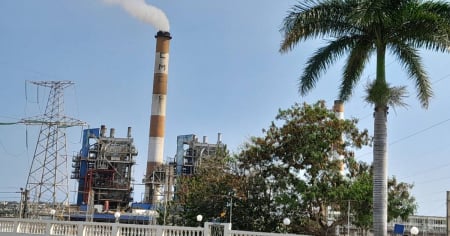
The electricity generation deficit in Cuba continues to impact the population, with no signs of improvement. On Tuesday, April 15, the Electric Union (UNE) reported that the maximum outage registered the previous day was 1,601 megawatts (MW) at 8:20 p.m., coinciding with the time of highest demand in the country.
The situation of the National Electroenergetic System (SEN) is critical. At 7:00 a.m. this Tuesday, the total availability was 1,820 MW, compared to a demand of 2,395 MW, resulting in a capacity deficit of 645 MW. By noon, an impact of 925 MW is anticipated. The forecast for peak evening hours is even more severe: with a projected demand of 3,390 MW and an availability not exceeding 1,820 MW, the deficit could reach 1,570 MW, with an estimated impact of up to 1,640 MW.
Regarding the infrastructure, the UNE detailed that unit 2 of the Felton Thermoelectric Power Plant (CTE) remains out of service due to a breakdown. Additionally, unit 2 of the Santa Cruz CTE, units 3 and 4 of the Cienfuegos CTE, and unit 5 of the Renté CTE are under maintenance. The limitations in thermal generation amount to 412 MW. Furthermore, 94 distributed generation plants are offline due to a lack of fuel, which accounts for 619 MW less in the system, along with another 29 MW that remain unavailable due to a shortage of lubricants.
As part of the strategy to maintain a portion of the supply, the UNE reported that the production from the eight new photovoltaic solar parks was 1,039.99 megawatt-hours (MWh) during the last day.
In the capital of the country, the Electric Company of Havana reported that due to the deficit, scheduled electricity cuts by blocks will take place this Tuesday. Between 10:00 a.m. and 2:00 p.m., service will be interrupted in block 4; from 11:00 a.m. to 3:00 p.m., the blackout will affect block 3. Then, from 3:00 p.m. to 7:00 p.m., it will be block 1's turn, and between 7:00 p.m. and 10:00 p.m., electricity will be cut in block 2.
This is in addition to the disruption recorded on Monday night due to a malfunction at the San Agustín electrical substation. This failure interrupted service in several neighborhoods of La Lisa municipality, including Bello 26, Alturas de La Lisa, Novoa, San Agustín, Barbosa, Arroyo Arenas, and El Cano, as well as in areas of the Playa and Marianao municipalities. According to the Electric Company of Havana, damage assessments are being conducted to restore service as quickly as possible.
Frequently Asked Questions about Blackouts in Cuba and the Energy Crisis
What is the cause of the energy deficit in Cuba that leads to blackouts?
The energy deficit in Cuba is due to several causes, including breakdowns in the generating units of thermoelectric plants, scheduled maintenance that reduces operational capacity, and the lack of fuel affecting distributed generation plants. These conditions have resulted in a deficit exceeding 1,600 MW, severely impacting electricity supply in the country.
How are blackouts affecting the Cuban population?
Power outages are severely affecting the daily life of Cubans, limiting access to basic services and causing discomfort and uncertainty. Prolonged interruptions impact both household activities and family finances, as well as hinder the functioning of essential public services.
What measures are being taken to mitigate the energy crisis in Cuba?
To mitigate the energy crisis, Cuba has incorporated new photovoltaic solar parks, which have contributed a certain amount of energy to the system. However, this production is insufficient to cover the deficit. Additionally, scheduled block blackouts have been implemented in Havana and other provinces to better manage the limited availability of electricity.
What is the forecast for the electricity supply in Cuba?
The forecast for electricity supply in Cuba is not optimistic, as the generation deficit could persist or even increase in the near future. The lack of investment in infrastructure, dependence on thermal power plants, and fuel shortages continue to be significant obstacles to improving the situation.
Filed under: