
Related videos:
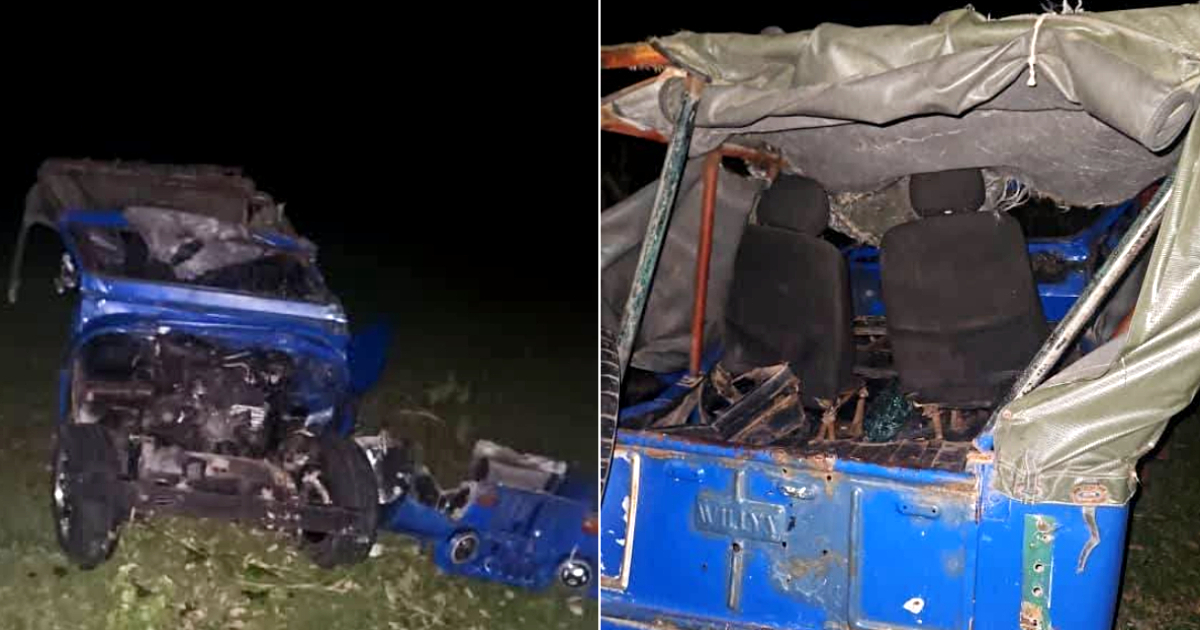
A traffic accident that occurred on the night of this Tuesday in the province of Holguín resulted in several injuries after a passenger transport Jeep Willys overturned on the road.
The accident occurred in the section of the Carpintero community, between the municipalities of Sagua de Tánamo and Mayarí, an area with narrow roads and poor nighttime visibility. According to witnesses, the jeep lost control and overturned, causing severe damage to the body and scattering its parts several meters away.
In the images shared on Facebook by the user identified as Loidel Gainza, the extent of the impact is evident: the vehicle, completely wrecked, lost its front end, the roof collapsed, and the seats were displaced. The condition of the jeep suggests a violent rollover.
So far, no fatalities have been reported, although local sources indicated that several occupants were injured and were taken to nearby hospitals. The authorities have not yet issued an official statement nor specified the exact number of injured individuals.
This type of accident once again highlights the issues of rural transportation in Cuba, where many vehicles in use lack minimum technical conditions and travel on poorly maintained roads, without adequate lighting or signage.
The news is still developing and will be updated with more information as it becomes available.
The Willys in Cuba and their high accident rate
This is not the first serious accident related to jeep-type vehicles in Cuba, especially the Willys, which are widely used by their owners for passenger transport.
In July 2023, a young woman died and four people were injured after a Willys jeep overturned in Mayarí, also in Holguín. In August of the same year, another incident involved a jeep that collided with a MININT motorcycle in Havana, resulting in one injury.
More recently, in March 2024, a severe collision in the Cuban capital between a jeep and a tourist type pisicorre raised concerns about transportation conditions.
The Willys jeeps, introduced in Cuba in the 1940s and 1950s, were initially used for military and agricultural purposes. Their durability and toughness made them popular among farmers and transporters, transforming them into a symbol of rural transportation in Cuba before 1959.
Many of these vehicles are still in circulation today, modified and patched together with improvised parts, which increases the risks on the road.
Filed under: