
Related videos:
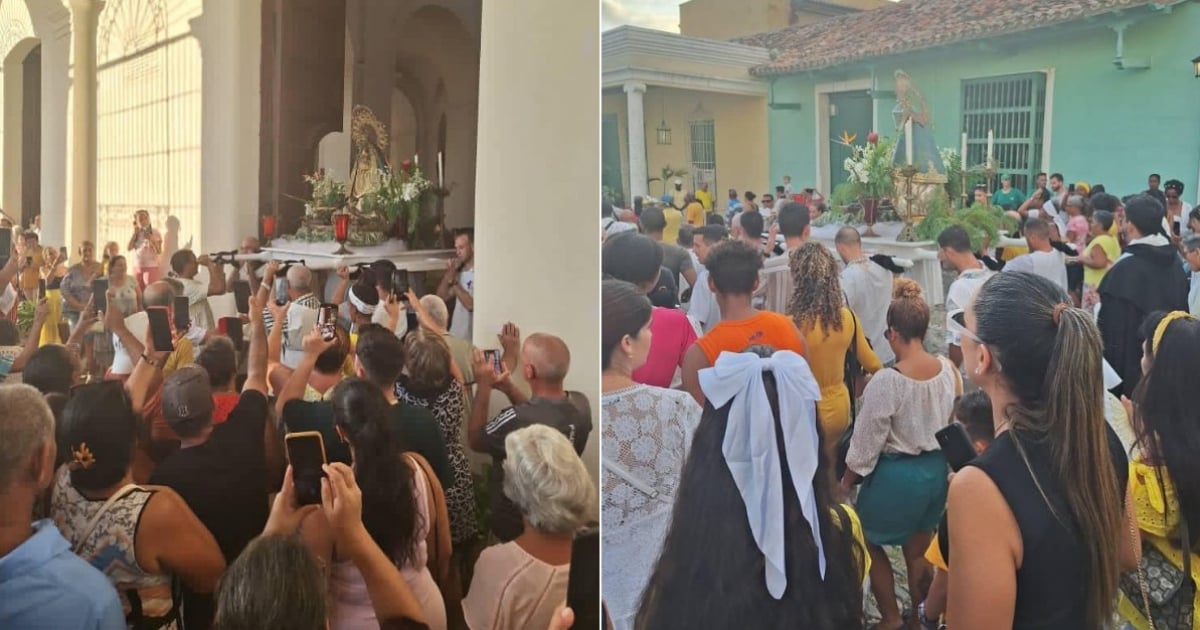
The Cuban regime has once again made its authoritarian and hostile stance against religious freedom clear by prohibiting the procession of Christ of Humility and Patience in Trinidad, Sancti Spíritus, a tradition with over 100 years of history deeply rooted in the popular devotion of the people.
The refusal, firmly denounced by priest Lester Rafael Zayas Díaz, once again reveals the systematic repression against public expressions of faith that do not conform to the ideological dictates of the Communist Party.
The priest, at the forefront of the Parish Church of the Holy Trinity, denounced in a brave publication on Facebook the abuse by the authorities, whose response was filled with contradictory and false arguments.
The regime claimed that the procession "is not a custom in Trinidad" - even though it has existed for over a century - and that the request was submitted after the deadline.
However, Zayas Díaz made it clear that the request was submitted 58 days in advance, almost a month beyond the official requirement of 30 days, and pointed out that it was the negligence of the authorities that prevented its processing.
The government not only ignored the request, but while hundreds of worshippers waited to go out into the street, it filled the park in front of the Church with plainclothes surveillance agents and others on unregistered motorcycles, a threat that made the true fear of the State clear: not of a riot or disorder, but of the power of faith and its ability to mobilize.
Zayas Díaz, known for his pastoral commitment and his critical yet deeply human messages, described the incident as "an irresponsible transgression" and an act that "wounded the dignity" of the faith community.
More than just a procedure, a humiliation
The authorities' refusal not only represents an infringement on a centuries-old expression of Catholic faith, but it also deepens the mistrust between the Church and the State in a country that continues to criminalize spirituality outside of the official dogma.
Zayas did not stop at the bureaucratic complaint.
He went further: he questioned the political backdrop of those decisions and the double standard of a government that promotes events like the Canchacharazo: an improvised festival in honor of an alcoholic beverage, filled with noise, vulgarity, and propaganda, lacking cultural roots in Trinidad, yet receiving full official support in terms of logistics and promotion.
Meanwhile, public expressions of faith are being suppressed, even those deeply rooted in the history and culture of the Cuban people.
"Denying the exercise of a right ultimately threatens all rights, and this makes a society unjust," wrote Zayas in a text that quickly went viral.
What is power afraid of?
The question that looms over this entire scandal is the same one raised by Zayas in his letter: What would have happened if the procession had taken place? Probably nothing. A community praying, carrying an image, affirming their faith.
But for a regime that requires total control over public and symbolic space, even an expression of devotion can seem subversive if it is not controlled by those in power.
In his reflection, Zayas chose a powerful verse to title his letter: "It is a fearful thing to fall into the hands of the living God" (Hebrews 10:31). With these words, he not only addresses his congregation. It is a direct reminder to those who today, from the halls of power, trample on rights with the arrogance of those who believe they are above accountability. Because the silence and fear they sow will not last forever.
Today, that "living God" whom they fear is not the one who represses or watches over them. He is the one who walks in the frustrated footsteps of a denied procession, the one who burns in the throats of those who could not sing, and the one who holds, in the darkness of injustice, the invincible light of faith.
More than a century of faith vs. state censorship
The procession of Christ of Humility is a centuries-old tradition that was only interrupted after the triumph of the Revolution, when the Cuban state embarked on its ideological crusade against religion.
Although in recent years certain liturgical expressions in public spaces had been at least partially restored, the recent wave of prohibitions shows that the rejection of the Catholic Church remains a constant in the Cuban power apparatus.
This new case is not an isolated incident. For the second consecutive year, the government prohibited the Solemn Stations of the Cross on Palm Sunday in El Vedado, Havana, an activity organized by the Vicariate of the Archdiocese.
Father Zayas himself reported the suspension, stating that the authorities simply did not approve the request, as had happened in 2024 with the Santo Entierro, also in El Vedado.
It is not new. The Cuban regime has historically feared everything it cannot control: free art, independent press, human rights… and also religion, when it is lived freely and without fear. Because faith, like dignity, cannot be confined to a sacristy nor extinguished with unlicensed motorcycles.
Repression against religious demonstrations has been a constant in recent years. The Catholic Church in Cuba has faced bureaucracy, surveillance, threats, and systematic denials of its attempts to make its faith visible in the public space.
In 2019, for example, similar prohibitions were reported in Camagüey and Holguín, and in 2021, the UN Special Rapporteur on Religious Freedom warned that Cuban legislation allows for the penalization of religious practice, especially when it does not align with the interests of the State.
Frequently Asked Questions about the Ban on the Procession of Christ of Humility in Trinidad
Why was the procession of Christ of Humility prohibited in Trinidad?
The procession of Christ of Humility in Trinidad was prohibited by authoritarian decisions of the Cuban regime that impact religious freedom. The authorities unfoundedly claimed that the procession "is not a custom in Trinidad" and that the request was submitted late, although it was presented 58 days in advance.
What is the reaction of Priest Lester Rafael Zayas Díaz to the prohibition of the procession?
The priest Lester Rafael Zayas Díaz strongly denounced the ban on social media, describing it as an "irresponsible outrage" that wounded the dignity of the believing community. Zayas Díaz questioned the political background of the decision and criticized the repression of public expressions of faith.
How has the Cuban Catholic community reacted to the repression of religious demonstrations?
The Cuban Catholic community has reacted with criticism and denunciations against the regime for the systematic prohibitions of religious activities. These prohibitions have been viewed as an attack on religious freedom and have generated distrust between the Church and the State.
What other religious events have been affected by repression in Cuba?
In addition to the procession of Christ of Humility, other activities such as the Solemn Stations of the Cross on Palm Sunday in El Vedado, Havana, have also been prohibited by the Cuban regime. This reflects a pattern of repression towards public expressions of faith on the island.
Filed under: