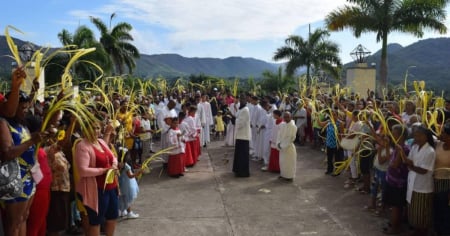
In the full solemnity of Palm Sunday, a group of young people was seen dancing to urban music of the "reparto" genre in front of the National Sanctuary of Our Lady of Charity of El Cobre in Santiago de Cuba, provoking a wave of outrage among believers and advocates for religious freedom.
In a video shared on social media, several young people are seen making provocative movements to the rhythm of popular dance music, while another person records them with a mobile phone.
Everything takes place in the immediate surroundings of the most important Marian temple in Cuba, regarded as a symbol of the faith and spirituality of the Cuban people.
The incident, reported on Facebook by independent journalist Yosmany Mayeta Labrada, occurs just days after the regime authorities censored the traditional Solemn Stations of the Cross procession for the second time, a Christian procession that was scheduled for this Sunday in Vedado, Havana, with a route planned from Línea to Letrán.
This act, many of whom describe as a display of vulgarity and a loss of values, brings to the forefront the deterioration of respect for sacred spaces and the trivialization of religious sites as a backdrop for viral content.
Various voices from civil society have condemned what has occurred, lamenting that while expressions of faith are hindered, disrespectful behaviors toward traditions and religious symbols are tolerated—or even promoted.
The Cuban Catholic Church has denounced on several occasions the loss of values in society, a situation exacerbated by the economic and moral crisis the country is experiencing, where the cult of spectacle often replaces respect for the spiritual.
These events reflect a pattern of tensions between contemporary cultural expressions and respect for religious spaces in Cuba
For instance, in December 2024, it was reported that children were subjected to military indoctrination in a church in Havana, which sparked criticism regarding the use of sacred spaces for political purposes.
Additionally, priest Alberto Reyes has been a critical voice regarding the lack of religious freedom in Cuba. On several occasions, he has denounced how the authorities restrict religious activities and use places of worship to promote government agendas.
These background factors demonstrate how the instrumentalization of religious spaces and the censorship of expressions of faith have been recurring practices in the country.
The recent incident at the Santuario del Cobre fits into this context of tensions between forced secularization and the resistance of religious communities to maintain the sacredness of their spaces
Filed under: