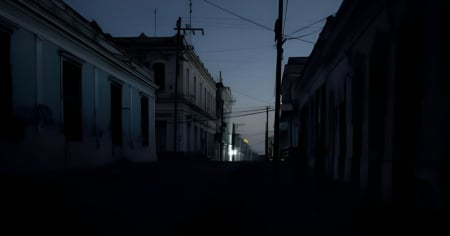
The energy crisis shaking Cuba reaches a new critical point this Tuesday, with widespread blackouts across the country.
Yesterday, the 24-hour service was affected and remained disrupted throughout the early hours of today. The highest volume of outages yesterday reached 1,736 MW at 7:50 p.m., coinciding with peak demand time.
Although the figure remained below the 1,858 MW forecasted by the Electric Union (UNE), the number is still extremely high.
The system's availability at 7:00 a.m. today was only 1,480 MW, while the demand exceeded 2,600 MW, creating an immediate deficit of 1,147 MW.
It is estimated that by noon there will be blackouts totaling around 1,400 MW, an extremely high daytime figure.
However, the situation becomes even more concerning when looking ahead to the evening, when a peak demand of 3,350 MW is expected, compared to an availability of 1,752 MW, resulting in a deficit of 1,598 MW.
In summary, it is estimated that the overall impact during peak hours could reach up to 1,668 MW at night.
Structural failures and fuel crisis
The report reveals a series of failures and maintenance issues that continue to undermine the capacity of the National Electro-Energy System (SEN).
Breakdown: Unit 5 of the CTE Mariel, Unit 5 of the CTE Nuevitas, and Units 1 and 2 of the CTE Felton.
Maintenance: Unit 2 of the Santa Cruz CTE, Units 3 and 4 of the Cienfuegos CTE, and Unit 5 of the Renté CTE.
This is accompanied by a limitation of 232 MW in thermal generation.
A total of 62 distributed generation plants (474 MW) are out of service due to a lack of fuel.
Additionally, 32 MW are unavailable due to a lack of lubricants.
For the peak, the entry of Unit 1 of Felton at 205 MW and the entry of Unit 3 of Renté at 67 MW are considered.
Both aspects were underscored as "reliefs" of the day by Lázaro Guerra Hernández, general director of Electricity at the Ministry of Energy and Mines, during his daily appearance on Cuban television.
Solar energy: an insufficient relief
The technical report also highlighted the production of 986 megawatt-hours (MWh) generated by the eight new photovoltaic solar parks, a figure that, while representing progress in diversifying the energy matrix, is clearly insufficient given the magnitude of the current deficit.
A crisis without an immediate solution
The reality of the SEN reveals a deep structural and operational crisis that does not seem to have a short-term solution.
Although the government has called for energy efficiency and has invested in renewable sources, the aging national infrastructure, reliant on fossil fuels, remains extremely vulnerable to technical failures and resource shortages.
Meanwhile, Cuban citizens are facing another day of prolonged blackouts, with no specific date in sight for a sustained recovery of the electric service.
What for many has become a routine—the return of the candle, the blackout in the middle of dinner, the fan stopped on a hot night—has once again become a symbol of a country that still struggles to turn on the light.
Frequently Asked Questions about the Energy Crisis in Cuba
What is the current situation of the electricity deficit in Cuba?
The electrical deficit in Cuba is critical, with widespread blackouts affecting the country due to a generation deficit that exceeds 1,700 MW during peak hours. The aging infrastructure and fuel shortages exacerbate this situation.
What factors contribute to the energy crisis in Cuba?
The energy crisis in Cuba is due to a combination of breakdowns, scheduled maintenance, and a lack of fuel. The electrical infrastructure is vulnerable and largely dependent on fossil resources, making it prone to technical failures and shortages.
What measures is the Cuban government taking to address the energy crisis?
The Cuban government has made calls for energy efficiency and has invested in renewable energy sources, such as solar energy. However, solar energy production remains insufficient to cover the significant deficit of the National Electroenergy System (SEN).
How do blackouts impact the daily life of Cubans?
Prolonged power outages significantly affect the quality of life for Cubans, disrupting daily activities, economic activities, and the operation of essential services. Citizens face uncertainty and distress due to the absence of a clear plan for restoring electrical service.
Filed under: