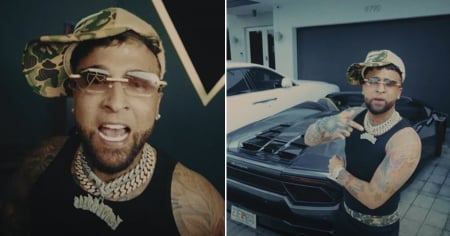
The Cuban reggaeton artist Ovi —whose real name is Ovidio Crespo— shared strong opinions about President Donald Trump during a recent interview with broadcaster Enrique Santos, where he expressed mixed feelings regarding his administration, particularly concerning the treatment of immigrants. The artist, who has lived in the United States since emigrating from Cuba, spoke from his personal experience as a Latino and as a public figure with a very distinct urban image.
“I am confused because I don’t like that people are being imprisoned for a tattoo. This is not Cuba. This is a free country,” stated Ovi, known for his numerous tattoos, even on his face. “I am an artist. I am not a gangster, nor a criminal, nor am I on the streets. I am a singer and I have an image. Justin Bieber has dozens of tattoos,” he added, defending the right to aesthetic expression without being criminalized for it.
The singer denounced that the detention of individuals, such as some Venezuelans, solely based on their appearance, represents a form of discrimination. “To me, that is racism. They say it’s about affiliation. That’s not fair,” he stated, clearly expressing his disagreement with policies that, in his opinion, make judgments based on looks.
In that same space, Enrique Santos asked him about his current stance towards Donald Trump, who is now in his second presidential term. Ovi was honest: “I supported him during his first term, the country was doing well. But it hurts me for my immigrant brothers, because I am an immigrant.” He criticized the hardening of rhetoric and actions against migrants, especially Cubans who continue to arrive in search of a better life.
“It's being tough on immigrants when there are Americans who are also crazy and murderers. We immigrants are fighters, good people, humble and who don't steal, and who contribute to this country as well. There are many immigrants who work, the artist asserted, defending a community that —as he said— contributes more than is acknowledged.”
At the end of the interview, the artist also referred to Oniel Bebeshito, praising him for his achievements in the urban industry: “He’s doing things that hardly any other artist is doing. He’s filling stadiums. We need to celebrate that. To do what he does, you need to have money.” However, he also hinted at the producer Ferrante: “I don’t know him, nor am I interested. In fact, Bebeshito and I started to do something, but Ferrante won’t let him record with me.”
Frequently Asked Questions About Ovi, Immigration, and Criticism of Donald Trump
Why does Ovi criticize Donald Trump's immigration policies?
Ovi criticizes Donald Trump's immigration policies because he believes they are discriminatory and harmful to immigrants. In his interview with Enrique Santos, he expressed his concern over the detention of individuals based on their appearance, which he calls a form of racism. Ovi, as an immigrant, feels that these policies do not acknowledge the positive contributions of immigrants to the United States.
How has Ovi's migration process affected his music career?
The migration process of Ovi, which included a three-month detention and the threat of deportation to Cuba, has significantly influenced his music career. Despite this challenge, Ovi has managed to make a strong comeback in the music scene with the release of his track "Los Rockstar no van al cielo," which has gone viral and solidified his position as an international Cuban artist.
What is Ovi's stance on the criminalization of appearance in the United States?
Ovi is against the criminalization of appearance, arguing that it is unfair for people to be judged and detained based on their image, such as having tattoos. In his interview, he defended aesthetic expression as a right, comparing his situation to that of other artists like Justin Bieber, and rejected the notion that appearance should be linked to criminal activities.
Filed under: