
Related videos:
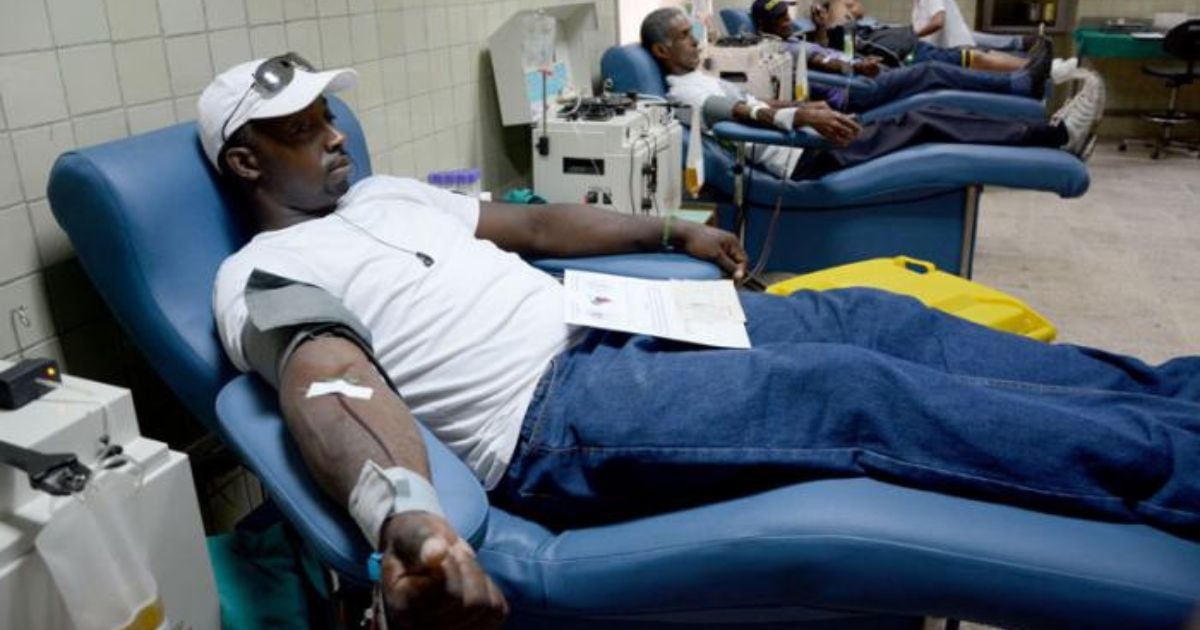
For the first time, the Cuban government, through the business group BioCubaFarma, has publicly acknowledged its intention to commercialize blood plasma from donors as part of a new foreign investment project, according to the official newspaper Granma.
Although the sale of blood and its derivatives has been highlighted for years by independent investigations, this is the first time that the regime officially acknowledges this type of business to its population.
The announcement was made by the Pharmaceutical Laboratories AICA, which is part of BioCubaFarma, and presented the proposal to build a plasmapheresis center, managed by the industry, for the extraction of blood plasma and its future commercialization.
The engineer John Wilber Arrazcaeta, director of Investments at AICA, justified to Granma that the proposal to build a plasmapheresis center responds to the need to address the chronic shortage of basic medical supplies on the island and explained that the project will be developed under the modality of foreign direct investment.
According to Arrazcaeta, unlike traditional whole blood donation, plasmapheresis allows for the return of red blood cells to the donor, extracting only the plasma.
The engineer explained that the establishment of the plasmapheresis center represents a business opportunity for the regime, as it will allow for the sale of the extracted plasma to fund the project's operation and achieve quality standards that enable its export to international markets.
Although the Cuban government has historically benefited from the export of blood, plasma, and other derivative products, as documented by the NGO Archivo Cuba, which estimates revenues exceeding $1.323 billion obtained between 1995 and 201, it had so far avoided openly acknowledging these practices before the national public.
This new admission marks a shift in the official communication strategy regarding a business that has been the subject of numerous allegations of opacity and lack of informed consent from donors.
With this initiative, the regime not only formalizes the commercialization of its citizens' blood but also creates a new avenue to finance its pharmaceutical sector amid the deep economic crisis the island is experiencing.
From Shadows to the Market: Cuban Plasma as a Commodity
In 2017, the NGO Archivo Cuba reported that the Cuban government had acquired 34.5 million dollars in a single year from the sale of blood plasma abroad.
According to statements made at the time by María Werlau, the executive director of the organization, the regime carried out these operations without informing donors about the final destination of their blood, describing these practices as part of the state's "shady dealings."
The investigation indicated that Cuba never officially reported those exports, although they were recorded in international trade databases.
This history of complaints reinforces the assertion that, although the Cuban government benefited for decades from the sale of blood and its derivatives, it has avoided admitting it openly until now.
Archivo Cuba strengthened these claims in 2021 by announcing that it would publish new studies on the business of exporting blood and human organs by the Cuban regime.
María Werlau revealed on that occasion that the investigations pointed to systematic practices of extraction and commercialization of human products, in which even the collaboration of international organizations such as the Pan American Health Organization (PAHO) would be documented.
The annual report for that year also included concerning data on the forced blood extraction from political prisoners in previous decades, highlighting that the exploitation of the population's biological resources was not a recent practice, but rather part of a historical pattern of institutionalized abuse.
Additionally, it was pointed out that the official blood donation campaigns, promoted by the government as acts of altruism, concealed the true commercial purpose of many of those extractions.
Werlau emphasized that the regime never included these revenues in public reports nor informed Cuban donors about the final use of their blood.
The systematic concealment of these operations, along with the lack of informed consent, constituted a serious violation of human rights, according to Archivo Cuba.
The investigation by Archivo Cuba made further progress in 2022, when it revealed that between 1995 and 2019, the Cuban regime had received over 1.323 billion dollars through the sale of blood and its derivatives, tissues, glands, and human organs.
The collected data, around 808 million, specifically corresponded to blood exports and blood-derived products, operations that were never disclosed to the Cuban people.
Werlau warned that many of these businesses involved practices as opaque as forced extractions from political prisoners and those executed, especially during the 1960s and 1970s.
Historical reports, such as the Annual Report of Cuban Foreign Trade and documents from the Inter-American Commission on Human Rights, documented the existence of systematic blood extractions from death row inmates, practices that remained hidden under the guise of supposed revolutionary altruism.
Moreover, international trade records revealed that Cuba was exporting human products to countries such as Brazil, Venezuela, Argentina, Colombia, Iran, Russia, Ecuador, and Belarus, despite the regime's insistence in its internal propaganda on portraying blood donation as a purely humanitarian act.
These facts reinforce that the recent official acceptance of plasma commercialization is not a novelty in the regime's practices, but rather an acknowledgment of an activity that, for decades, remained concealed from both the Cuban citizens and the international community.
Although the Cuban regime has turned blood and its derivatives into a lucrative export business, the shortage of blood products in the island's hospitals remains alarming.
The lack of donors, the decrease in recruitment campaigns, and the inadequacy of healthcare infrastructure are factors that authorities use as justification for the shortage of blood products in the public health system.
Frequently Asked Questions about the Sale of Blood Derivatives in Cuba
Why did the Cuban government decide to commercialize blood plasma?
The Cuban government justifies the commercialization of blood plasma as a response to the chronic shortage of basic medical supplies on the island. According to engineer John Wilber Arrazcaeta, director of Investments at AICA, the foreign investment project to build a plasmapheresis center will generate revenue to finance operations and improve the quality of products for export.
What has been Cuba's history in the sale of blood and its derivatives?
Historically, the Cuban government has generated significant income through the sale of blood and its derivatives, although it has not publicly admitted this until now. According to the NGO Archivo Cuba, between 1995 and 2019, revenues exceeding 1.323 billion dollars were recorded from the export of these products. The operations have been criticized for their lack of transparency and informed consent from donors.
What impact does plasma commercialization have on the Cuban population?
The commercialization of plasma represents a new approach to financing the pharmaceutical sector amidst Cuba's economic crisis. However, it raises concerns about informed consent from donors and the lack of basic medical supplies in the island's healthcare system, which continues to face a severe shortage of medications and resources.
What additional measures has the Cuban government taken to address the economic and health crisis?
The Cuban government has implemented several measures, such as partial dollarization and the opening of new self-financing schemes in foreign currency for strategic sectors like health and biotechnology. Despite these actions, the shortage of medications and lack of resources continue to severely impact the population, and the measures have been criticized for their ineffectiveness in addressing the root of the crisis.
Filed under: