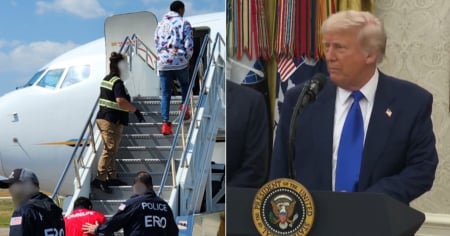
The president Donald Trump vehemently defended his tariff policy in response to criticism regarding its potential impact on the wallets of American consumers.
With his usual provocative style, the Republican leader employed a domestic metaphor to illustrate his vision: "I don't think an 11-year-old beautiful girl needs 30 dolls," he stated on the set of the program "Meet the Press" of the NBC network.
Trump has made tariffs on China a central piece of his economic discourse.
During the interview with journalist Kristen Welker, she reminded him of when he admitted that "perhaps dolls cost a couple of dollars more than usual."
The president, for his part, downplayed the potential impact of his tariffs on the cost of living for Americans and repeated that girls "can have three or four" dolls instead of 30.
"What we were doing with China was simply incredible. We had a trade deficit of hundreds of billions of dollars," he emphasized.
The presenter tried to steer the conversation toward the most immediate concern: will this mean higher prices and product shortages? Trump refused to accept that interpretation and dismissed the idea that there would be empty shelves in stores, staying true to his belief that his goal is not to limit consumption, but to combat what he sees as waste driven by cheap imports.
"It's not necessary to have 250 pencils. You can have five," he concluded, reiterating his point that the United States must learn to live with less and produce more within its borders.
An escalating trade war
The president's statements come in the context of an escalation in the trade war with China.
Weeks ago, his administration increased tariffs on a wide range of products, reaching up to 145% in some sectors. According to Trump himself, this policy has led to the collapse of Chinese factories and a supposed revival of the U.S. local industry.
"We are making a lot of money. Things are going wonderfully. We were losing 5 billion dollars a day with China. Now we have stopped doing business with them and we are saving," he said.
However, independent reports contradict this statement: while some companies have started to relocate operations, many others warn that production costs have risen due to the dependence on imported components, impacting their competitiveness.
Despite warnings from analysts and the U.S. Department of Commerce, which reported a GDP contraction of 0.3% in the first quarter of the year, the president remains convinced that the tariffs will not only strengthen the national economy but also reduce what he terms excessive and unnecessary consumption.
The contradiction between the message and the data
Despite the optimism of the former president, the economic outlook appears less promising.
According to the AP agency, the growth in consumption during the early months of the year was partly due to a rush by households to buy before new tariffs raise the prices of essential goods. Far from indicating strength, this behavior reveals concern among consumers.
Trump himself, however, has tried to dissociate the market downturn from his economic strategy. "This is Biden's market, not Trump's," he wrote on his social media, blaming his predecessor for the financial volatility.
Beyond the Dolls: A Contested Economic Model
The statement about dolls -which has been widely circulated and discussed on social media and in the media- is more than just an anecdote. It embodies a vision for the country: a less globalized, more austere economy focused on self-sufficiency. For Trump, it is not about depriving children of toys, but rather about reshaping the American consumption model.
But critics point out that behind the simplistic rhetoric lies a policy that could impoverish working families.
The possibility of paying more for fewer products is not, as he suggests, a mere lesson in frugality; it is a direct consequence of decisions that, according to economists, could cause more harm than good if not accompanied by a robust industrial strategy.
While the debate continues, it remains to be seen whether the dolls—be they two, three, or 30—will become a symbol of a broader and more polarizing policy.
Will the price of economic independence be a childhood with fewer toys? For Trump, the answer is clear: yes, but with more money in your pocket. For his critics, it is merely a reflection of a leader willing to minimize the human costs of his trade policies.
Frequently Asked Questions about Trump's Tariff Policy and Its Implications
Why does Donald Trump say that his tariff policy is beneficial for the U.S.?
Trump claims that his tariff policy strengthens the national economy by reducing what he calls "excessive and unnecessary consumption" and encouraging domestic production. He asserts that tariffs on China have collapsed Chinese factories and boosted the American local industry. However, there are criticisms and contradictions in his statements, as reports suggest that production costs have increased due to reliance on imported components, affecting the competitiveness of American companies.
How will tariffs affect American consumers?
Tariffs could result in higher prices and less accessibility for Americans. Trump has acknowledged that consumers may face an increase in the prices of certain products, such as dolls, which could cost a few dollars more. Additionally, a possible shortage of products is anticipated, similar to what was experienced during the COVID-19 pandemic, if the tariffs remain in place.
What economic impact could Trump's tariff policy have in the U.S.?
Trump's tariff policy could lead to an economic contraction. The Gross Domestic Product (GDP) of the U.S. contracted by 0.3% in the first quarter of 2025, and analysts worry that the tariff policy may cause more harm than good if not accompanied by a strong industrial strategy. Additionally, there are concerns about a potential inflationary spike and a slowdown in economic growth.
What is the Trump administration doing to counteract the negative effects of tariffs?
Trump has promised to reduce or eliminate income taxes for those earning less than $200,000 a year by using revenue from tariffs. Additionally, he has stated that his economic agenda is focused on making it easier to do business in the U.S., creating jobs, and building factories in the country. However, the effectiveness of these measures is under debate, as the impact of the tariffs remains a concern for economists and consumers.
Filed under: