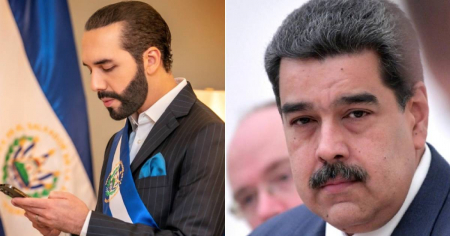
The Salvadoran president Nayib Bukele announced a new milestone in the fight against crime in El Salvador: 900 days without recording homicides since he took office in 2019.
"We closed on May 4th and we can announce that we have reached 900 days without homicides since we took office. To put it in context: during the previous administration, there wasn't a single day without homicides; and in the one before that, there was only 1. Thank God," he wrote on his X account.
"900 days without Salvadoran families crying because insecurity took a loved one away," stated the Presidency in another tweet.
This achievement has been described by the Salvadoran government as a historic milestone in a nation that, just a few years ago, topped the global lists for lethal violence.
In 2015, the homicide rate in El Salvador exceeded 100 per 100,000 inhabitants, one of the highest in the world. Today, that figure has drastically fallen to just 1.9, according to official data supported by the UN.
The state of emergency, the cornerstone of the Bukele model
Although the decrease in crime is attributed to the set of policies initiated with the Territorial Control Plan in 2019, most of the days without homicides—748 out of 900—have been recorded under the state of emergency in effect since March 2022.
This extraordinary measure, which grants extensive powers to the Executive and security forces, has been criticized by human rights organizations but has also been applauded by a significant portion of the Salvadoran population, weary of decades of violence.
The regime has allowed mass arrests without judicial warrants. According to government figures, more than 85,000 alleged gang members have been detained since its implementation.
Seizures of weapons, money, and drugs also increased, while historic gangs like MS-13 and Barrio 18 have lost a significant portion of their operational capacity.
The mega-prison as a symbol of the new order
One of the most visible elements of this strategy is the so-called Center for the Confinement of Terrorism (CECOT), a mega-prison built in the rural locality of Tecoluca with a capacity for 40,000 inmates. It was inaugurated in early 2023 and specifically designed to house high-risk gang members.
In March of that year, Bukele released a video showing the transfer of 2,000 tattooed prisoners, barefoot and in chains, which sparked both support and outrage in the international community. "This will be their new home, where they will live for decades, mixed together, unable to harm the population any further," he stated at the time.
Between applause and warnings
The success of Bukele's measures has been supported by broad sectors of Salvadoran society, as reflected in his reelection in 2023 with an overwhelming majority. However, organizations such as Amnesty International and Human Rights Watch have denounced arbitrary detentions, torture, and inhumane conditions in prison facilities.
Despite this, Bukele's image as an unyielding leader against crime has resonated beyond his borders. His model is cited as an example by right-wing politicians in Latin America and the United States, whose president has given him explicit support.
An unprecedented transformation
El Salvador has transitioned from being considered the most violent country in the Western Hemisphere to being, in the words of Bukele himself, "the safest in America." In 2023, only 154 homicides were recorded throughout the country, a figure unimaginable just a few years earlier.
The achievement is undeniable. However, the debate about the democratic cost of this transformation remains ongoing.
In a global context where populism and authoritarianism advance alongside promises of order and security, El Salvador has become a case study that divides opinions. What is indisputable, for now, is the outcome: fewer deaths, more control, and a leader who continually makes headlines.
Frequently Asked Questions about Bukele's Security Strategy in El Salvador
How many days has El Salvador gone without homicides under the government of Nayib Bukele?
El Salvador has reached a milestone of 900 days without homicides since Nayib Bukele took office in 2019. This achievement has primarily been made possible by the security policies implemented by his administration, such as the Territorial Control Plan and the state of emergency that grants extensive powers to the security forces.
What is the Terrorism Confinement Center (CECOT) in El Salvador?
The Terrorism Confinement Center (CECOT) is a megaprison in El Salvador built to house high-risk gang members. Inaugurated in early 2023, it has a capacity for 40,000 inmates and is one of the cornerstones of President Nayib Bukele's security strategy. The prison has been the subject of international controversy due to detention conditions and allegations of human rights abuses.
How has the state of emergency affected human rights in El Salvador?
The state of emergency in El Salvador, which has allowed for mass arrests without judicial orders, has been criticized by human rights organizations such as Amnesty International and Human Rights Watch. These organizations have reported on arbitrary detentions and inhumane conditions in prisons, raising a debate about the democratic cost of the government's security policies.
What is the current relationship between El Salvador and the United States in terms of security and migration?
The relationship between El Salvador and the United States has strengthened under the administrations of Nayib Bukele and Donald Trump, particularly on issues of security and migration. El Salvador has agreed to accept deportees, including dangerous criminals, in exchange for compensation. This agreement has been part of a broader effort to combat transnational crime and has generated both support and criticism due to its implications for human rights.
Filed under: