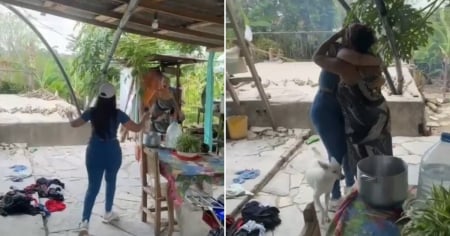
Milena, a Cuban living abroad and a TikTok user under @milenita9712, has reappeared on the platform with a video lasting nearly four minutes to respond to the criticisms she received after posting her family reunion in Cuba. In the previous images, she was seen arriving in a rental car and embracing her mother in front of a wooden house, which sparked a wave of comments questioning her economic priorities.
In this new post, Milena addresses a user named Analí, who wrote: “You should be ashamed to record and look at the conditions your mother lives in.”
“I am not embarrassed to record in front of my house, in front of my wooden house, which was my little home for so many years”, she responded. “In which I experienced so many things, so many beautiful moments, so many cyclones, so many lovely times with my family.”
Milena emphasizes that what should be embarrassing is the belief that living in a wooden house makes someone inferior. “People should be ashamed who think that just because someone lives in a wooden house, they are less than another. That is what is truly shameful.”
"Many people would like to have their mother, even if it's just under a bridge."
Throughout the video, Milena firmly and passionately defends the emotional value of that home. "Many people would like to be able to reunite with their loved ones, even if it's in a wooden house... and many people who can't see them, others who no longer have them in their lives."
“Why do we tell ourselves that it's shameful?”, he asks. “Many people would like to have at least their mother to hug, even if it's underneath a bridge, as many have placed me around there.”
Additionally, it clarifies that her mother does not live in that house, but in a new house built some time ago. “The house next door was built a long time ago... but we never forget that little house. We always keep it in our hearts.”
Milena asserts that she doesn't need to pretend or film in someone else's house: "I don't need to go record the video in front of someone else's house to give the impression. That really is pretending to have money."
"That's not shame, it's an honor."
Far from justifying herself, Milena turns the video into a personal reflection about her background and her growth. “I never thought the video would go viral because of the house, never. I thought people would like it because many cannot still go see their family.”
She also responds to those who criticize her for not crying in the previous video: “It was less than a year ago that I went to Cuba, just a little while ago. Also, each person channels their emotions in a different way.”
“That is not shame, that is an honor. Coming from humble beginnings and growing little by little, that is truly an honor for me,” he concludes.
A testimony that struck an emotional chord
The video triggered a flood of reactions. “I would give anything to hug my mother even if it were in a shack,” wrote one follower. Another commented: “Humility always makes us great. I would rather hug my family in a wooden house than not have them.”
Hundreds of people supported Milena's message and praised her natural way of sharing her life, away from appearances. “Don't pay attention, I saw a mother and daughter happy for their reunion,” wrote a user.
Background: the initial controversy
The case of Milena began to go viral after the publication of a video of her arrival in Cuba in a rented car, where she greeted her mother in front of a modest home. The main criticism revolved around the apparent contradiction between the expense of the trip and the conditions of the house.
In previous statements, Milena had already explained that renting the car was due to logistical needs. “Wearing a chain or having a car is not synonymous with luxury. It is a necessity in Cuba,” she said then.
It had also been clarified that the wooden house was built by his grandfather and is part of the family history, which is why it has not been demolished.
Frequently Asked Questions about Milena's Family Reunion in Cuba
Why doesn't Milena feel embarrassed about recording in front of the wooden house?
Milena feels no shame in filming in front of the wooden house because she deeply values its emotional significance. She believes that the true value lies in the memories and experiences lived there, not in appearances or the material conditions of the dwelling. For her, the house symbolizes humble beginnings and happy moments with her family.
What is the reason for renting a car for your trip to Cuba?
Milena rented a car for logistical reasons and personal needs during her stay in Cuba. She explained that in the Cuban context, renting a car is more of a necessity than a luxury, due to the difficulties with public transportation and the high costs of hiring private services.
Does Milena's mother currently live in the wooden house?
No, Milena's mother does not currently live in the wooden house. According to Milena, her mother resides in a new house built next door, but they keep the wooden house for its sentimental value, as it was built by her grandfather and is part of their family history.
How has Milena responded to the criticism about her lifestyle abroad?
Milena has responded to the criticism by stating that she doesn't need to pretend to be wealthy or film in a place different from her own. She expressed pride in her humble roots and argued that true honor lies in recognizing and accepting where one comes from, without worrying about external opinions regarding her way of life.
Filed under: