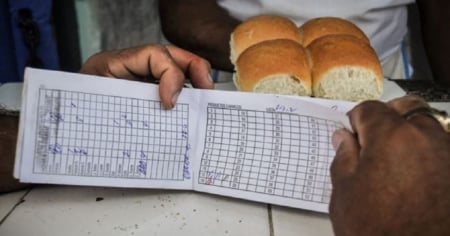
In Santiago de Cuba, there is no flour to ensure the regulated bread from the basic basket. Neither wheat nor effective solutions.
Production is facing significant setbacks due to the lack of imported raw materials and the inability to grind locally.
Instead of solutions, the authorities improvised a rotating distribution system: each time a truck with flour arrives from Havana, it is decided which municipality will receive it, while the others wait, with no certainty of when they will be able to bake again.
"The flour is coming from the capital of the country, with an uncertain frequency. It might come today, it might come tomorrow," acknowledged an executive from the food sector interviewed by the local media TurquinoTeVe.
The official explained that due to the country's situation with the arrival of the wheat vessels, the mills in the province are inactive.
So far this month, only four truckloads of flour have arrived, a ridiculous figure considering the daily needs of the province: 51.8 tons, of which 23 are consumed in just the main municipality.
But even when a truck arrives, there is no complete guarantee for the most populated area. "The policy we implement is that every time flour arrives, it is rotated... as it comes in, we rotate the flour," the executive explained.
Thus, each municipality receives bread only when it comes up in this logistical lottery: "That is the system we are implementing in the province so that everyone can have a piece of bread."
That is the official justification, but the reality is that more and more people are left without it.
The collapse in bread production in Santiago reveals a truth that the government cannot hide: there is no longer the capacity to guarantee the most basic food to the population, not even through rationing with the ration book.
This scenario of precariousness extends to other provinces.
In Guantánamo, for example, authorities have decided to restrict the distribution of regulated bread exclusively to children aged 0 to 13 and prioritized institutions such as hospitals and schools. They announced it would be "temporary," although there are no real guarantees of a swift return to normalcy.
The measure was met with a wave of criticism and outrage on social media. Cubans across the country are questioning what will happen to teenagers, the elderly, pregnant women, and workers, and how long the government will continue blaming external factors without taking responsibility for the evident collapse of the food supply system.
Meanwhile, in provinces like Matanzas, it is suggested to sell croquettes as a substitute for bread.
In a country where the rationed bread has been a symbol of survival and social control for decades, its disappearance is also a symbol of failure.
The failure of an economy that can no longer sustain even the most basic needs. And the failure of a political model that, despite its rhetoric of equity and resistance, fails to ensure that every Cuban has a piece of bread at the end of the day.
Frequently Asked Questions about the Bread Shortage in Cuba
Why is there a shortage of bread in Santiago de Cuba?
The shortage of bread in Santiago de Cuba is due to the lack of wheat flour, which is imported and whose distribution is irregular. Local mills are inactive, and the flour that arrives from Havana is distributed on a rotating basis among the municipalities, causing uncertainty in the production and distribution of regulated bread.
What alternatives have the Cuban authorities proposed in response to the lack of bread?
Authorities have resorted to makeshift solutions, such as selling stews and tea instead of bread. In some provinces, croquettes have been suggested as a substitute for bread, and in Guantánamo, regulated bread is distributed only to children and certain institutions. These measures have been met with skepticism and criticism from the public.
How has the shortage of bread affected the Cuban population?
The scarcity of bread has generated discontent and frustration among Cubans. The population is facing long lines and high prices for bread, which is a staple food in their diet. The most affected are children, the elderly, and low-income families, who depend on regulated bread for their daily sustenance.
What is the current situation of the flour mills in Cuba?
Currently, only the mill in Cienfuegos is operating in Cuba, but its production is not enough to meet national demand. The shortage of wheat flour severely impacts bread production, leaving many provinces without this staple food.
Filed under: