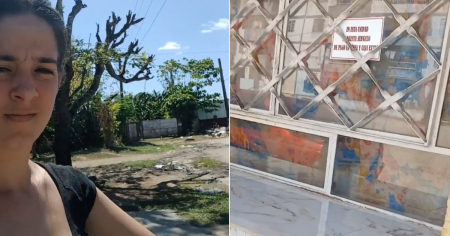
Official Cuban media has once again rediscovered the cold water in the daily economic chaos: this time, journalist Ana Maura Carbó highlighted it in an article titled “We're Talking About Prices... What About Bread?”, published in Tribuna de La Habana.
In the text, Carbó denounced the anarchy of prices for agricultural products and baked goods in areas such as Alamar, in Eastern Havana.
While it notes a slight downward trend in some products such as tomatoes, onions, and cabbage, what really raises alarms—and popular frustration—is the volatile behavior of bread prices, a staple food on Cuban tables and at risk of becoming scarce in some households.
During her tour of the Alamar neighborhood, Carbó highlights how prices change arbitrarily in a matter of days: “There’s one price for bread when you wake up and a week later it’s another; but not a lower price, rather it’s buoyant,” the journalist remarks ironically.
According to the account, street vendors, many of whom offer bread made in state bakeries and lack proper hygiene conditions, sell tiny pieces with no clear weight or quality control at increasingly higher prices, often justifying it with the usual excuse: the price of flour and supplies has gone up.
The note also criticizes the lack of visible boards displaying prices, as required by regulations, and points out the absence of effective control despite official regulations governing items such as chicken, oil, and milk.
"Everyone points out the cost that suits them," notes Carbó, referring to the complete lack of oversight from the authorities.
With a sharp and sarcastic tone, the author compares the situation to Odysseus's cleverness in front of the Cyclops Polyphemus, denouncing the invisibility of those responsible.
"Nobody has dared to review and impose a limit," he says, pointing to the lack of action from the state apparatus in response to speculation.
In a country where inflation overwhelms the average citizen's budget, the fluctuating price of bread—coupled with its reduced weight and lower quality—is just another example of a system in disarray, where even the most essential foods are not spared from chaos and improvisation.
Since September 2024, the production and distribution of bread in Cuba has experienced systematic deterioration, reflecting the collapse of state management over an essential food item.
In September of last year, the Cuban regime announced the reduction of the size of the basic basket bread, decreasing from 80 to 60 grams, with a price reduction from one peso to 75 cents.
The measure was justified by the shortage of wheat flour and the need to "ensure supply," although officials acknowledged potential delays due to logistical and energy challenges.
Days later, images surfaced on social media highlighting the ridiculous size of the regulated bread, which was even less than 50 grams. The distribution, in provinces like Matanzas, had to be carried out using wheelbarrows and electric carts from ETECSA, which showcased the collapse of the state transport system for basic products.
Despite the inspections ordered by the Ministry of Food Industry, criticism persisted regarding the poor quality and insufficient weight of the bread.
In the following months, the situation only worsened. Last March, the production chief of the Cuban Bread Company in Matanzas publicly admitted that there was only bread for one day, and that they were relying on urgent shipments of flour from Havana.
This was compounded by frequent fuel shortages, violations regarding the weight of the pieces, and a growing dependence on the informal market, where bread prices skyrocketed.
Extreme cases marked April. At the beginning of the month, it was reported from Holguín that consumers received bread with the smell and taste of cockroach, without offering a credible technical explanation.
This Monday, a social media user reported that they went out in the early morning to look for bread in stores and returned empty-handed, faced with a system incapable of ensuring even one unit per person each day.
Frequently Asked Questions about Price Anarchy and the Bread Crisis in Cuba
Why is there anarchy in bread prices in Havana?
The anarchy in bread prices in Havana is due to the lack of control and oversight by the authorities, which allows sellers to set arbitrary prices. This situation is exacerbated by the shortage of flour and the lack of suitable hygienic conditions in its production, leading to speculation and price variability.
How does the shortage of flour affect the price of bread in Cuba?
The shortage of flour has driven up the price of bread in Cuba, reaching up to 50 pesos per unit in some regions such as Santiago de Cuba. This results in increased costs for the product, particularly impacting the most vulnerable sectors of the population that rely on this staple food.
What measures is the Cuban government taking to control bread prices?
The measures taken by the Cuban government to control the price of bread have been ineffective. Although there are official regulations to regulate prices, they are not enforced, and the government has not implemented effective actions to supervise and stabilize the market, allowing speculation to continue.
Why is the quality of bread in Cuba so low?
The quality of bread in Cuba is low due to the lack of control over weight, poor quality of ingredients, and scarcity of flour. Additionally, bakeries face logistical and supply issues, which negatively impact the production and quality of bread distributed through the ration book.
Filed under: