
Related videos:
On Saturday morning, a new accident involving a ferrobús in Las Tunas raised concerns again in communities across eastern Cuba.
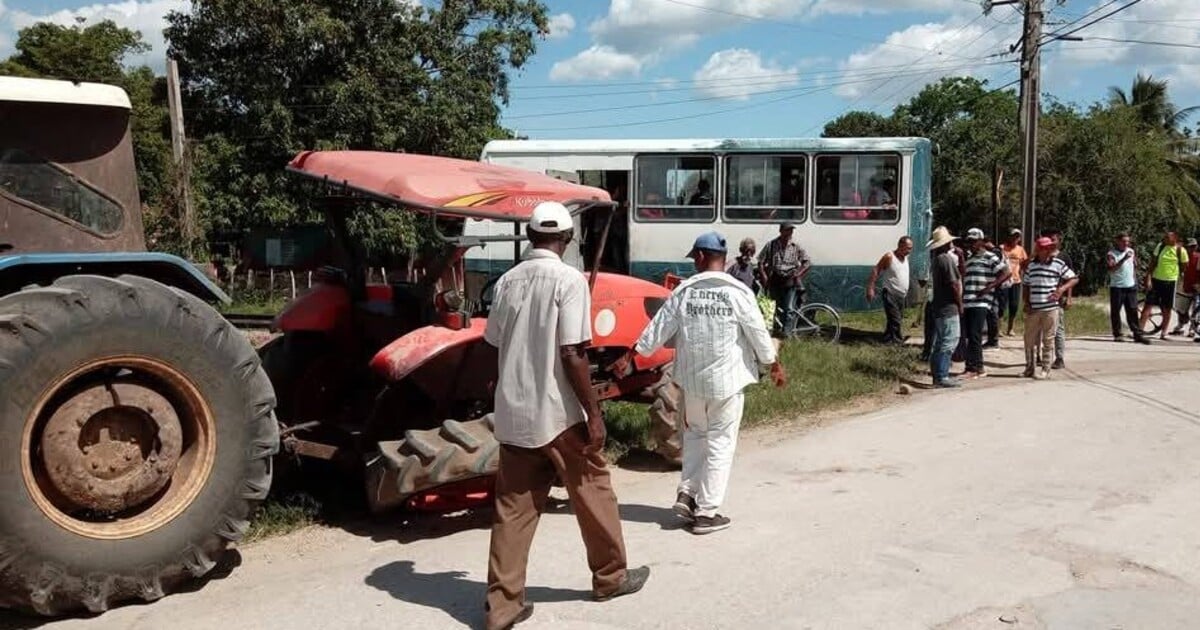
This time it happened in the Amancio municipality, at the level crossing of the Guita bridge, where the train-bus number 124, which was covering the route to the Las Pulgas community, collided with a tractor from the Grains Company.
Although no injuries were reported, the incident caused a temporary disruption of rail traffic and the mobilization of municipal authorities, who arrived at the scene to assess the damage and coordinate actions to restore service.
The incident was shared in the Facebook group "Revolico Amancio" by a user identified as Pollo x Pescado, and has sparked comments due to being another accident involving a ferrobús - vehicles improvised from old buses adapted to railway tracks - which are the only means of transportation available in many rural areas of the country.
Although the causes of the collision have not been disclosed, comments suggest that the priority clearly lies with the ferrobús.
"Thank God nothing happened, but it did impact railway traffic. Can you imagine, with the number of trains and sugarcane machines that pass through there," said a resident in the area.
"Without meaning to offend anyone, that operator doesn't know what to do when faced with a stop sign or before a level crossing," said an internet user.
"That is a place that has quite a view from any distance, and rarely do two transports of that kind pass by. The carahata has priority because of the type of transport it is," another one pointed out.
"The railway is for trains, while tractors are moving at full speed. The drivers are going at full speed and are not paying attention to the traffic signals," stated a third party.
"We had a terrible scare, but thank God nothing serious happened," recalled a user.
A repeated pattern
This type of accident is not isolated.
In February, a rail bus derailed in the municipality of Palma Soriano, Santiago de Cuba, resulting in nine injuries, some with fractures, although none were severe.
The vehicle ended up overturned, and the injured were transported to the nearest clinic in trucks.
"It is sad that no one takes into account the terrible conditions of those cars, which are incredibly old, and the roads they travel on, not to mention," a local resident reported.
Years ago, other similar incidents were reported: in 2022, in Holguín, a derailment was attributed to the poor condition of the tracks; and in 2023, also in Palma Soriano, a ferrobús collided with a trailer whose driver did not obey a stop signal.
A makeshift "solution" in response to the crisis
The ferrobuses -also known as 'caratas'- have been introduced by the Cuban government as an emergency solution to the collapse of the national transportation system.
They are the result of technical modifications to discarded buses, to which metal wheels and buffers are installed to run on rails.
In some provinces, the government ordered the addition of trailers to transport goods, including basic food items and agricultural products to remote communities.
This alternative, far from being celebrated, has been denounced by residents as a symbol of the structural deterioration of public transport and the precariousness with which thousands of Cubans in rural areas survive.
"Sadly, these things that affect us so much have to happen to see if anyone cares about the situation," expressed a resident of Palma Soriano on social media.
Meanwhile, accidents like that of the number 124 ferrobús in Amancio not only reflect a pattern of constant risks but also expose the neglect faced by many communities in the country, where mobility relies on recycled vehicles, crumbling roads, and alarming institutional indifference.
Frequently Asked Questions about the Rural Transport Crisis in Cuba and Ferrobús Accidents
What happened in the ferrobús accident in Las Tunas?
The train number 124 collided with a tractor in the municipality of Amancio, Las Tunas, temporarily interrupting rail traffic. Fortunately, no injuries were reported, but the incident highlighted the precarious nature of rural transportation in Cuba.
Why are ferrobuses so important in Cuba?
In many rural areas of Cuba, the ferrobuses are the only available means of transportation. These vehicles, improvised from old buses adapted to the railway tracks, have become an emergency solution in response to the collapse of the national transportation system.
What are the causes of bus accidents in Cuba?
Train accidents in Cuba are frequent due to the poor condition of the railway tracks and the age of the vehicles. Additionally, the lack of proper maintenance and disregard for traffic signals contribute to this issue.
What does the ferrobús accident in Las Tunas reflect about transportation in Cuba?
The ferrobús accident in Las Tunas reflects the structural deterioration of public transport in Cuba and the precariousness with which thousands of Cubans in rural areas survive. This situation highlights institutional neglect and the urgent need to improve transportation conditions in the country.
Filed under: