
Related videos:
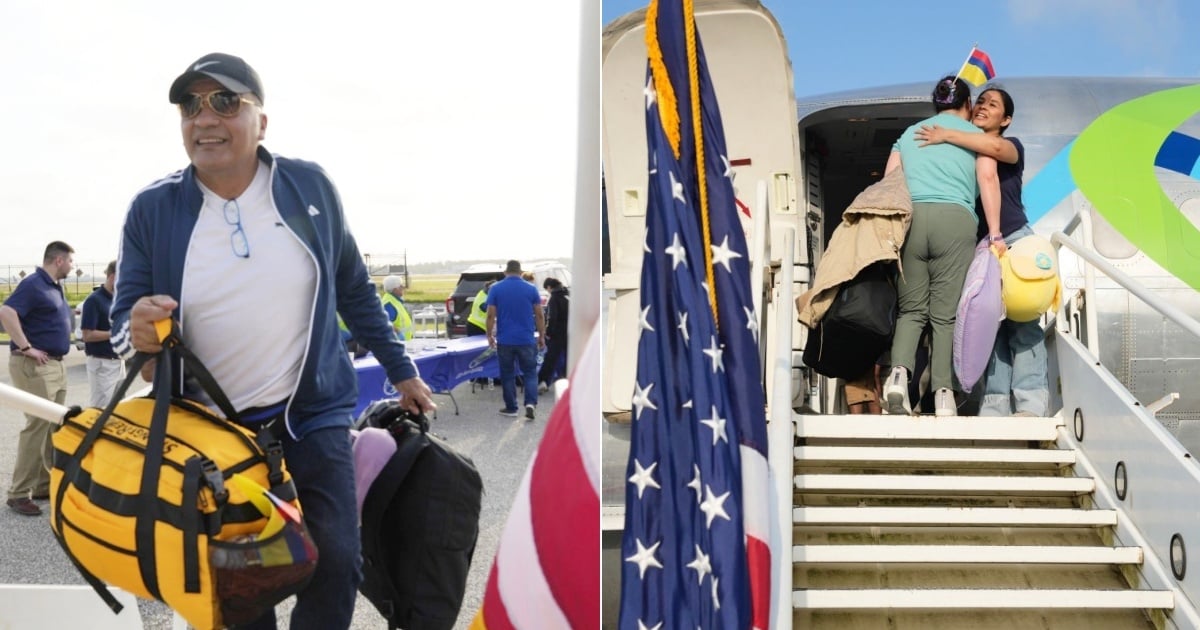
In a move that marks a new chapter in the immigration policy of the United States, the government of President Donald Trump has carried out the first self-deportation flight as part of the controversial program CBP Home.
According to the announcement made by the Secretary of Homeland Security, Kristi Noem, a group of 64 migrants -38 Hondurans and 26 Colombians- voluntarily returned to their countries of origin this Monday on a flight that departed from the city of Houston, Texas.
This flight marks the beginning of a new strategy driven by the White House to expedite the departure of undocumented migrants currently in U.S. territory, offering financial incentives and promises of a potential legal pathway for returning in the future.
A "voluntary" return under pressure
"The Department of Homeland Security (DHS) conducted its first charter flight today with 64 individuals who voluntarily chose to self-deport to their countries of origin", stated Noem, who shared images of the flight on her official account on X.
Although the program is presented as an opportunity for a dignified and voluntary return, Noem's statements convey a coercive tone.
In the same statement, it warned that those who do not join this program will be subject to severe consequences “fines, arrest, deportation, and will never be able to return.”
"Deport yourself now and preserve your opportunity to potentially return in a legal and correct manner," Noema concluded in a clear message to those who still remain in the country without documentation.
Economic incentives and institutional support
The immigrants who participated in this first flight not only had the logistical support of the DHS, but also received financial incentives.
According to the U.S. government, each person received a stipend of $1,000, in addition to assistance during the trip.
All of them "preserved" the possibility of returning legally to the United States at some point, although the exact legal mechanisms for doing so were not specified, nor whether they would avoid the established legal sanctions.
On the other hand, the governments of Honduras and Colombia also participated in the reintegration process.
The 38 Honduran beneficiaries were welcomed by the "Brother, Sister, Come Home" program, an initiative of the government of Tegucigalpa, which includes an additional bonus of 100 dollars for those over 18, food vouchers, and assistance in finding employment.
In the Colombian case, the 26 returnees were received by the Colombian Institute of Family Welfare (ICBF) and the Department for Social Prosperity (DPS), which provided social services for reception and support.
A warning to the undocumented community
The Trump administration has made it clear that this is just the beginning of a broader offensive against undocumented immigrants.
The message is twofold: Those who cooperate will receive assistance and the hope of a legal return; those who do not will face the full weight of the immigration system.
This approach seeks to redraft the immigration strategy based on the premise of self-deportation, a tactic that, while used in the past in other forms, is now presented as a visible pillar of Trump’s policy.
The implementation of this program coincides with the Supreme Court overturning a court order that blocked the cancellation of Temporary Protected Status (TPS) for Venezuelan citizens, a decision that has left approximately 350,000 migrants in a vulnerable situation.
Since the Trump administration, it has been argued that maintaining TPS for Venezuela is “against the national interest” of the United States, and that decisions of this nature should not be in the hands of the judiciary. The lack of a definitive resolution has plunged thousands of migrants into an uncertain situation.
Currently, migrants from 16 countries benefit from Temporary Protected Status, including nearly 200,000 Salvadorans. The uncertainty created by recent judicial and political decisions poses a direct threat to their stay in the country.
Meanwhile, the Supreme Court is reviewing an appeal related to the cancellation of the CHNV program, which allowed the entry of approximately 500,000 migrants from Cuba, Haiti, Nicaragua, and Venezuela for humanitarian reasons.
An increasingly restrictive immigration policy
The first self-deportation flight under Trump's presidency and the progress toward the termination of TPS signify an intensification of the hardline immigration policy that has characterized his administration.
With incentives on one hand and threats on the other, the U.S. government is redefining the boundary between "voluntariness" and coercion.
Although the aforementioned initiative provides temporary resources to those who decide to leave, the lack of legal clarity and punitive rhetoric raises doubts about its true humanitarian nature.
For hundreds of thousands of migrants, the future in the United States hangs by an increasingly fragile thread.
Filed under: