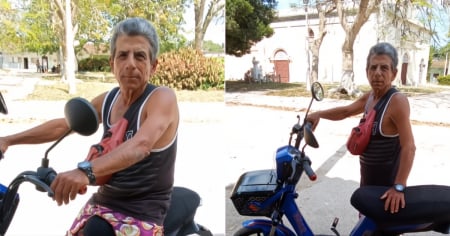
A Cuban father residing in the United States has publicly reported that he has been unable to see his son for over a year, following a family dispute that, he claims, led to a restraining order and the blocking of all forms of communication with the child.
The case was brought to light through an interview with the Cuban TikToker Dairon Cano and has sparked extensive debate among internet users.
His testimony
The man recounted that in 2014 he brought his partner and his son from Cuba. Shortly after, the relationship ended, and although the child's mother formed a new family, he insists that he has maintained frequent contact with his son, whom he saw regularly.
According to his account, the last time he spent time with the boy was in May 2023, during a visit to a hotel. “I bought him baseball gear, we played… it was a great day,” he recalled.
Months later, he tried to visit him at his home, where the younger one expressed affection, but since then, he claims he has been blocked by the mother and her current partner.
The father reported that a phone argument with his ex-partner's husband may have triggered a restraining order.
“Those people don't want me to be close to my son. But I love him, I provide for him, I pay 518 dollars a month in child support. I don't understand why they won't let me see him,” she stated.
He also stated that his family was blocked from the minor's social media and that they have not heard from him in over three years.
Divided opinions on social media
The testimony generated various reactions among users of TikTok and other platforms, expressing both empathy and skepticism. Some individuals questioned the gaps in the story and reminded that the judicial system in the U.S. typically requires solid evidence to issue legal measures such as a restraining order.
“This story is poorly told. No one here is given a restraining order without evidence or reasons. If he pays child support, he has the right to see the child,” pointed out a user.
Others advised the father to go back to court and assert his rights through legal channels. “You have to go to court, reopen the case, and summarize the story. It’s the only way to make the law work”, wrote another.
A user went further, emphasizing the need to consider both sides before taking a stance. "Life has taught me that you have to listen to both sides. This story is missing much more than half."
Another person claimed that “with the evidence of the money they take from you for the child and the health insurance, you go to court. You don’t have to go to your child’s house, it’s all handled in court”.
There were also calls for respect for the rights of minors to have contact with both parents. "If the father wants to resume his relationship with his child, we mothers cannot deprive a child of that right. That belongs to them, not to us."
The legal framework in the U.S.
Family laws in the United States generally prioritize the best interest of the child. The right to visitation or shared custody does not depend on the payment of child support, but it also cannot be arbitrarily denied by one parent without a court order.
Restraining orders require concrete evidence of violence or harassment and can be contested in court. Furthermore, any parent can request a modification of a visitation schedule or reopen a custody case if they believe that circumstances have changed.
These legal tools are available even to immigrants, regardless of their immigration status, and can help resolve complex situations like the one reported by this Cuban father.
Frequently asked questions about the family dispute of a Cuban parent in the U.S.
Why can't the Cuban father see his son?
The Cuban father cannot see his son due to a restraining order following an argument with his ex-partner's husband. This situation has blocked all communication with the minor, according to his testimony.
What arguments are being presented on social media regarding this family dispute case?
Opinions on social media are divided. Some users express empathy towards the father, while others remain skeptical and point out that restraining orders in the U.S. require solid evidence. The father is advised to go to court to assert his rights.
What are a parent's legal rights in the U.S. regarding custody and visitation?
In the U.S., family laws prioritize the best interest of the child. The right to visitation or joint custody is not contingent on the payment of child support, and restraining orders require concrete evidence of violence or harassment. Parents can request modifications to visitation arrangements if circumstances change.
How can the Cuban father try to legally resolve this situation?
The Cuban father can attempt to resolve the situation by going to court to reopen the custody case and present his account of the events. It is essential that he seeks legal advice to ensure that his rights and those of his child are respected.
Filed under: