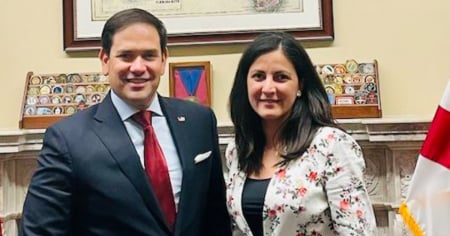
The Cuban-American congresswoman María Elvira Salazar reiterated this Friday her request to the administration of Donald Trump not to deport over 530,000 migrants from Cuba, Haiti, Nicaragua, and Venezuela who were legally admitted under the humanitarian parole program, which has been invalidated by the Supreme Court.
In a letter addressed to the president, Salazar urged the use of the Deferred Enforced Departure (DED) executive tool, which would provide temporary relief from deportation to beneficiaries while asylum processes, background checks, and pending immigration applications are completed.
"These migrants entered the United States legally, trusting in the empty promises of the Biden administration. We cannot ignore the human cost," wrote the representative from Florida on X.
"I urge the administration to exercise its executive authority and grant the DED to prevent them from being sent back to violence and repression," he emphasized.
The DED is a migration mechanism that does not confer permanent legal status but temporarily protects citizens from designated countries against deportation. It also allows for work permit applications during the period of validity.
Salazar, who had previously made the same request to President Donald Trump, argued that granting this benefit would allow for "proper case-by-case verification," protecting both national security and the moral commitment of the U.S. to those fleeing oppression and violence.
"We must protect the promises made to these people with compassion and responsibility," he stated.
"Cuba, Nicaragua, and Venezuela are living under communist dictatorships; Haiti is collapsing due to gang violence. These cases deserve special attention," he added.
Salazar's request comes after the decision of the Supreme Court that authorized the Trump administration to revoke humanitarian parole without individual assessments, reversing a key measure of the Joe Biden administration.
Created in 2022, the CHNV program allowed the legal entry of citizens from those four countries with sponsors ensuring their economic support. Since then, more than half a million people have accessed this benefit, many of whom have already begun residency processes, particularly Cubans under the Cuban Adjustment Act.
However, the cancellation of the program leaves tens of thousands in a migratory limbo who still do not qualify for other protections.
Salazar's statement marks a distinct position within his party, which has largely celebrated the judicial decision as a "victory for national security."
The Department of Homeland Security (DHS) itself, under the Trump administration, labeled parole beneficiaries as "illegal," despite the fact that they entered the country with official authorization.
The letter also comes in the wake of growing criticism within the Cuban-American community in Miami, where Salazar was featured on a billboard labeling South Florida politicians as "traitors" for failing to defend migrants against the radical shift in immigration policies.
Frequently asked questions about María Elvira Salazar's request to prevent deportations
What is the DED and how could it benefit migrants?
The DED is a migration mechanism that offers temporary protection against deportation to citizens of countries designated by the President of the United States. Although it does not grant permanent legal status, it allows beneficiaries to apply for work permits during its validity. María Elvira Salazar has asked President Trump to use this tool to protect migrants from Cuba, Haiti, Nicaragua, and Venezuela who were legally admitted under humanitarian parole.
What is María Elvira Salazar's stance on migrants under humanitarian parole?
Congresswoman Salazar has repeatedly expressed her support for migrants who entered the United States legally under humanitarian parole. She has requested that they be granted temporary protection while their asylum and background check processes are completed. Salazar believes that it is a moral obligation of the U.S. to protect those fleeing violence and oppression in their home countries.
What is the current situation of the beneficiaries of humanitarian parole following the Supreme Court's decision?
The recent decision by the Supreme Court has revoked the humanitarian parole program, leaving more than 530,000 migrants in a migration limbo. These migrants now face the risk of deportation, despite having entered the country legally. The cancellation of the program means that many of them must seek other forms of immigration protection to avoid being deported.
What criticisms has María Elvira Salazar received for her stance on immigration?
María Elvira Salazar has been criticized both for supporting Trump's immigration policies and for blaming the Biden administration for the current immigration limbo. Some sectors accuse her of not doing enough to protect migrants, while others point out that her party has promoted restrictive policies that affect these groups. However, Salazar continues to advocate for the need to grant temporary protections to migrants under humanitarian parole.
Filed under: