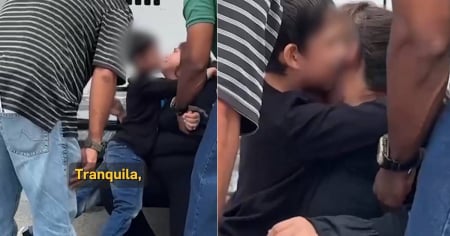
Last Friday, the United States government deported to Honduras the wife of an Army sergeant, coinciding with her birthday.
Shirly Guardado, 27 years old, spent 11 weeks in detention at the Montgomery Processing Center in Texas.
At that time, she missed her little son's first birthday and her wedding anniversary with her husband, Sergeant Ayssac Correa, an active member of the United States Army.
Arrest without a warrant and deportation without a hearing
The couple's misfortune began on March 13, when the young mother was arrested at her workplace by ICE agents pretending to be traffic officers.
They told her she had to accompany them as she was supposedly involved in an accident. They never presented an arrest warrant.
"Everything was a lie to get her out of the building. And that’s when they arrested her," her husband reported to Telemundo 51.
Guardado entered the United States from Honduras when he was just 16 years old. In 2022, he married Correa, with whom he had his son, a U.S. citizen.
He was in the process of regularizing his status through the Military Parole Permit (PIP), a special program that protects immediate family members of military members from deportation.
"We were in the final step," the officer specified. "A month prior, he had his appointment and everything was going well."
However, the process was abruptly interrupted when she was placed under expedited deportation proceedings, without a hearing before a judge or the right to appeal.
"They are separating us as a family."
In a video call from the detention center, Guardado expressed that his detention has been extremely painful. "They are separating us as a family."
The young woman arrived in Honduras handcuffed on a repatriation flight alongside 140 other Hondurans. At the airport, a brother was waiting for her with a bouquet of flowers for her birthday. But she has nothing to celebrate.
Correa, 25, is now alone with her one-year-old baby in the United States, dealing with frustration, anger, and helplessness.
"It was an honor for me to serve. I began in 2018, I was deployed to Syria. But now I feel completely betrayed. I feel that the country to which I have given so much has stabbed me in the back," he emphasized.
The soldier reported that ICE has detained other spouses of soldiers, even inside military bases.
"Supposedly, we sacrifice ourselves for the country, and they come to our homes to tear our families apart," he said on the program 100 Days of Trump, from Noticias Telemundo.
Martin Reza, Shirly's attorney, emphasized that his client has no criminal record and has been checking in with ICE periodically for over ten years. "She has a citizen son, a citizen husband, and is a military spouse. None of that mattered," he lamented.
An uncertain future
Correa now faces a heart-wrenching decision: stay in the U.S. or abandon his military career to reunite with his wife.
"When I obtain the necessary permits, I will sell everything and go there with my son," she stated.
Meanwhile, his wife is trying to adapt to a country she left as a teenager, without resources, separated from the two loves of her life.
"I am not afraid to say what happened. With all this, they have just lost someone who was willing to give their life for their country. I do not want to continue serving a country that does not care for its people or its soldiers," he concluded.
The case of this couple highlights, once again, the disconnect between immigration policy and the principles that the United States claims to uphold.
In the name of supposed security, families are being torn apart, even those that have vowed to protect the nation.
Frequently Asked Questions about Deportations and Immigration Policies in the U.S.
Why was Shirly Guardado, the wife of a U.S. Army sergeant, deported?
Shirly Guardado was deported despite being in the process of regularizing her immigration status through the Military Parole Permit (PIP). Her detention and subsequent deportation occurred without a judicial hearing or right to appeal, and were preceded by a deception at her workplace by ICE agents.
How does Shirly Guardado's deportation affect her family?
The deportation of Shirly Guardado has left her husband, Sergeant Ayssac Correa, alone in the United States with their one-year-old son, facing the tough decision of continuing his military career or reuniting with his wife in Honduras. This separation has caused significant frustration and disappointment for Correa, who feels that the country he has served has not protected his family.
What is the Military Parole Permit (PIP) and why did it not protect Shirly Guardado?
The Military Parole Permit (PIP) is designed to protect immediate family members of U.S. military personnel from deportation. In the case of Shirly Guardado, despite being in the final step of the regularization process under this program, her deportation was abruptly executed without following the proper procedure, exposing a disconnect between immigration policy and its implementation.
What is the impact of current immigration policies on military families in the U.S.?
The current immigration policies in the U.S. are leading to the separation of families, including those with members on active military duty. Cases like that of Shirly Guardado and others like it demonstrate how these policies are impacting military families, creating insecurity and frustration, and challenging the principles of protection that the country claims to uphold for its soldiers and their loved ones.
Filed under: