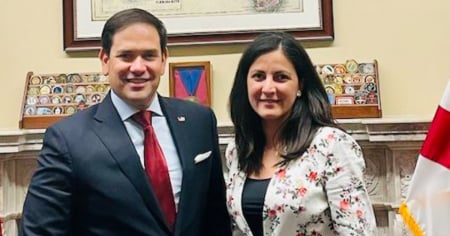
The congressman Mario Díaz-Balart announced this Friday that they are currently seeking a way to find a solution for Cubans, Haitians, Nicaraguans, and Venezuelans exiled for political reasons, who had their humanitarian parole revoked.
Following the decision of the United States Supreme Court that authorizes the immediate revocation of humanitarian parole for over 530,000 migrants from Cuba, Venezuela, Nicaragua, and Haiti, which could lead to a wave of mass deportations, Díaz-Balart promised to advocate for these individuals, according to a statement published on X, as reported.
"Carlos Giménez, María Elvira Salazar, and I are working with the Trump Administration to present the case and find a permanent solution for Cubans, Haitians, Nicaraguans, and Venezuelans who have fled political crises and cannot return to their home countries due to legitimate claims of persecution," he wrote.
In his statement, he expressed feeling "proud" to represent "some of the largest groups of Cubans, Haitians, Nicaraguans, and Venezuelans": "We will continue advocating for them."
In their opinion, the situation of these migrants is the result of Joe Biden intentionally opening the border to millions of people, in a wave that included countless bad actors who took advantage of his open border policies.
With this statement, Cuban-American Congresswoman María Elvira Salazar joined the calls urging Donald Trump to utilize the executive tool of Deferred Enforced Departure (DED), which would provide a temporary relief from deportation for beneficiaries while asylum processes, background checks, and pending immigration applications are completed.
"We support President Trump in upholding the rule of law at the southern border, which was nonexistent over the past four years," affirmed Díaz-Balart, while calling for the protection of political asylum seekers.
Previously, María Elvira Salazar had argued that granting the DED benefit would allow “adequate case-by-case verification,” protecting both national security and the moral commitment of the U.S. to those fleeing oppression and violence.
His statement marks a distinct position within his party, which has largely celebrated the court ruling as a "victory for national security."
Migrants who entered through a humanitarian parole now face the risk of deportation, despite having legally entered the country.
The cancellation of the program means that many of them must seek other forms of immigration protection to avoid deportation.
The CHNV program provided a legal and regulated way to enter, with residence and work permits for two years. Although the beneficiaries were admitted under the legal status of "parole," the official Republican narrative now labels them as "illegal," even as many have begun the regularization process, similar to Cubans protected by the Cuban Adjustment Act.
Frequently Asked Questions about the Revocation of Humanitarian Parole and the Situation of Migrants in the U.S.
What does the revocation of humanitarian parole mean for migrants from Cuba, Venezuela, Nicaragua, and Haiti?
The revocation of humanitarian parole means that over 530,000 migrants from these countries may face mass deportations. This is due to a Supreme Court decision that allows the Trump administration to revoke this status, leaving many in legal limbo and without adequate immigration protection.
What is the Deferred Forced Departure (DED) tool and how can it help affected migrants?
The Deferred Forced Departure (DED) is a mechanism that provides temporary deportation relief to certain migrants designated by the President of the United States. It allows beneficiaries to remain in the country while asylum processes and background checks are completed, although it does not confer permanent legal status. María Elvira Salazar has urged the Trump administration to use this tool to protect migrants affected by the revocation of parole.
What is the position of Cuban-American congress members on the revocation of humanitarian parole?
Cuban-American congress members such as Mario Díaz-Balart and María Elvira Salazar have expressed their concern over the revocation of humanitarian parole. They have worked with the Trump administration to seek permanent solutions that would protect migrants fleeing political crises in their home countries. However, their position has become divided within the party, which has largely hailed the judicial decision as a victory for national security.
What alternatives do Cuban migrants affected by the revocation of humanitarian parole have?
Cuban migrants can apply for the Cuban Adjustment Act if they have been in the U.S. for more than one year and one day. This would allow them to obtain permanent residency. For those who do not meet this requirement or have not begun their application process, it is advisable to seek legal counsel to explore alternatives and avoid deportation.
Filed under: