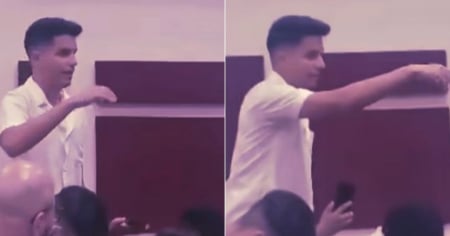
A medical student in Cuba was the protagonist of an intervention this Thursday that has gone viral on social media due to its forcefulness and clarity in refuting the arguments of the Telecommunications Company (ETECSA) and the regime itself, amid a crisis caused by the rise in internet tariffs.
The intervention took place during one of the meetings between representatives of the Federación Estudiantil Universitaria (FEU) and the rectors of Cuban universities, called to "explain" the new ETECSA rates and to try to contain the growing discontent among the youth.
The young man, whose identity and affiliation are unknown, responded firmly to the officials, using precisely the same official rhetoric that the regime has attempted to use to justify unpopular measures. His intervention, filled with critical irony and realism, highlighted the generational frustration with the system.
"They are restricting our internet as a company, as a monopoly, because this is the only company we have in Cuba. I would like them to explain to me again how I can have balance if I can’t recharge from abroad. Because I could have 10,000 pesos of balance and recharge all the 360 peso packages I want, but... how do I get that balance?" he asked.
"How can I have a balance if international top-ups are not available? It's a lie that Pepe or Armando will transfer money to me via Transfermóvil because they also need to have a balance to do that. So... If I can't have a balance without being topped up from abroad, this measure is not socialist, comrades", he said confidently.
The student reminded ETECSA and the Cuban government that their responsibility as a state enterprise is to respond to the interests of the citizens and generate accessible services for the people living in Cuba.
ETECSA is a socialist-owned company, it belongs to the Cuban people, and this (the students gathered there demanding change), this is the Cuban people," the young man pointed out.
The government ignores the students and insists on the rate hike
The academic strike in Cuba began on June 4 and is spreading across universities throughout the country, with its epicenter at the University of Havana. The response from the ruler Miguel Díaz-Canel has been clear: There will be no reversal of the rate increase.
During his weekly podcast From the Presidency, accompanied by Tania Velázquez, general director of ETECSA, Díaz-Canel stated that suspending the measures would amount to “giving up revenue to maintain the service.”
The communist leader stated that the telecommunications system is facing a situation that is “complex from a technological standpoint” and that, if unpopular decisions are not made now, “the country would be very close to collapse”.
Despite acknowledging that the connection is becoming increasingly slow and costly, he reiterated that the sacrifice is necessary to "move forward" and warned that a blackout in communications could soon occur. "When a technological collapse happens, we will also be held accountable then," he said.
The alleged collapse that the regime wants to use to intimidate the people would imply, according to the president of ETECSA, that “we would not be able to make phone calls, that we would not be able to send messages, that we would not be able to reach our schools or workplaces.”
Díaz-Canel explained that his government now needs to take a step back in order to move forward more effectively. “We were making progress, but we have to pause, take a step back to gather what we are missing” and to improve conditions for the future.
The students remain steadfast in their fight
The student movement shaking Cuban universities not only demands fairer fees and equitable connectivity but also the resignation of the national president of the FEU, Ricardo Rodríguez González, whom they accuse of representing government interests rather than those of the students.
In response to the growing public backlash, the regime's reaction has been the same as always: to deny the existence of the academic strike and to accuse the students of being manipulated by a supposed "media war" orchestrated from abroad.
The words of the young medical student resonate like a crack in the official wall: “Because ETECSA is a company of the socialist state" and is acting against the people. His sentiment encapsulates that of more than a generation of Cubans tired of paying for the mistakes of a system that, increasingly, shuts the doors to their future.
Filed under: