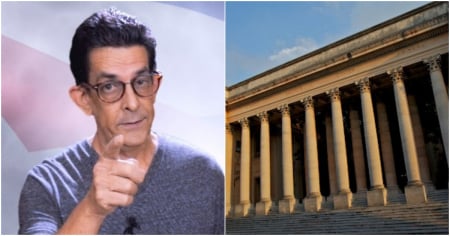
The Cuban comedian Ulises Toirac announced on his social media that State Security summoned him for an interview.
Ulises released a short video on Facebook while he was on the street heading to the location.
"I'm heading towards a conversation, an exchange, they told me exchange. It seems they don't like what I'm saying. Let's see," he expressed.
Hundreds of friends and followers showed their support.
"Oh, oh, they called you to account for those bastards who think they own the actions and lives of others," a local from Havana told him.
"Surely Gustavito and the judge are waiting for you there to sign the sentence. We are with you; good luck, skinny," said an emigrant.
" trolls don't like intelligent and thoughtful people," pointed out another.
"How can a country prosper that aims to silence any idea, any opinion, and any vision that deviates even slightly from the official line?" questioned a parent.
The actor has been very active in recent days with critical statements regarding ETECSA's new measures.
On Wednesday, he reacted to the student strike initiated by the Faculty of Mathematics and Computer Science at the University of Havana, warning that any attempt at repression by the government would bear an "unpayable" political cost.
For Toirac, the event shapes a "very interesting" scenario, while also being a critical crossroads for power.
"Repression will come at a political cost (very high in my opinion, I would say immeasurable); allowing it is a demonstration of political weakness never seen before," he wrote on Facebook, and concluded: "There are things you can foresee if you have brains, but more than brains, there has been arrogance."
Days earlier, Toirac questioned the Cuban leadership's disconnection from the realities of the country and denounced the systematic manipulation of the official discourse.
"Uno de los peligros de vivir en una burbuja […] es to have no clue about what’s going on. Y actuar en consecuencia", escribió en una publicación que rápidamente se viralizó.
Previously, following the televised appearance of ETECSA's president, Tania Velázquez, regarding the controversial rate increase, it was noted that the leader did not provide any real updates on the company's status.
"If there is a crisis of that magnitude, which is not the fault of the consumer but rather of the company itself, then it should have started with: 'I resign,'" concluded the comedian.
Since the new prices imposed by the telecommunications monopoly of the regime were announced, Ulises rejected the measures in a post that combined irony, denunciation, and an economic analysis of the sector's collapse in Cuba.
His message began with an apparently understanding tone: "The Government can no longer subsidize products and services" such as connectivity or food. "The days of freebies are over," he emphasized.
He then presented a bitter portrait of reality: a Cuban peso that "is worth less than its shell", a population with no purchasing power, and a government unable to print more bills. All of this was summarized in two words: "Bad luck."
The new tariff scheme by ETECSA, reminiscent of the neoliberal packages so criticized by the Cuban regime, is regarded as abusive and discriminatory by the vast majority of the Cuban population, and described as "armed robbery."
The measure requires that once the meager data package allowed for browsing in a month (only 6 GB) is exhausted, the customer must rely on top-up plans at very high prices in CUP and foreign currency, far beyond the reach of most citizens who earn their salaries in a highly devalued Cuban peso amidst rampant inflation.
Following widespread public rejection, ETECSA attempted to quell criticism with newly announced measures, offering 12 GB for 720 CUP and access to free educational sites, but only for university students.
But the young people have rejected that "privilege" and demand equal treatment for all citizens.
The wave of student discontent over such decisions led students from the Faculty of Mathematics and Computer Science at the University of Havana to call for an indefinite academic strike.
Frequently Asked Questions about Ulises Toirac’s Summons by State Security and His Criticisms of the Cuban Government
Why was Ulises Toirac summoned by State Security in Cuba?
Ulises Toirac was summoned by State Security due to his criticisms of the Cuban government, particularly regarding the measures from ETECSA and other current political and social issues on the island. His statements, which blend humor and irony, have been highly critical of official policies, likely prompting the summons.
What has Ulises Toirac said about the new rates of ETECSA?
Ulises Toirac has harshly criticized the new rates of ETECSA, calling them "armed robbery" and a measure that deepens social exclusion. According to the comedian, these rates are abusive and discriminatory, primarily affecting those who do not have access to foreign currency.
How has Ulises Toirac reacted to the student strike in Cuba?
Ulises Toirac has warned that any attempt at repression by the Cuban government against the student strike would have an "incalculable" political cost. The comedian has praised the bravery of the students and pointed out that the situation represents a critical crossroads for the authorities.
What does Ulises Toirac think about the economic situation in Cuba?
Toirac criticizes the economic policy of the Cuban government, highlighting that "the Cuban peso is worth less than a shell" and that the economy is in a critical state. He denounces the lack of incentives to work and the disconnection of leadership from the reality of the country, which, according to him, perpetuates poverty and social inequality.
Filed under: