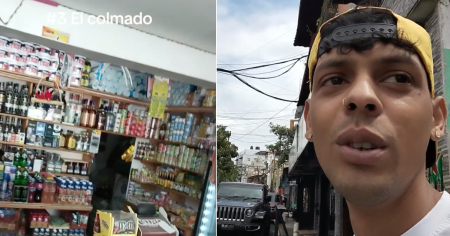
A video shared on social media has thrilled thousands of people by showing the reaction of an elderly Cuban as he experiences, for the first time, the abundance of a supermarket outside of Cuba.
The video was published by his grandson, Pedro Ortega, who documented his grandfather's visit to a market in the Dominican Republic, a place he had never visited before.
In the images, the elderly man appears completely amazed by the wide variety of products and the abundance on the shelves.
As she walks through the hallways, the woman recording asks him, "What is this? What do you call this here? Capital... what?"
The grandfather's response could not have been more emphatic: "Capitalism," he said, a single word that encompasses the workings of a completely different economic system from the one he knew in his country.
In a more emotional moment, the man expresses with nostalgia: "I want to go back to my country," reflecting a mix of joy and longing.
The brief exchange highlights the stark difference between the Cuban economic model, which is based on scarcity and central planning, and the market freedoms that exist in countries like the Dominican Republic.
"My Cuban grandfather gazes in awe at a market in the Dominican Republic. It is his first time traveling outside of Cuba, and he is witnessing what freedom looks like," Pedro Ortega reported while sharing the video on his X account.
The shock of abundance: A common experience for many Cubans
The reaction of this Cuban grandfather is not unique.
In recent years, Cuban migrants have shared their own similar experiences of taking their family members for the first time to a supermarket abroad.
In May, Liuver Figueredo, a resident of Brazil, recounted how it was to take his mother to a supermarket in São Paulo. Her excitement upon seeing the variety of products was so overwhelming that, at first, she hardly dared to put anything in the cart, but then she loosened up and, to her surprise, asked for everything.
"I told her, 'Put in the cart everything you like.' She looked at me like a little girl and I said, 'Whatever you want,'" Figueredo shared, describing the joy of seeing her mother enjoy something that many consider routine, but for her was a luxury never experienced on the Island.
In April, an 87-year-old Cuban woman went viral after visiting a supermarket in Spain for the first time. In a video posted by her grandson, the woman couldn't believe the variety of foods, especially the pizzas and ice creams.
"Are these all pizzas too? In all different sizes?" the grandmother exclaimed, visibly excited, as her grandson showed her the available sizes and flavors.
Her reaction, a blend of astonishment and emotion, touched the hearts of thousands on social media, who commented on the stark contrast between the economic realities of Cuba and those of other countries.
Moving and reflective reactions
In a similar case, in February, a Cuban named Noe expressed deep emotion after making his first purchase at a supermarket in Miami.
While pushing his cart full of products, he expressed his sorrow about the situation in Cuba, saying: "My heart breaks in two, thinking of the people in Cuba, with the misery and hunger that exist, that there is nothing."
A global phenomenon: From Cuba to the world
This phenomenon has begun to be known among Cuban migrants as the "supermarket shock."
It is a visceral and spontaneous reaction to a reality that many never imagined they would experience. After years of living under a restrictive and scarce economic system, many Cubans who emigrate cannot help but feel a mix of astonishment and gratitude at the abundance of products.
These reactions also reflect the profound impact that scarcity in Cuba has had on its citizens, who are often forced to ration or give up basic necessities.
Contact with economic freedom and the variety of products in foreign markets creates a critical awareness of the situation facing Cubans within their homeland.
"Capitalism," replied the Cuban grandfather upon seeing the opulence in the Dominican supermarket.
That simple word encapsulates a significant difference from what most Cubans have known for decades, and it resonates as a reflection on the freedoms and choices that many never dreamed they would have the opportunity to enjoy.
Frequently asked questions about the experiences of Cubans in foreign supermarkets
Why are Cubans amazed when visiting a supermarket abroad?
Cubans are amazed when visiting supermarkets abroad due to the abundance and variety of products available, which sharply contrasts with the scarcity and limited options they face in Cuba. This experience is often shared by migrants who take their relatives to explore supermarkets outside the island, generating reactions of astonishment and excitement.
What does the term "supermarket shock" mean for Cubans?
The "supermarket shock" is a phenomenon that occurs when a Cuban experiences for the first time the abundance of products in supermarkets of other countries. This reaction is due to the difference between the scarcity experienced in Cuba and the availability of goods abroad, resulting in a significant emotional impact on those who undergo it.
How does the reaction of the Cuban grandfather reflect a criticism of Cuba's economic system?
The reaction of the Cuban grandfather upon seeing the abundance in a Dominican supermarket reflects a criticism of the socialist economic system in Cuba, characterized by scarcity and centralized planning. This experience highlights the contrast with capitalism, where the variety of products is vast and accessible, symbolizing for many Cubans a form of economic freedom that they do not experience in their country.
Why do these experiences go viral on social media?
These experiences go viral on social media because they touch on deep emotional chords, showcasing both the joy and the pain of Cubans as they confront such disparate economic realities. Furthermore, they serve as implicit denunciations of the situation in Cuba, generating empathy and solidarity among those who understand the magnitude of this contrast.
Filed under: