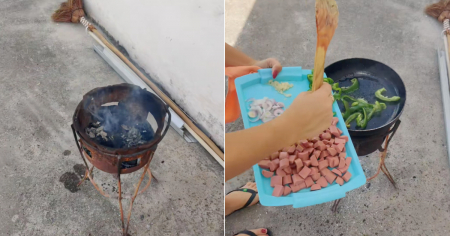
The crisis of the Cuban electrical system has ceased to be a contingency and has turned into an oppressive routine.
On Saturday, June 21, the Electric Union (UNE) reported a maximum generation deficit of 1,880 MW, one of the highest figures since systematic records began, only surpassed by the historical record of 1,901 MW on April 23.
This situation has led many Cubans to describe the country's energy reality as a "labyrinth without an exit".
The UNE reported that throughout Saturday and into the early hours of Sunday, the service was affected, attributing the deterioration to a demand higher than expected and the unexpected shutdown of unit 1 at the CTE Santa Cruz.
For this Sunday, the state-owned company estimated an availability of only 1,820 MW against a demand of 2,958 MW in the morning, with an impact of up to 1,750 MW during the evening peak hour.
The population, however, no longer perceives this information as data but rather as a humiliating routine. Comments on social media reflect a discontent that goes beyond mere anger: “I can’t take it anymore”, “It’s daily torture”, “Every day is worse than the last”, repeat hundreds of voices in the posts from CiberCuba and in the official channels of the UNE.
A user commented: “They have normalized this situation. We don’t want more justifications, we want solutions. We are living in a permanent and inhumane crisis.” Others pointed to the inequality in service distribution: “Some have electricity while others face multiple blackouts... three years without resolving anything.”
On his social media, the official journalist José Miguel Solís published a ranking of the largest blackouts, highlighting that five of the twelve worst deficits in history occurred in April and three in June 2025. This Saturday the 21st was recorded as the second worst day ever in terms of blackouts, confirming the trend towards collapse.
“We have been overwhelmed for a while”, commented users from Matanzas, Granma, Camagüey, and Guantánamo, where reports indicated power outages lasting up to 24 consecutive hours, interrupted only by brief moments of light lasting one or two hours.
Popular discontent has escalated from criticism to sarcasm and despair. "If we are to endure more, let it be more darkness", one user sarcastically remarked. Another suggested that the Council of State meet without air conditioning: "If they ask for resilience, let them endure it with us".
Meanwhile, complaints about the lack of transparency and doubts regarding the accuracy of the daily reports from the UNE are growing. "Every day one unit comes in, but two go out. It's the same circus.", wrote a user. Official promises of improvement have been systematically refuted by reality.
With the arrival of summer, conditions worsen: sweltering heat, mosquitoes, food going bad, children and the elderly unable to sleep. "It's not a life", Cubans repeat time and again, while the UNE recites technical reports that no one believes anymore. "This is no longer an edge of collapse", declared a commentator. "We are already in it".
Filed under: