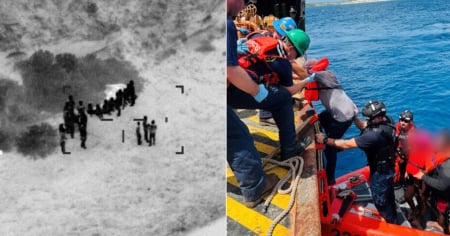
The United States Coast Guard (USCG) reported this Thursday the interception of six Cuban migrants in Bahamian waters, as part of patrol and immigration control operations in the Florida Strait and the Caribbean.
Through its official account on the social media platform X (formerly Twitter), the USCG detailed that the crew of the Cutter Robert Yered carried out the interdiction operation and subsequently transferred the migrants to Bahamian authorities for the appropriate procedures.
"The crew of the Cutter Robert Yered transferred six Cuban citizens to the Bahamian authorities on Thursday, following their interception in Bahamian waters," the agency reported under the hashtag #Breaking.
So far, no details have been provided regarding the health status of the migrants or the circumstances under which they were detected at sea.
The Coast Guard has intensified operations in the region due to attempts at illegal sea departures from Cuba, a phenomenon that has persisted in recent months despite the anti-immigrant policies of the Trump Administration, and as a consequence of the economic and social crisis facing the island.
U.S. authorities have reiterated multiple times that individuals intercepted at sea are not eligible to enter or remain in the United States and are returned to their country of origin or transferred to the authorities of the countries where they are located, as in this case to the Bahamas.
The number of Cuban rafters repatriated by U.S. Coast Guard in the past eight months indicates a significant reduction in migration flows from the island through the Florida Strait in FY 2025, compared to previous years.
According to the latest reports from the Customs and Border Protection (CBP) office, in recent months illegal migration of Cubans to the U.S. has experienced a drastic decline.
In March, only 132 unauthorized entries were recorded, and in April, the numbers remained extremely low, with 130 irregular entries, across both land borders and by sea.
The tightening of immigration policies by President Donald Trump's administration has significantly impacted the behavior of those seeking to leave Cuba amid an acute persistent economic and social crisis.
The causes of Cuban migration, such as the economic crisis—characterized by shortages of essential goods, inefficiencies in basic services, and inflation—along with repression, a lack of freedoms, and social insecurity, have not disappeared, but the routes to the United States have become increasingly inaccessible.
Frequently Asked Questions about the Interception of Cuban Raftists by the U.S. Coast Guard.
What happened to the six Cuban rafters intercepted by the U.S. Coast Guard?
The U.S. Coast Guard intercepted six Cuban migrants in Bahamian waters and subsequently transferred them to Bahamian authorities for the appropriate procedures. This action is part of the patrol and immigration control operations in the Florida Straits and the Caribbean.
Why do Cuban migrants attempt to reach the United States by sea?
Cuban migrants are trying to reach the United States due to the economic and social crisis in Cuba, characterized by the scarcity of essential goods, inflation, and a lack of freedoms. Despite the risks and stricter immigration policies in the U.S., many see sea voyages as their only option to seek a better future.
How has the immigration policy of the Trump administration affected Cuban migrants?
The Donald Trump administration has hardened immigration policies, significantly reducing illegal migration from Cuba to the U.S. in recent months. Individuals intercepted at sea are not eligible to enter or stay in the United States and are returned to their country of origin or to the country where they were located.
What happens to Cuban migrants after they are intercepted at sea?
After being intercepted at sea, the Cuban migrants are handed over to the authorities of the country they are in, such as the Bahamas in this case, for repatriation procedures. This is done in coordination with local authorities and in accordance with the policies of each country.
Filed under: