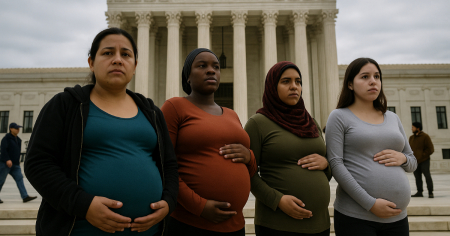
The United States Supreme Court ruled this Friday in favor of the Donald Trump administration, granting a legal victory that allows him to move forward with his proposal to eliminate automatic citizenship by birthright, a measure that could have profound implications for millions of people, especially children of immigrants born on U.S. soil.
The court's ruling, with a conservative majority, temporarily authorizes the Executive to implement measures aimed at restricting this constitutional principle, while legal disputes in lower courts continue. This is a key step in Trump's immigration strategy, which has sought since his first term to redefine the terms of who can be considered a citizen in the United States.
What is citizenship by birth?
Known in English as jus soli (right of the soil), citizenship by birth is a legal principle that grants nationality automatically to every person born within the territory of a country, regardless of the nationality or immigration status of their parents.
In the United States, this right is enshrined in the 14th Amendment of the Constitution, which states that "all persons born or naturalized in the United States, and subject to its jurisdiction, are citizens of the United States."
This principle has been for decades a fundamental guarantee for the children of immigrants, including many Cubans, who gain U.S. citizenship at birth, even if their parents do not have legal status.
What does Trump want to do?
Donald Trump's proposal aims to eliminate automatic citizenship for children of immigrants in irregular situations, arguing that this right has been “misinterpreted” and has become an “incentive for illegal immigration.”
With the support of conservative sectors, Trump has argued that citizenship should only be granted to those born to citizen or legal resident parents. Today's ruling temporarily empowers his administration to initiate executive actions aimed at this objective, while constitutional challenges are litigated in federal courts.
Which countries recognize citizenship by birth?
The jus soli is not universal. Although it was widely adopted in America in previous centuries, today only a minority of countries upholds this principle without restrictions.
Countries that grant citizenship by birth without conditions:
- Argentina
- Barbados
- Belize
- Bolivia
- Brazil
- Canada
- Chile
- Cuba
- Dominica
- Ecuador
- El Salvador
- Fiyi
- Granada
- Guatemala
- Guyana
- Honduras
- Jamaica
- Lesotho
- Mexico
- Nicaragua
- Pakistan
- Panama
- Paraguay
- Peru
- Saint Kitts and Nevis
- Saint Vincent and the Grenadines
- Saint Lucy
- Trinidad and Tobago
- United States
- Uruguay
- Venezuela
In Europe, most countries do not automatically recognize citizenship by birth, but rather apply jus sanguinis (right of blood), meaning nationality is transmitted by the parents, not by the place of birth.
Who could it affect?
The elimination of jus soli in the United States would directly impact the children of immigrants in irregular situations, including hundreds of Cuban families, who have turned to American soil as a means of escape from the political repression and economic hardship of the Cuban regime.
The measure could leave thousands of minors in a legal limbo, without automatic access to citizenship or associated rights, such as healthcare, education, or legal protection.
Reactions and next steps
Various human rights organizations and immigration lawyers have described the ruling as a direct threat to the principle of equality before the law. Groups like ACLU and Human Rights Watch have pledged to continue the legal battle.
For their part, sectors aligned with Trump celebrate the decision as a step towards "regaining control over immigration" and preventing "abuses of the system."
The controversy is just beginning. Although the Supreme Court has given a temporary green light, the core of the case will still need to be resolved in lower federal courts, which signals a new season of legal and political tensions amid the election campaign.
Filed under: