
Related videos:
As always, it is a pleasure to converse with the versatile Cuban artist Camila Arteche, who not only hosts a podcast but also sings, dances, acts, and presents a show.
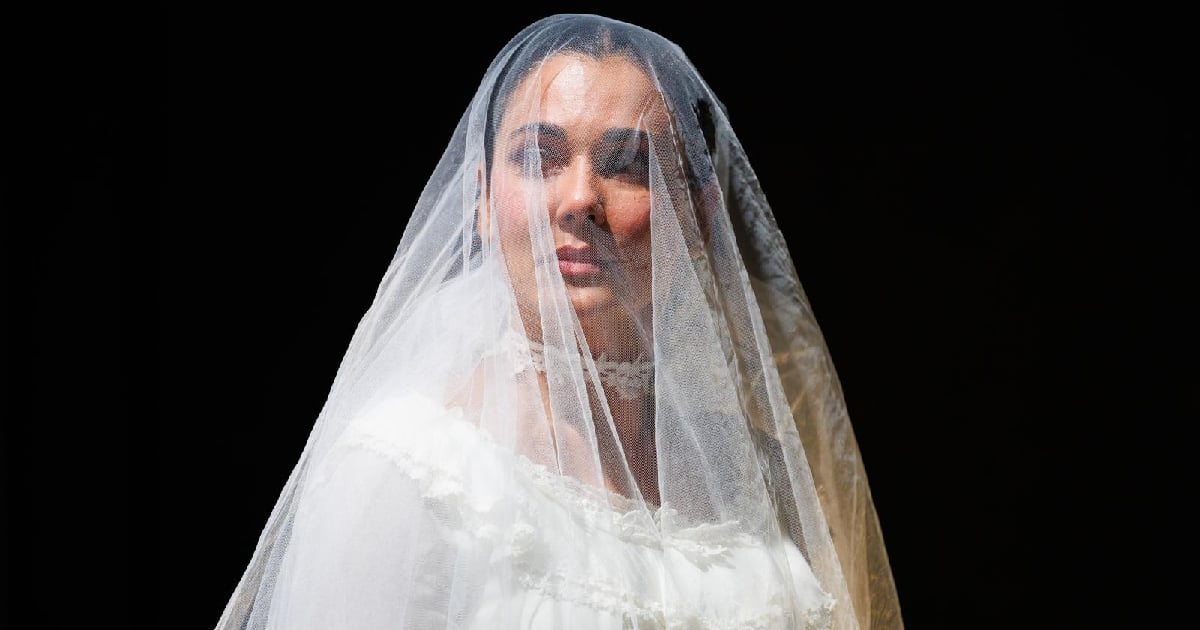
The beautiful habanera is feeling happy, pleased with her recent participation in the staging of the first part of Califas Trilogy, by Roger Q. Mason, a true theatrical odyssey that challenges genre, time, and the identity of California.
In this case, Arteche took part in "California Story", which inaugurates the ambitious trilogy, delivering a performance that required her to speak in perfect English.
CiberCuba adorns itself as it welcomes this Cuban woman brimming with rhythm, color, and flavor. How did you fare in a purely American production? What roles did you portray (I know it was more than one); how did you come to be part of the production?
I arrived at the project because last year I filmed a series in the Dominican Republic, which was a production between Hollywood and Singapore (a series that has not yet been released).
The casting director, who lives in Los Angeles, called me to audition for this play, and that’s how I was selected. This is how I came to “California Story”.
Then, let's say I moved to Los Angeles, completing a fruitful season with 16 shows, five days a week. It has been very exhausting because it is a highly demanding production, both emotionally and physically. But it is a beautiful show, directed by Michael Álvarez and written by Roger Mason.
Who produces it, and what is the work about?
It is a production by Outside in Theatre, which is a well-known theater company in Los Angeles. It is a play that somehow tells the story, or part of the story, of California, focusing on the last Mexican governor of California, named Pío Pico.
In fact, there are many streets and places that still bear his name.
It is a fascinating story of exclusion that speaks to the American dream from its beginnings. It is a story of power, of people belonging to minorities; in this case, it particularly resonates with my characters.
Who were those characters?
I portray María Isadora Pico, sister of this governor who married a man who later became very powerful in California.
In other words, it is a true story, a completely historical work, but at the same time it is futuristic because it intertwines that era, the 1800s, with 2051, when the Apocalypse is supposedly coming and the world is entirely water.
So, in that 2051, I play another character named Mexican Woman, who is like an extension of Isadora.
The topic is interesting... and what did the character represent for you?
For me, as a woman and as a Latina, it means a great deal to have portrayed these characters. One reason is that they represent a very important historical aspect, not only for Mexican culture but for Latino culture as a whole.
And another reason is that the work has a very special journey reflecting what women have gone through over the years. So for me, it is very, very important, and I feel that it has been a privilege and a great honor to be portraying this; moreover, I am doing it with a great deal of respect, because I am literally representing an entire culture, from which I have also had to learn a great deal.
I can imagine the effort you must have put in, a work entirely in English.
Indeed. The work has demanded a lot from me because I have had to not only do it entirely in English, but many parts are in period English.
Additionally, this work in Los Ángeles features choreography, dance performances, and many contemporary dance pieces; I had to learn to skate. In short, it's a demanding production.
How did it go with your teammates in Califas Trilogy?
I have to tell you that my colleagues are incredible. We are seven actors on stage: Peter Mendoza, who plays Pío Pico, a Chicano actor recognized in the local theater; David Santos, who is well-known in many series and portrays another brother, Andrés Pico, who was also very important in history.
Sawyer Shine, who represents my husband; another excellent artist, young and talented. I have loved working with him, he is very nice.
Other three actresses also participate, and they are absolutely amazing: Morgan Danielle Day, Gracie Cartier, and Aphrodite Armstrong. They are referred to as the Legendary Children, serving as that voice of conscience, those characters who tell the story from a different perspective.
What does theater mean to you?
The theater has been my school for a long time. It was the first thing I learned, and it was also the first thing I did when I started acting, when my mom took me to a children's theater group.
It was the first thing I did as a professional and it was the first thing I studied because in school what you receive is training for theater acting. Being close to the audience and feeling their energy is something very special. It is true that each medium has its own charm; for me, they are all fascinating.
When I'm asked, "What's your favorite?" I can tell you it's movies, but each one has something very special.
Who is Camila Arteche? What were your early steps like, did your family always support you?
My grandmother, my mother, my father, my whole family has always supported me, Juli, and it's wonderful because in my family, even though there aren’t any other actors, there is that vibe that art brings.
I have a cousin who is a writer; my father was an incredible dancer and wrote beautifully; my mother is a dancer who would have loved to be a professional ballerina.
That spark and passion for art has always been present in my home. My mom is also a lover of music and reading, and she's incredible; so that was always a part of my household, but I am the one who became a professional artist.
I owe a lot to my family because I have always felt supported, right from day one, since I was little, with my mom and dad taking me to my theater classes, my dance classes, my English classes, my classes for everything.
I went through it all, and one didn't realize it at the time, but now I look back and think about everything my mom and dad had to go through to take me to those classes, to those radio programs…
I hosted a live radio show since I was eight years old. Every Sunday, I had to get up at six in the morning because the show started at eight, and I needed to be in Vedado by seven for rehearsal and to go on air.
You have to realize how much I must have liked it for me, so little at the time, to endure that "train," as we Cubans say.
In all those years, my grandmother has been a talisman; my grandmother means everything to me. When I was writing novels in Cuba, I never liked having my scripts read aloud; I mean, I am very private about that. No one knows what I am working on until it appears, until it airs on television or until they go to the theater and see it. I never talk about what I am doing in the moment; however, my grandmother would hide from me and read the scripts of the novels.
"Hey, they could be 88 scripts of a hundred and something pages each!" she read them meticulously.
So much so that when the soap operas aired, my grandmother already knew what was going to happen and knew everything because she had secretly read the script without me knowing.
I took my grandmother to many recordings I had in Cuba. When I filmed the movie El acompañante, I brought her along to the set a couple of times.
When I was working on a novel, at least once during the eight months of filming, my grandmother would spend the whole day with me... and people loved her!
All the teams always treated her beautifully. When I filmed "Bailando en Cuba," my grandmother accompanied me to every recording. I had to be there five or six hours before the show started, and she spent that time with me, in makeup, enjoying the banter of the technicians, sitting in the theater.
You have experience in various media. You already told me that cinema was the one that attracted you the most, but how do you feel about the others? For example, do you feel better hosting "Bailando en Cuba" or acting?
For me, that doesn't depend on the medium; it depends on the human quality of the work teams and the quality of the product as well, right? So, "Bailando en Cuba" was a very beautiful experience for me in terms of hosting, very challenging, where I grew and learned a lot; it was the first time I did that on television, as I had been doing it in cabaret for many years.
I spent five years of my life as the host of Tropicana; I performed at Macumba, Havana Café, Copa Room, and La Maison... in other words, I did a lot of cabaret work as a presenter, and it was a great education as well.
I love cinema and all the movies I have made, without any distinction, all of them.
And television opened many doors for me, it brought me popularity in Cuba, especially through soap operas. Right after graduating, I made my first soap opera, in other words, I graduated while making my first soap opera; I have a lot to thank television for as well.
The series I mentioned at the beginning of this interview is for television, but not for traditional linear TV; it's designed for the kind of television that is used today, digital, with platforms and so on.
In other words, “I have walked many paths,” but each one has something to offer, which is why I reiterate that, for me, it depends on the quality of the teams and how I feel on a personal level, you know? Not the medium itself.
Speaking of cinema, you received, among others, the award from the Association of Theatre Critics of New York in the category of Best Supporting Actress for your role as Lisandra in the film El acompañante. Is this the beginning of your journey in the seventh art, or do you prefer theater and television?
That is an award I received a long time ago. The Companion was one of the first films I made in my life, and many others have come since then, thank God. Yes, the seventh art is one of the media that I am most passionate about, I really enjoy it.
In Miami, I have also made many short films, with very talented people who have won numerous awards. I have even ventured as a producer in short films in cinema in Miami. That has been another beautiful aspect of my experience.
Beyond being an actress or a host, you are a "one-woman band." I wonder: what else is there for Camila Arteche to do?
The United States has given me more opportunities; obviously, it has provided me with more challenges and more expansion, because I have had to navigate in another language, adapt to different accents, learn new skills, and have more exposure, let's say, in the projects and the things I have done.
What else do I need to do? I always want to act. This, thank God, is a profession that you can do for a lifetime as long as you keep your mind right, you know?
What I want is to continue working on projects that inspire me deeply and align with who I am and what I want to express as a human being. That's not something I would say I'm lacking; it's what I want to keep doing.
How is Camila Arteche doing in her love life?
Well, I am very happy sentimentally. In this last season, so to speak, of my life, I spent a lot, a lot of time choosing. To put it one way, because I believe that all people in the world have the possibility to choose our partners, and no one forces us.
Perhaps in some cases that is true, but it is not the majority. So, it took me a long time to choose a partner. I was very clear about what I wanted and how I wanted my life to be, especially my life as a couple.
Y it was like this that came… the perfect match for me!, I believe, until now, until today. In the world, the only thing that does not change is change itself, so it has been this way up to today.
The only thing I can say is that close friends were the ones who encouraged that meeting of souls to happen. I’m not going to say anything more, but yes: with that good, living in the present, above all.
Both of us have very similar ways of thinking about life, and when we don't, the truth is that we are learning a lot from each other, which is ultimately the point. With great respect and an abundance of love, which is also part of the idea.
Would you like to perform in Cuba again?
If I would love to perform in Cuba again, it would be for the people, because every time I visit my mother and grandmother, the people on the street in Cuba treat me with such great love and are so special to me, despite the many years since I left.
And how they remember me! I know that’s thanks to social media as well, having the opportunity for them to continue seeing my work over there.
I would like to work in Cuba for that reason, for the people, for my people! That's why I would like to, not for any other reason, but yes, for the people!
One last question: would you like to do "Cecilia Valdés"?
Yes!!!!!!!! Of course!
I bid farewell to Carmila Arteche, for me the actress who could best portray the legendary character of Cirilo Villaverde. Look at her and tell me if she isn’t the “Cecilia Valdés” of our times.
Filed under: