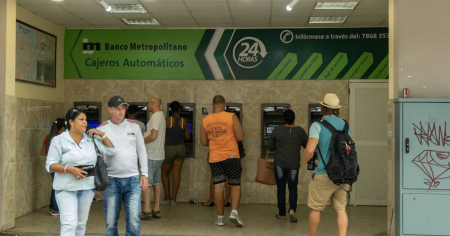
In Pinar del Río, banking was promised to make life easier, but it has become a daily obstacle for workers, retirees, and self-employed individuals who struggle with empty ATMs, unstable connections, and businesses that still demand cash.
The result is a system that, rather than modernizing, has complicated access to wages and basic consumption.
An extensive report from the official newspaper Guerrillero acknowledged that the limited network of ATMs collapses daily under long lines that flood portals and streets.
The infrastructure is insufficient: banks do not receive enough money to frequently replenish the ATMs, and smaller denominations dominate, making it cumbersome to withdraw modest amounts. Neither the use of additional tellers nor extended hours compensate for the lack of liquidity.
In parallel, digital payments face a double barrier: the lack of technological culture among an aging population and the refusal of many businesses to accept transfers.
Raydelín Martínez, a state worker, explained to the newspaper that he had been waiting in line for days to withdraw his 5,000 pesos salary, while finding it difficult to make payments through electronic platforms.
"Sometimes it's because there's no electricity, and without connection, Enzona doesn't open; other times it's because stores prefer that people pay in cash. The fact is, they make life difficult for you, as if everything else we experience isn't enough," Martínez summarized.
Many users report having trouble paying amounts over 1,500 pesos at some merchants, something that the bank itself denies.
Confusion persists even among those trying to follow the rules. Clients like Francisco Argudín, 70, are unable to distinguish whether they are paying into a fiscal account, which prevents them from receiving benefits. Others, like Enrique González, face double charges for paying online and do not receive refunds, only the offer to take another product.
The officials from the Banco Popular de Ahorro and Bandec acknowledge the limitations. They state that “neither QR codes nor fiscal bank accounts have a limit on income. They can receive anywhere from 10 pesos a day to 10 million or more,” but they admit that the lack of electricity and data connectivity hinders their normal use.
Of the more than 270 radio bases in the province, 66% do not have energy backup: when the power goes out, they shut down and all mobile traffic is suspended.
The businesses are also not aligned. Many self-employed workers, small and medium-sized enterprises (mipymes), and non-agricultural cooperatives insist on cash payments, arguing that they are unable to access the funds for operational expenses later on.
The inspection detects evasion such as the use of personal accounts and the absence of QR codes, for which fines ranging from 16,000 to 36,000 pesos can be applied to TCP and mipymes, and from 24,000 to 60,000 pesos in the case of cooperatives.
The state tries to maintain control through sanctions, but the figures reveal an uncomfortable reality: only between 10% and 12% of the 700,000 monthly transactions are conducted through digital means in Pinar del Río. The goal of a more transparent and controlled system is hindered by a cash culture that does not disappear by decree.
For retirees, the situation is even more critical. Although banks claim to guarantee cash payments, the conditions do not always allow for it. They face endless waits at ATMs or shops that do not accept cards, just when they are most vulnerable to the forced change.
Bancarization has failed to meet its goals and “far from making people's lives easier, it has created another problem... the primary aim of the process is for the population to be able to take advantage of certain benefits, but, unfortunately, it has been quite the opposite,” admitted Calex Edilio González Chill, coordinator of programs and objectives of the Provincial Government in Pinar del Río.
Meanwhile, Cubans remain trapped in a financial limbo: their digitized salary is not accepted in many businesses; banks have no cash; and establishments, rather than facilitating the transition, are obstructing it. The result is clear: after a month of work, not everyone can access their money. A model that was supposed to empower ends up leaving people with less control and more frustration.
In April of last year, the official press in Matanzas also acknowledged the failure of banking integration in the western province, mentioning businesses that evade fiscal control, non-functional QR codes, and lack of connectivity.
The Cuban government acknowledged in April 2024 the failure of the banking process initiated in August 2023, as well as the official exchange rate it established for foreign currencies as part of the "economic and monetary reorganization."
Banking in Cuba has been a topic of constant debate and frustration for the population. The initiative faced significant resistance due to the lack of technological infrastructure and distrust in the state financial system.
Cubans have reacted with outrage, pointing out that the measure not only limits their access to cash but also complicates trade and basic services. The lack of operational ATMs, long lines at banks, and the requirement for electronic payments in a country with constant connectivity issues were some of the most reported problems.
Despite the difficulties, in June 2024, the ruling Miguel Díaz-Canel insisted on the banking of agricultural markets, a measure that met with even more resistance, especially among producers who rely on cash for their daily transactions.
The proposal aimed to digitalize payments in the marketing of food, but farmers warned that the Cuban banking system was not prepared to manage transactions in the agricultural sector without affecting the availability of products in the markets.
By the end of 2024 and the beginning of 2025, banking access became a key factor in the liquidity crisis in Cuba. In municipalities like Jovellanos, workers faced restrictions on withdrawing their salaries in cash, leading to long lines and widespread dissatisfaction.
In Santiago de Cuba, there were even reports of vandalism against bank branches, reflecting the desperation of a population forced to deal with a collapsed financial system.
Despite the government's attempts to present banking as an economic solution, the reality on the streets revealed a landscape of uncertainty and discontent. The failure of the program not only affected the daily lives of Cubans, but it also impacted the exchange rate, making access to foreign currency more expensive and deepening the economic crisis on the island.
Frequently Asked Questions about Banking in Pinar del Río and the Service Crisis
Why has banking failed in Pinar del Río?
Bancarization has failed in Pinar del Río due to a lack of infrastructure, which includes an insufficient network of ATMs that collapse under long lines, a shortage of cash to supply them, and difficulties in using digital payments due to low technological literacy and the reluctance of businesses to accept transfers. These issues have complicated access to salaries and basic consumption, generating frustration among the population.
What problems do retirees face with the banking system in Cuba?
Retirees face long waits at ATMs and banks, where they often cannot receive their full pensions due to a lack of cash. Additionally, some businesses do not accept cards, which increases the vulnerability of this group to a system that was meant to ease their lives, but has instead turned out to be another obstacle.
What is the current situation of telecommunications services in Pinar del Río?
Fixed-line telephony in Pinar del Río has experienced significant interruptions, affecting more than 60,000 customers due to failures in the telephone exchange. Although ETECSA has partially restored the service, the lack of transparency and high rates have caused strong discontent among users, who depend on a monopoly without competition.
Filed under: