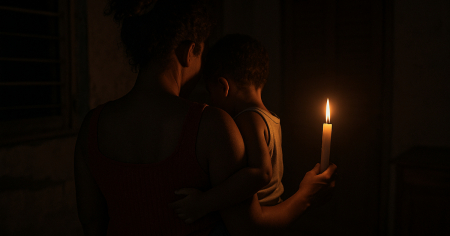
A Cuban resident in Murcia has reported on social media the dire humanitarian situation currently facing the island, sounding the alarm about power outages of up to 23 hours a day, food shortages, political repression, and systematic censorship that, he claims, the world is willfully ignoring.
"The people of Cuba are dying of hunger, the people of Cuba are experiencing power outages of 22 and 23 hours daily," expressed vehemently the content creator @el.profesor.cubano, known on TikTok for addressing the Cuban reality from a critical and personal perspective. "What is happening in Cuba is a crime, and the world needs to know about it," he stated in the video, which has garnered thousands of views and reactions.
From Cartagena, this Cuban emphasized that his message is not directed at political leaders, but "to people like me," because —as he stated— "the leaders know everything and do nothing." He insists that expressing oneself freely about the realities of Cuba comes with personal consequences, such as the inability to return to the island. "Cuban individuals who denounce what is happening in Cuba cannot enter; they are automatically labeled as counter-revolutionaries," he lamented.
"When I tell you that in Cuba there are 23 hours of blackouts, that if you make a poster that says 'freedom' you could be imprisoned for 20 years, without throwing a stone, without offending anyone... I have to let you know this. It's my duty," he stated. "I know what I'm risking, and still, I am going to speak up."
The young man also mentioned that his mother, who still lives in Cuba, recently turned 63 "with nothing," and he hopes to be able to bring her to Spain "above all those people, above all those dictators."
Reactions: indignation, support, and calls to action
The video generated a flood of comments, both from Cubans inside and outside the island and from Spaniards who expressed empathy and surprise at the magnitude of the crisis.
"Let everyone know what Cuba is like," wrote a user. Others described the situation as a "silent genocide", denouncing the lack of food, drinking water, medications, and basic services. Some even shared recent experiences on the island: "The first day we arrived, there were 16 hours without power; the second day, 13," commented an internet user. Another user reported power outages of up to 44 continuous hours in rural areas.
Several internet users questioned the international passivity in the face of what they describe as a humanitarian catastrophe. “There are no rallies, no parades, no government denounces it,” pointed out one user. “The whole world knows and does nothing because Cuba has no oil,” said another.
Other comments, however, criticized the creator for shifting the focus of their usual content to a more political one, although they acknowledged the truth of their allegations. "You know how things are in Cuba, it’s not new to anyone, but well, you changed the topic. Good luck," wrote a follower.
A history of viral reports
The content creator, son of the comedian Antolín El Pichón, has released several videos in recent months where he compares his experience in Spain with the life he left behind in Cuba, using everyday objects to illustrate the scarcity and precariousness faced by Cubans.
In one of his most talked-about videos, he displayed a satellite antenna on the street and recalled that these are illegal in Cuba: “In Cuba, you have to hide that where you least expect it, because if they catch you, you could end up in prison,” he explained in reference to the information censorship.
It has also reported on the difficulties in accessing basic goods. In another viral video, it broke down what can be purchased with an average Cuban salary —the equivalent of about 20 euros per month— and explained that, even if resources are available, obtaining products like shampoo or rice relies on contacts and favors.
In a more personal post, he reminisced about his grandfather's life, collecting nails on the Cuban streets due to the lack of hardware stores, and expressed his amazement at finding tools available in any Spanish shop.
More recently, he highlighted the symbolic value of an empty bucket, which in Cuba can be repurposed for bathing, storing water, or cooking, demonstrating the ingenuity of the people in response to structural scarcity.
"The world needs to know what is happening in Cuba."
The video concludes with a direct message to the Cubans who criticize him for speaking out: "If you don't have the courage to do it because you want to keep going to Cuba, I understand and respect that... but don't interfere with what I'm doing. I will speak out, and people will know what is happening in Cuba."
Her words have resonated within an increasingly active community advocating for awareness of the Cuban crisis, and her voice joins that of hundreds of Cubans in exile who, through social media, are trying to shed light on what they consider an emergency ignored by the international community.
Filed under: