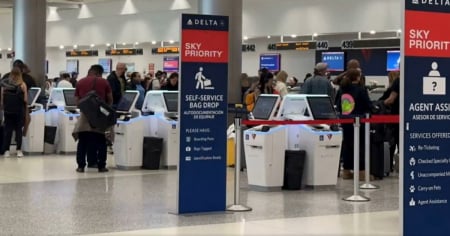
After nearly two decades of one of the most unpopular security measures at airports in the United States, the Transportation Security Administration (TSA) has officially announced that passengers will no longer have to remove their shoes when going through security screening.
This decision, which marks a turning point in the country's airport security policies, responds to an evolution in technology, a new tiered control strategy, and the desire to provide a smoother experience for travelers, according to revelations from the U.S. press.
The news was confirmed by the Secretary of Homeland Security, Kristi Noem, during a press conference held this Tuesday at Ronald Reagan National Airport in Washington.
According to his explanation, the removal of the measure has an "immediate effect" and is part of a broader initiative to optimize controls without compromising security.
“Passengers will continue to go through multiple levels of screening. They will also undergo an identity verification”, declared Noem.
He also warned that “at times, some individuals may be asked to remove their shoes if we deem it necessary to apply additional levels of scrutiny.”
Karoline Leavit, press secretary of the White House, hailed the measure, calling it "great news from DHS" on social media.
The origin of the measure: The "shoe bomber"
The requirement to remove one's shoes at security checkpoints was formally implemented in 2006, although its origins date back to December 22, 2001.
On that day, Richard Reid, a British citizen later nicknamed the "shoe bomber," attempted to detonate explosives hidden in his footwear during a flight from American Airlines between Paris and Miami.
The attack was thwarted by the intervention of the crew and passengers. The plane managed to make an emergency landing in Boston.
Although the attempt was unsuccessful, the threat was taken very seriously.
Five years later, after new alerts about liquid explosives in 2006, the TSA tightened security measures by introducing liquid restrictions and requiring all passengers to remove their shoes for inspection.
Technological evolution and new security strategy
According to Noem, the current context is different: the implementation of advanced scanning technologies, new security protocols, and the "layered security" strategy allow for the flexibility of certain measures without compromising the effectiveness of threat detection.
This tiered approach includes the use of state-of-the-art full-body scanners, biometric verification, enhanced identification through the implementation of the REAL ID program, and an increased presence of security personnel at strategic points.
Additionally, it was announced that other practices, such as removing belts, showing laptops, or extracting liquids from carry-on luggage, are also under review.
These measures could be relaxed in the next six to nine months as part of pilot programs that are about to start.
What exactly changes?
From now on, the elimination of the "no shoes" protocol applies to all passengers using standard security checks.
Until this announcement, only those enrolled in programs such as TSA PreCheck, CLEAR, IDEMIA, and Telos were exempt from removing their shoes.
The benefits for these frequent travelers remain in effect and also include not having to remove their belt or coat, nor take electronic devices out of their luggage.
However, with this new policy, millions of passengers across the country will experience a streamlined security check process, which promises to reduce lines, wait times, and inconveniences.
Progressive application at the airports
Although the official announcement states an immediate change, implementation at each airport may vary slightly.
Some had already begun implementing the measure before the announcement, such as Cincinnati International Airport, Philadelphia International Airport, and Piedmont Triad International Airport in North Carolina.
On the other hand, last Monday, travelers at Syracuse Airport (New York) no longer had to remove their shoes, while on Tuesday morning, this measure was still required at O'Hare Airport in Chicago, according to reports from CNN affiliates.
This suggests that the transition may take a few days as protocols and equipment are adjusted at the various checkpoints across the country.
The decision has been well received by the public and by representatives of the aviation sector.
Nicholas Calio, CEO of Airlines for America, emphasized that “making security decisions based on risk assessments and leveraging advanced technologies is a sensible approach to policy change.”
A spokesperson for the TSA also emphasized the agency's commitment to innovation: "The TSA and DHS are always exploring new and innovative ways to enhance the passenger experience while maintaining a strong security posture."
Frequently asked questions about the removal of the "no shoes" protocol at U.S. airports.
What security measure has the TSA removed at airports in the United States?
The TSA has removed the requirement for passengers to take off their shoes when going through security checks at airports in the United States. This measure aims to streamline the travel experience and is a response to technological advancements and a new tiered security strategy.
Since when has this new TSA policy been implemented?
The removal of the shoe removal policy has an "immediate effect" since its announcement by Homeland Security Secretary Kristi Noem. However, the implementation may vary slightly between airports as the new protocols are adjusted.
What other security measures are under review by the TSA?
In addition to the elimination of the "no shoes" protocol, other practices such as removing belts, displaying laptops, or extracting liquids from carry-on luggage are under review. These measures may be relaxed in the next six to nine months as part of pilot programs.
Why was the measure of removing shoes at airports originally established?
The measure of removing shoes was implemented after the attempt by the "shoe bomber" in 2001. Richard Reid tried to detonate explosives hidden in his footwear during a flight, which led to the tightening of security measures at airports five years later.
Filed under: