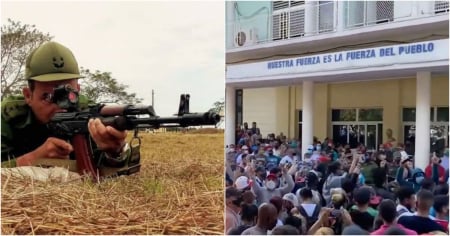
The Cuban leader Miguel Díaz-Canel asserted this Friday that Cuba "is unwavering," as it marks four years since the social uprising on July 11, 2021, the largest civic protest against the regime in over six decades.
"Cuba stands firm because we are a people who know how to fight; for having the spirit of the cimarrones and mambises; for being the children of a Revolution built through intelligence and courage," he wrote on his X account.
The message is accompanied by an image of the sculpture of José Martí, located at the Anti-Imperialist Tribune in front of the United States Embassy in Havana. The work, by the sculptor Andrés González, depicts the National Hero carrying his son while pointing towards the diplomatic headquarters, serving as a symbolic protest against the U.S. government.
On July 11, 2021, thousands of Cubans took to the streets to peacefully protest in more than 40 cities, chanting “Freedom!” and “Homeland and Life!”, demanding an end to the dictatorship.
The Cuban government downplayed the legitimacy of the massive protests, arguing that they had been organized from the United States. However, it was an unprecedented day of citizen courage that ended in violent repression following Díaz-Canel's words on national television, when he stated: “The order to confront is given”.
That order unleashed a wave of repression on the streets of the country. Cubans confronted other Cubans. Thousands of young people were imprisoned for their political beliefs, many of whom are still serving lengthy sentences in the island's prisons.
On the fourth anniversary of 11J, the government asked its institutions to publish messages of political reaffirmation on social media using the hashtag #CubaEstáFirme, but Cubans are strongly convinced that the regime is becoming weaker every day and its end might be closer than ever before.
In exile, the Cuban community commemorates the date with peaceful demonstrations. This Friday, activists from the Movimiento Acciones por la Democracia will honor the 11J with an event in Plaza de Santo Domingo, in Madrid, from noon until 9:00 p.m.
Frequently Asked Questions about the fourth anniversary of the 11J in Cuba
What happened on July 11, 2021 in Cuba?
On July 11, 2021, thousands of Cuban citizens demonstrated in over 40 cities across the country, demanding freedom, rights, and an end to the dictatorship. These protests, known as 11J, were the largest in decades and were marked by a collective cry of “Freedom!” and “Homeland and Life!”. The Cuban government suppressed the protests with violence, resulting in numerous arrests and long sentences for many demonstrators.
How has the Cuban government responded to the anniversary of 11J?
The Cuban leader Miguel Díaz-Canel stated that Cuba is “firm” on the fourth anniversary of 11J, highlighting the resilience of the Cuban people against what he describes as external aggression. However, the Cuban community both inside and outside the island maintains that the regime is becoming increasingly weak. Abroad, particularly in Madrid, the anniversary was marked by peaceful demonstrations for freedom.
What has been the United States' position regarding the events of July 11 and the situation in Cuba?
The United States Secretary of State, Marco Rubio, sent a message of support to the Cuban people, reaffirming his government’s commitment to the cause of freedom in Cuba. Rubio condemned the repression of the Cuban regime and highlighted the bravery of those who continue to fight for freedom despite the repression. The United States has maintained its critical stance towards the Cuban government, denouncing human rights violations on the island.
What does the hashtag #CubaEstáFirme, promoted by the Cuban government, symbolize?
The hashtag #CubaEstáFirme is a campaign by the Cuban government to project an image of strength and resilience in the face of criticism and social discontent. The government has urged its institutions to disseminate messages of political reaffirmation using this hashtag on social media, attempting to counter the perception of weakness of the regime. However, many Cubans believe that the reality within the country is different and that the regime is increasingly weakened.
Filed under: