
Related videos:
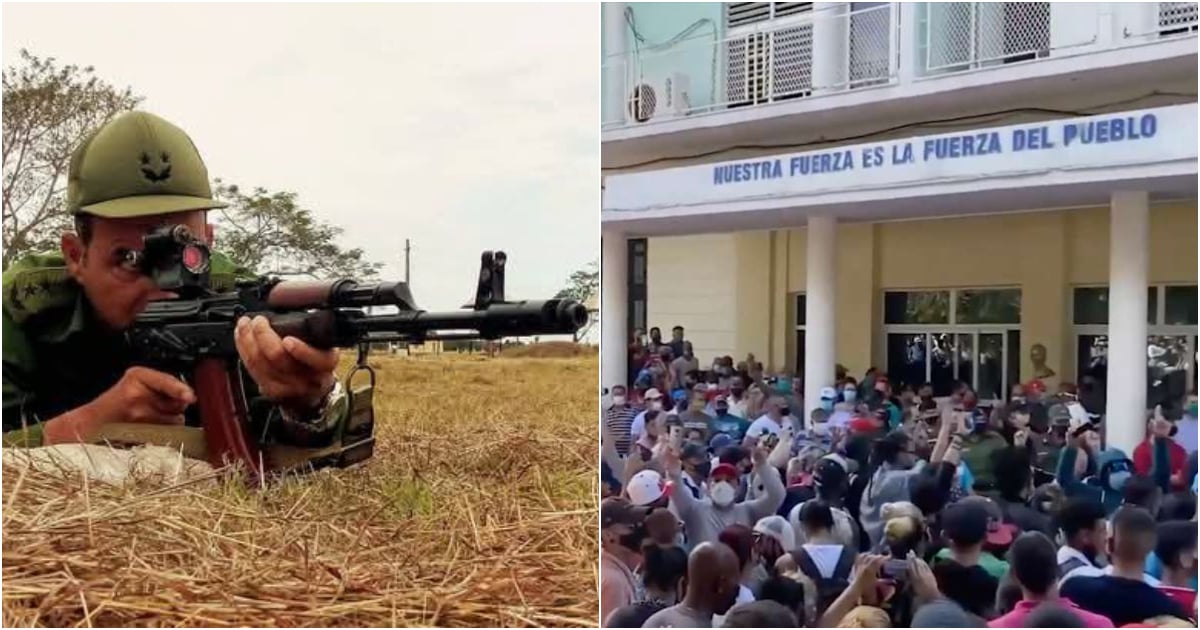
Four years after the social outbreak of July 11, 2021, the largest protest against the Cuban regime in over six decades, the Revolutionary Armed Forces (FAR) have come out to assert their presence.
In a series of posts from their official social media profiles, the Eastern and Western Armies disseminated messages filled with war rhetoric and political triumphalism, reaffirming their loyalty to power and leaving little room for doubt: they will not tolerate dissent.
“Nobody will defeat us, we will never give up,” asserts the Eastern Army in a message posted on their Facebook profile on July 11. The message is accompanied by rhetorical phrases such as “we have a brave and worthy people” and “a people that raises the flag of the lone star and does not kneel,” along with the hashtag #CubaEstáFirme.
Instead of remembering the citizens who died, were imprisoned, or went into exile after that historic uprising, the military forces have chosen to reinforce their commitment to the so-called Revolution and stand united with the Communist Party.
The Western Army did not fall behind. In a video and several posts on Facebook, it reaffirmed its preparation “with firmness, bravery, and dignity to defend the Homeland,” while waving slogans about “invincibility” and presenting itself as a guarantor of peace... on its own terms.
He also reiterated the narrative that the FAR are part of the people, although the 11J demonstrated that the repression was carried out precisely by those who claim to protect the citizens today.
From the military institution, there is an insistence on speaking of "sacrifice" and "loyalty," yet there is no mention of the origin of the protests: the desperation caused by the economic crisis, the lack of freedoms, and the constant repression. There is also no discussion of the hundreds of detainees, many of whom are minors, nor of the summary trials or the disproportionate sentences that followed.
In its place, the message this July 11 is clear: the military apparatus remains intact, mobilized, and determined to stifle any signs of dissent. Instead of building bridges or opening spaces for dialogue, the FAR clings to the usual script.
On the fourth anniversary of the 11J, the government asked its institutions to post messages of political reaffirmation on social media using the hashtag #CubaEstáFirme, but Cubans are strongly convinced that the regime is weaker every day and its end may be closer than ever before.
During the day, the Cuban leader Miguel Díaz-Canel wrote on his X account that "Cuba is strong because we are a people that knows how to fight; because we have the spirit of the cimarrones and mambises; because we are children of a Revolution forged with intelligence and courage."
The Cuban government downplayed the legitimacy of the massive protests on July 11th, arguing that they had been organized from the United States. However, it was an unprecedented day of civic bravery that ended in violent repression following Díaz-Canel's remarks on national television, when he stated: "The order to combat is given".
Exiled Cubans and activists for freedom in Cuba are holding today an information day and a demonstration in Madrid to commemorate the fourth anniversary of 11J.
In April, the Miami International Film Festival premiered the documentary The Eternal Night of Cuba (Cuba’s Eternal Night), a powerful documentary that depicts the humanitarian crisis, repression, and the massive exodus from the island following the large protests of July 11 and 12, 2021.
The 66-minute audiovisual follows five Cubans over the course of two years as they confront government repression, shortages of food and medicine, and the largest mass exodus the island has ever experienced, according to the synopsis.
In order to suppress the protests of July 11th in dozens of cities and towns across Cuba, the Díaz-Canel regime resorted to violent repression and arbitrary arrests of demonstrators - including minors - which was followed in the subsequent months by summary and exemplary trials that violated due process and imposed long and unjust sentences.
During the repression of the protests, 36-year-old citizen Diubis Laurencio Tejeda was shot and killed by a police officer while participating in the peaceful demonstration in the La Güinera neighborhood in Havana on July 12. So far, he is the only confirmed fatality from those events.
Another Cuban, Osiris Puerto Terry, was shot multiple times by firearms from the regime's forces during the protest at the Toyo corner in the Diez de Octubre municipality.
The wave of government repression against the demonstrators of July 11 not only resulted in mass incarcerations but also led to a tragic outcome that includes the death of at least four political prisoners in custody.
These cases reflect the inhumane conditions of Cuban prisons, medical negligence, and the systematic abuse towards those who dared to demand freedom in a country where dissent is brutally punished.
The organization Prisoners Defenders and other human rights groups have reported that the Cuban regime is holding 1,150 political prisoners, the majority of whom were arrested for protesting against the Díaz-Canel government.
In January 2025, the regime in Havana announced the release of 553 individuals due to international pressure and following the decision by the administration of former U.S. President Joe Biden (2021-2025) to remove Cuba from the list of state sponsors of terrorism.
After the initial releases, the process was halted for more than a month, but in March, the Vice President of the Supreme People's Court (TSP) of Cuba stated that the procedure was completed successfully and was divided into two phases: 378 applications approved in January and 175 in February.
Human rights organizations have reported that the Cuban regime has inflated the numbers of releases by mixing political prisoners with common inmates, and that most of those released had already been eligible for parole for months or were under an open regime.
Furthermore, activists insist that the government still holds hundreds of prisoners of conscience in Cuban jails and that those released remain under surveillance and restrictions. Meanwhile, the regime continues to warn that those who do not comply with the imposed conditions could be sent back to prison at any time.
Frequently Asked Questions about the Fourth Anniversary of 11J in Cuba
What was the response of the Cuban Armed Forces on the fourth anniversary of 11J?
The Revolutionary Armed Forces (FAR) reaffirmed their loyalty to the regime and spread messages of militaristic rhetoric and political triumphalism, asserting that they would not tolerate dissent. Instead of commemorating the victims of repression, they chose to rally behind the Communist Party, emphasizing their readiness to quash any signs of unrest.
What happened during the protests on July 11, 2021, in Cuba?
On July 11, 2021, thousands of Cubans took to the streets in the largest protest against the regime in over six decades, demanding freedom and a change in the system. The demonstrations were violently suppressed by the authorities, resulting in mass arrests, summary trials, and lengthy sentences for the participants.
How has the Cuban government reacted to international criticism regarding the repression of July 11th?
The Cuban government has undermined the legitimacy of the protests, arguing that they were organized from the United States. Additionally, it has verbally attacked dissidents and opponents, labeling them as "mercenaries" in the service of foreign interests, while disregarding the internal demands of the Cuban people.
What impact did the documentary "The Eternal Night of Cuba" have on the protests of July 11th?
The documentary "La noche eterna de Cuba" depicts the humanitarian crisis and repression on the island following the protests of July 11, featuring five Cubans who confront government repression, shortages, and mass exile. It has been a key testimony to highlight the human rights situation in Cuba.
Filed under: