
Related videos:
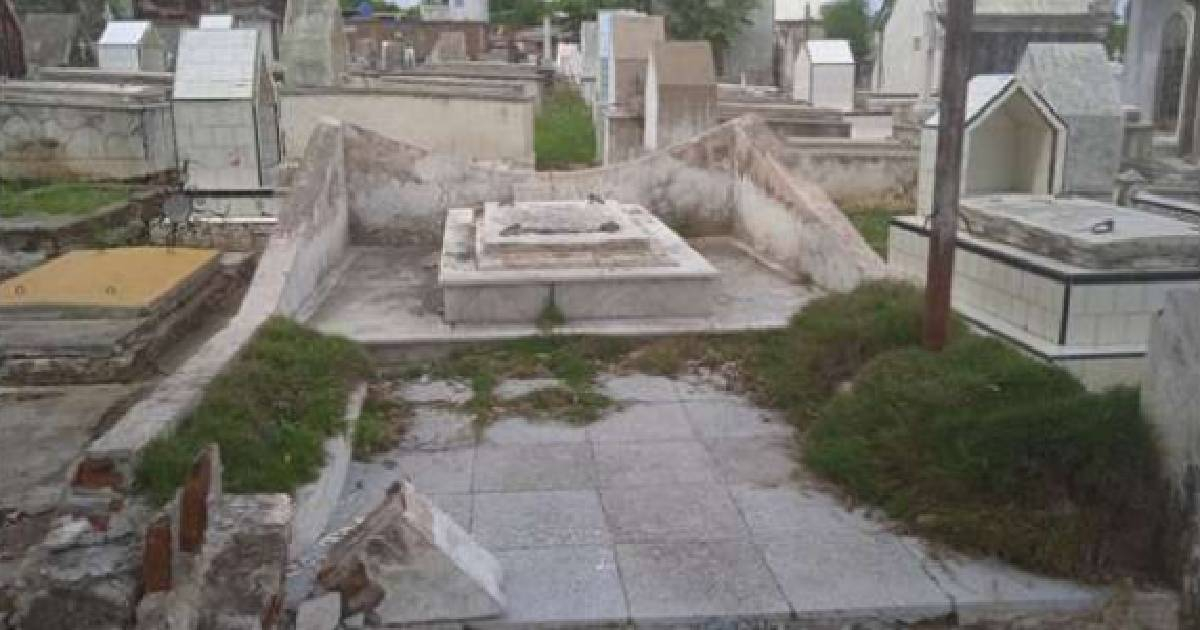
The San Rafael cemetery in the city of Guantánamo displays the decay of mausoleums dedicated to heroes of the Liberation Army, many of whose gravestones are now illegible or completely destroyed.
Among the cracked tombs and the rust that corrodes the marbles rest the remains of those who fought for independence. "However, institutional neglect, public ignorance, and systematic vandalism have turned it into a 'heritage' at risk of extinction," lamented a report from the official newspaper Venceremos.
While the remains of many of those heroes were transferred in 1985 to the mausoleum of La Confianza, the media questioned, "What will happen to the original graves that once sheltered the remains of our mambises for years?"
The final resting place of the independence general Pedro Agustín Pérez, better known as Periquito Pérez, dated 1914 and built from marble, is in fair condition, lacking maintenance and oversight. The ritual of raising the flag in his honor is no longer even observed.
The graves of patriots such as Francisco Pérez Pérez, Santo Pérez Ruiz, Martí Alayo, and Prudencio Martínez, among many others, have also fallen victim to neglect.
In front of the cemetery, a statue dedicated to another mambí general stands vandalized, while a dump spreads at its feet. "It's the height of disrespect. Anyone who comes to visit their dead does so amidst garbage and foul smells. How can we accept that the tribute to our liberators coexists with such undignified decay?" he emphasized.
The deterioration is not solely due to the passage of time, but also to poor practices by those responsible for its care. Neither the Provincial Monument Center, the state-owned Community Services company, the municipal Heritage Office, local historians, nor veteran associations "view the problem as a priority."
Despite its historical value, the cemetery is not designated as a Local Monument and lacks “a heritage route for its visit, adequate signage, or a historical-cultural guide to highlight its significance,” lamented the source.
Amid invasive plants, broken tombstones, and lost records, the San Rafael Cemetery is undergoing a process of collective amnesia. The mausoleum where Flor Crombet rested has either vanished or become unrecognizable.
Even though there are graves such as those of the peasant leader Niceto Pérez, the fighter Ramón López Peña, or the internationalists, "even those have not received the treatment they deserve. In fact, the exact location of many veterans of the Liberation Army remains unknown due to a lack of records," he added.
According to the report, “some of the staff responsible for maintenance have contributed to bad practices, negligence, and even acts of vandalism. What should be an open-air museum is now a living testament to local amnesia.”
As we approach the 140th anniversary of the cemetery in 2026, the media urged immediate action to transform it into an educational heritage route, declare it a Local Monument, and restore it as a space for historical remembrance.
In February 2025, the report concerning the conditions of the Guantánamo cemetery gained significant attention following the release of a video that displays open graves, uncontrolled weeds, and a strong foul odor.
In September 2023, an extensive report by Venceremos revealed that noxious gases were emanating from open vaults in the San Rafael cemetery, affecting the daily lives of nearby residents, who reported a sustained unsanitary situation justified by an institutional order not to seal the niches until they reached full capacity of bodies.
In response to the increasing citizen complaints demanding urgent measures regarding a problem that affects the health, dignity, and rest of the deceased, cemetery officials and staff from the Necrological Services acknowledged the overcrowding, staff shortages, and material limitations. They stated that a solution would be the new cemetery in Santa Catalina, which was under construction at that time.
A profound neglect plagues the cemeteries in Cuba. Recent images from the Chinese Cemetery in Havana revealed its alarming state of abandonment, with destroyed tombs, exposed bones, and overflowing weeds, despite its historical and cultural value as a National Monument.
The cemetery of San Rafael in the city of Colón, Matanzas, built in the 1920s, presents a landscape of open ossuaries, exposed bones, destroyed chapels, and an environment rife with unsanitary conditions, as highlighted in a report by the provincial newspaper Girón, which published the journalistic work on its online site.
In December 2024, it was reported that an unusual and outrageous situation persisted in the cemetery of the town of Felton, in Holguín, where a fallen tree remained atop several graves without local authorities taking action to remove it.
Frequently Asked Questions about the Abandonment of San Rafael Cemetery in Guantánamo
What is the current state of the San Rafael cemetery in Guantánamo?
The San Rafael cemetery is in a state of alarming deterioration, with mausoleums and gravestones of heroes from the Liberation Army damaged, open graves, and an unsanitary environment. Institutional neglect and vandalism have contributed to this situation.
Who are some of the notable figures buried in San Rafael Cemetery?
Among the heroes buried in the cemetery are General Pedro Agustín Pérez, known as Periquito Pérez, and other patriots such as Francisco Pérez Pérez, Santo Pérez Ruiz, Martí Alayo, and Prudencio Martínez, whose graves have also fallen victim to neglect.
What measures have the authorities taken to address the cemetery issue?
So far, the authorities have not taken effective measures to address the issue of the San Rafael cemetery. The lack of action and negligence on the part of responsible institutions have left the cemetery in a critical state without heritage routes or proper signage.
What impact does the abandonment of the San Rafael cemetery have on the local community?
The neglect of the San Rafael cemetery affects the dignity and rest of the deceased, creates an unhealthy environment for nearby residents, and fosters a collective amnesia by failing to preserve the historical significance of the site, which could serve as an educational and cultural focal point for the community.
Filed under: