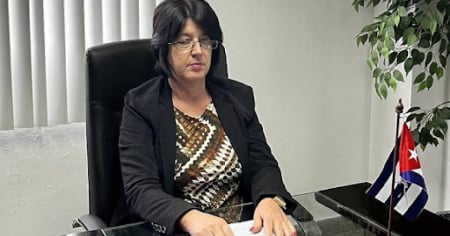
Miguel Díaz-Canel acknowledged on Tuesday the existence of begging and homelessness in Cuba, in stark contradiction to the Minister of Labor and Social Security, Marta Elena Feitó Cabrera, who just a day earlier had denied the existence of beggars in the country and went as far as to criminalize those who solicit alms in public spaces.
During an intervention before the Commission for Youth, Childhood, and Women's Equality Rights of the Cuban Parliament, Díaz-Canel expressed regret over certain statements made in that same commission regarding what he described as a “real and unwanted phenomenon in our society.”
"The existence of certain expressions of vulnerability, such as people experiencing homelessness or exhibiting itinerant behaviors… these individuals, whom we sometimes describe as beggars or associated with begging, are actually concrete expressions of the social inequalities and the accumulated problems we face”, stated the leader in a report released by Cubadebate.
Although he did not name Minister Feitó, the president clearly distanced himself from her stance.
“I do not agree with some of the opinions expressed by the commission on this topic. It would not be honest if I did not share with you what I think: making such judgments is counterproductive,” he asserted.
The ruler emphasized that this type of statement was made precisely in a discussion space about policies to address "vulnerable" sectors and the implementation of government programs with a social focus.
“If we are acknowledging that this problem exists and that there are actions to address it, we cannot denigrate those who are directly involved. Doing so reveals a lack of understanding of the reality the country is facing. I would dare to say that it reflects a superficial approach and a misdirected focus on the complexity of the phenomenon,” he emphasized.
Díaz-Canel admitted that these types of issues "have always existed, although today they take on a different dimension due to the depth of the crisis."
"It involves phenomena caused by multiple factors: economic, social, familial, and, in some sectors, by a breakdown in the structure of values," he emphasized.
He reiterated that the State has acknowledged this issue, and there are explicit commitments for addressing it within the main social programs of the country, including the Program for the Advancement of Women, and stated: "All of this reflects the humanist vocation of the Revolution."
"If these are our issues, then the vulnerable are ours, the homeless are ours, the families and communities in vulnerable situations are ours. It is our responsibility to address them from the Party, because the Party - unique and socialist - represents all Cuban men and women," he said at another moment.
He urged officials to act with sensitivity and without arrogance: “We must act with sensitivity, seriousness, humanism, and promote unity through participation… with welcome, assistance, solidarity, respect, humility, warmth, and ethical and decent behavior.”
He acknowledged the impact of the economic crisis on the increase of these vulnerabilities, and as expected, he referred to the "intensification of the blockade" as one of the causes that aim to provoke social breakdown, division, and the downfall of the Revolution.
Aseguró que existen múltiples programas en marcha, financiados incluso en un contexto de restricciones económicas, para atender estas realidades.
"This demonstrates sensitivity, political will, and government commitment. Because here, politics and government action go hand in hand."
“I cannot agree with certain expressions that have been made, nor with particular criteria that distort the recognition of realities that truly exist... We are not going to confront a vulnerable person. We are going to support those who are in a situation of vulnerability. Those people are not our enemies,” he reiterated.
"Yes, those manifestations do exist. We do not feel ashamed to acknowledge it. They exist, but we address them. We feel for the people who experience that situation. We have the will to overcome it. We have the will to transform it, because otherwise, we would not be revolutionaries... We know what the deep-rooted causes are, but we cannot deny that the problem exists," he concluded.
Humanist Discourse vs. Institutional Control: The Contradictions of the Cuban Regime in the Face of Extreme Poverty
Despite Miguel Díaz-Canel's explicit acknowledgment of the existence of homeless individuals and other forms of social vulnerability, his rhetoric contradicts the practices and policies of the regime that, in everyday reality, render these very groups invisible or criminalize them.
While the president appealed to the sensitivity and humanistic vocation of the system, the truth is that the state's actions have been more focused on preserving an image of a "Revolution without poverty" than on addressing the structural causes of social deterioration.
His intervention, although critical, seems more like a damage control maneuver in response to an unpopular speech than a genuine desire for transformation.
Miguel Díaz-Canel's statements acknowledging the existence of homeless individuals and beggars in Cuba starkly contrast with the institutional policies promoted by his own government.
Although the leader appealed to a humanist approach and defended attention to vulnerable sectors as part of the revolutionary ideology, state practice still follows a logic of social control and concealment that contradicts his discourse.
A concrete example of this contradiction is Agreement 10056/2025 of the Council of Ministers, which has been in effect since April and establishes a protocol for the treatment of individuals with "wandering behavior."
Far from discussing extreme poverty or social exclusion, the document resorts to euphemisms to describe situations that in any other country would be recognized as expressions of destitution, abandonment, or structural marginalization.
This agreement delegates control of the phenomenon to provincial and municipal governments, which must establish multidisciplinary teams composed of social workers, medical personnel, law enforcement, and prosecutors.
These groups are tasked with identifying, classifying, evaluating, and relocating individuals experiencing homelessness, often without ensuring their consent or basic rights.
Instead of providing long-term structural solutions, the official approach is based on forced relocation, containment in Social Protection Centers - which allow for a temporary confinement of up to 90 days - and the "return to the place of origin" of those affected.
In addition, the official narrative shifts the responsibility for the crisis onto Cuban families and the U.S. embargo, without acknowledging the deep internal causes of social disintegration: widespread impoverishment, lack of housing, an aging population, mass emigration, the collapse of public services, and the real vulnerability experienced by thousands of retirees.
Recent reports, even in official media such as Girón and Sierra Maestra, show how elderly people who have worked their whole lives now have to beg or sell goods on the streets to survive, without sufficient state support.
The criminalization of loitering is accompanied by institutional campaigns aimed at "rescuing" the homeless through street raids and confinement in state-run centers.
While Díaz-Canel speaks of sensitivity and justice, governors like Marieta Poey in Matanzas are ordering operations to forcibly relocate homeless individuals, who are accused of “harassing” tourists or “exhibiting negative behaviors,” instead of being acknowledged as victims of a failing system.
Frequently Asked Questions about the Situation of the Homeless in Cuba and Díaz-Canel's Statements
What did Díaz-Canel acknowledge about begging in Cuba?
Díaz-Canel acknowledged the existence of begging and homeless people in Cuba, highlighting that these are expressions of social inequalities and accumulated problems facing the country. This acknowledgment contradicts the statements made by the Minister of Labor and Social Security, Marta Elena Feitó, who had denied such a situation.
What was the stance of the Minister of Labor, Marta Elena Feitó, on the homeless in Cuba?
Marta Elena Feitó, Minister of Labor and Social Security, denied the existence of beggars in Cuba, arguing that people who ask for alms are "disguised" as beggars. The minister criminalized those who search for food or alms on the street, in a speech that has been widely criticized for its lack of sensitivity towards vulnerable groups.
What are the causes that Díaz-Canel mentions for the vulnerability situation in Cuba?
Díaz-Canel attributes the situation of vulnerability in Cuba to multiple factors, including economic, social, and familial issues, as well as a breakdown in the value structure. The leader also mentioned the impact of the economic crisis and the "intensification of the blockade" as causes aimed at social collapse.
What contradictions exist between Díaz-Canel's discourse and the policies of the Cuban regime?
Although Díaz-Canel speaks of sensitivity and social justice, his statements contrast with the regime's policies, which tend to overlook or criminalize the most vulnerable sectors. An example of this contradiction is Agreement 10056/2025, which establishes control protocols rather than assistance for people experiencing homelessness.
How has Cuban society reacted to the government's statements on begging?
The government's statements have generated a wave of outrage both inside and outside of Cuba. Intellectuals, artists, and citizens have strongly criticized the minister's assertions and the lack of effective action from the government, demanding real recognition and addressing of poverty and vulnerability in the country.
Filed under: